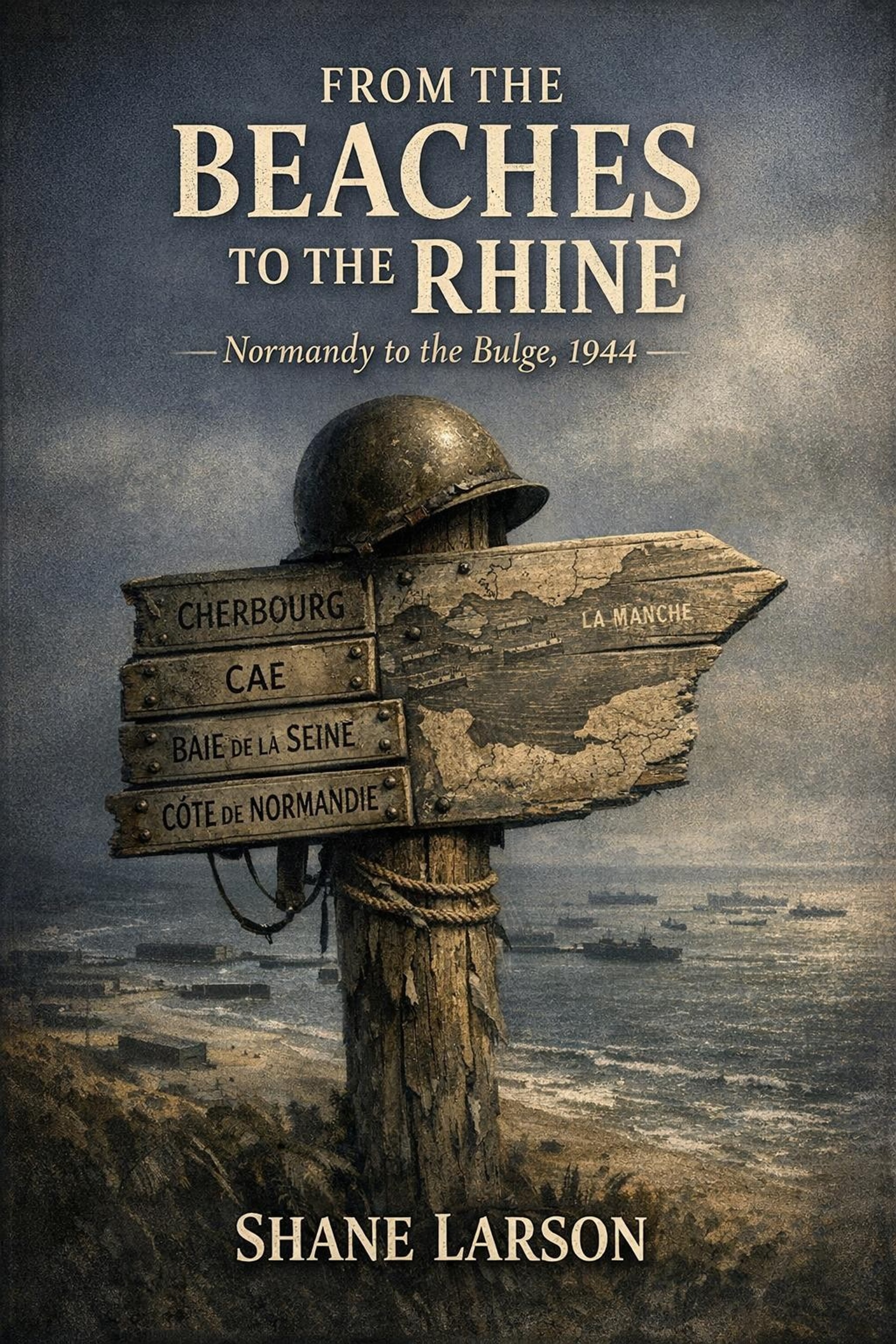
From the Beaches to the Rhine
Normandy to the Bulge, 1944
By Shane Larson
About This Book
In the last week of August 1944, the fastest advance in the history of the United States Army rolled to a halt on the banks of the Meuse. No German line stopped it. Patton's lead tanks had fuel gauges reading empty, and behind them the Red Ball Express was burning petrol by the hundred thousand gallons a day in order to deliver petrol. Every ton feeding a front four hundred miles inland was still coming ashore where it had come ashore in June: over open sand in Normandy, and through one wrecked harbour at Cherbourg.
The pursuit that might have finished Germany in 1944 stopped against sums, not soldiers. And in the pause, a German army that had practically ceased to exist rebuilt itself and began quietly hoarding tanks and fuel for a counteroffensive of its own. The winter that followed — the Hürtgen Forest, the flooded polders of the Scheldt, the Battle of the Bulge — happened because of that pause.
How does the same alliance perform the greatest supply feat in military history in June and then fail a far simpler version of the same test in September? That question runs through this account of the 1944 campaign in the west, and the answer is not the one the famous memoirs give.
The spring of 1944 saw a problem solved that no military planner had ever solved before: sustaining an army of millions on a hostile coast that offered no port at all. The solution — prefabricated harbours assembled off the beaches, an undersea fuel line, a spring bombing campaign that left the French railways unable to carry German reinforcements — meant the build-up race was decided before the first soldier waded ashore. Then, in early September, the port of Antwerp fell into Allied hands with its cranes still standing, and sat useless for nearly three months, because the seventy miles of estuary between the city and the sea had been left in German hands while attention went elsewhere, above all to the airborne gamble at Arnhem. First Canadian Army finally cleared the Scheldt across deliberately flooded ground in one of the least remembered battles of the western war. The date Antwerp opened, not any date on a beach, set when the war could end.
Two more arguments hang from that one. Normandy itself was not a hard few weeks followed by a breakout — it was one of the most intense attritional battles the war produced, and in the rifle companies the loss rates stood comparison with the trenches of the First World War. And the great command quarrels — Caen, the Falaise gap, broad front against single thrust — were genuine military disagreements with defensible cases on both sides, argued out here in tonnage figures rather than personalities. Throughout, the evidence is ranked: what a headquarters ordered on the morning of an attack outranks what a general wrote a decade later with his reputation at stake, and the reader is always told which layer a claim is standing on.
What's Inside
- A rehearsal that killed hundreds: Exercise Tiger at Slapton Sands, the secrecy around it, and what the invasion planners learned from the disaster.
- A deception you could audit: Ultra let the Allies read German assessments and confirm Fortitude was believed — which held German reserves at the Pas-de-Calais for seven weeks after the landing.
- The revised D-Day arithmetic: the systematic name-by-name count of the Allied dead, why it moved the figure, and why the superseded number still circulates.
- The bocage as a learning curve: an army solving a tactical nightmare in three weeks under fire, at rifle-company casualty rates the "breakout" narrative never shows you.
- Caen and Falaise re-tried on the documents: the orders and war diaries set against the memoirs, with a verdict the reader is equipped to dispute.
- The tonnage behind the broad-front quarrel: what an armoured division drank per day, what the beaches could land, and the gap between them — laid out so you can run the numbers yourself.
- Market Garden from the records: what was actually known about the panzers near Arnhem, when, and at what confidence — against the tidier, more damning story everyone has heard.
- The Scheldt restored to the centre: the Canadian campaign in the polders, Walcheren's breached dykes, and the before-and-after supply figures once Antwerp finally opened.
- The Ardennes decided by fuel: why the German offensive was beaten by its own petrol figures before the first shot, and why St Vith and Elsenborn Ridge mattered more than Bastogne.
Why I Wrote This
I could not place the Scheldt on a map. I have read about D-Day since I was a boy — everyone has, it may be the best-covered military subject in the English language — and I still had to look up where the estuary was. That gap bothered me. The battle that plausibly decided when the war in Europe ended is one almost nobody can locate, while the popular story of 1944 jumps from the beaches to the Bulge and quietly skips the months where most of the campaign's dead were killed. Once I saw that, I couldn't unsee it. The rifle-company loss returns from Normandy read like 1916. The Canadians who cleared the polders barely appear in the standard telling. I wrote this book because the version of 1944 most of us carry around leaves out the part that decided it.
Frequently Asked Questions
Is this book mostly about D-Day?
No, and that is deliberate. The landing gets one chapter of fourteen, roughly its true share of the campaign. D-Day is superbly served by existing books; the fighting that came after it — where most of the campaign's casualties actually fell — is not, and that is this volume's ground.
Do I need to read the earlier volumes of the series first?
No. This is Volume 8 of ten, but it was built as an entry point — more readers come to the Second World War through 1944 than any other door. A "War So Far" section in the Introduction brings a new reader to June 1944 in a few pages.
Does it cover the Battle of the Bulge and the Malmedy massacre?
Yes. The Ardennes offensive closes the book, with the fuel arithmetic that doomed it stated up front. Malmedy is treated as an established crime with sourced figures — as are the American shootings of German prisoners that followed, which most accounts leave out.
Does the book take sides between Montgomery, Eisenhower and Patton?
It takes sides on evidence, not on generals. Contemporary orders and signals outweigh war diaries, and war diaries outweigh postwar memoirs, which are treated as evidence about their authors. Where the arithmetic leans one way, the book shows the numbers; where a question has no clean answer — and broad front against single thrust does not — it says that instead.
How is this different from other histories of the Normandy campaign?
Three ways: the supply system is treated as the campaign's decisive weapon rather than background hum; contested casualty figures are given as ranges with the disagreement named; and the Canadian, Polish, French, Belgian and Dutch contributions are load-bearing parts of the story rather than courtesy paragraphs.
How long is the book?
About 81,000 words — 271 pages in paperback — in fourteen chapters plus an introduction, a conclusion, and three appendices: a 1944 timeline, a supply-figures appendix laying out the tonnage argument in numbers, and a nine-nation order of battle with annotated sources.
If You Liked This, You Might Like
- The Empire Collapse Pattern — the recurring ways great powers are undone from inside, the structural version of what happened to Germany's war effort in this volume's final chapters.
- Collapse Proof — the mirror-image question: what lets a system survive its own success, which is precisely the test the Allied supply plan failed in September 1944.
- When the World Burned — the same lesson thirty-two centuries earlier: an interlocking world where the shipping lanes failed and the palaces starved.
The war in the west was won on quays, railheads and truck beds, and this is 1944 told from there — with the men who paid for every mile kept in plain view. Volume 8 of The Second World War Chronicles.
Included with Kindle Unlimited — read it free if you're a member.
New Military History releases and free chapters — no spam, unsubscribe anytime.