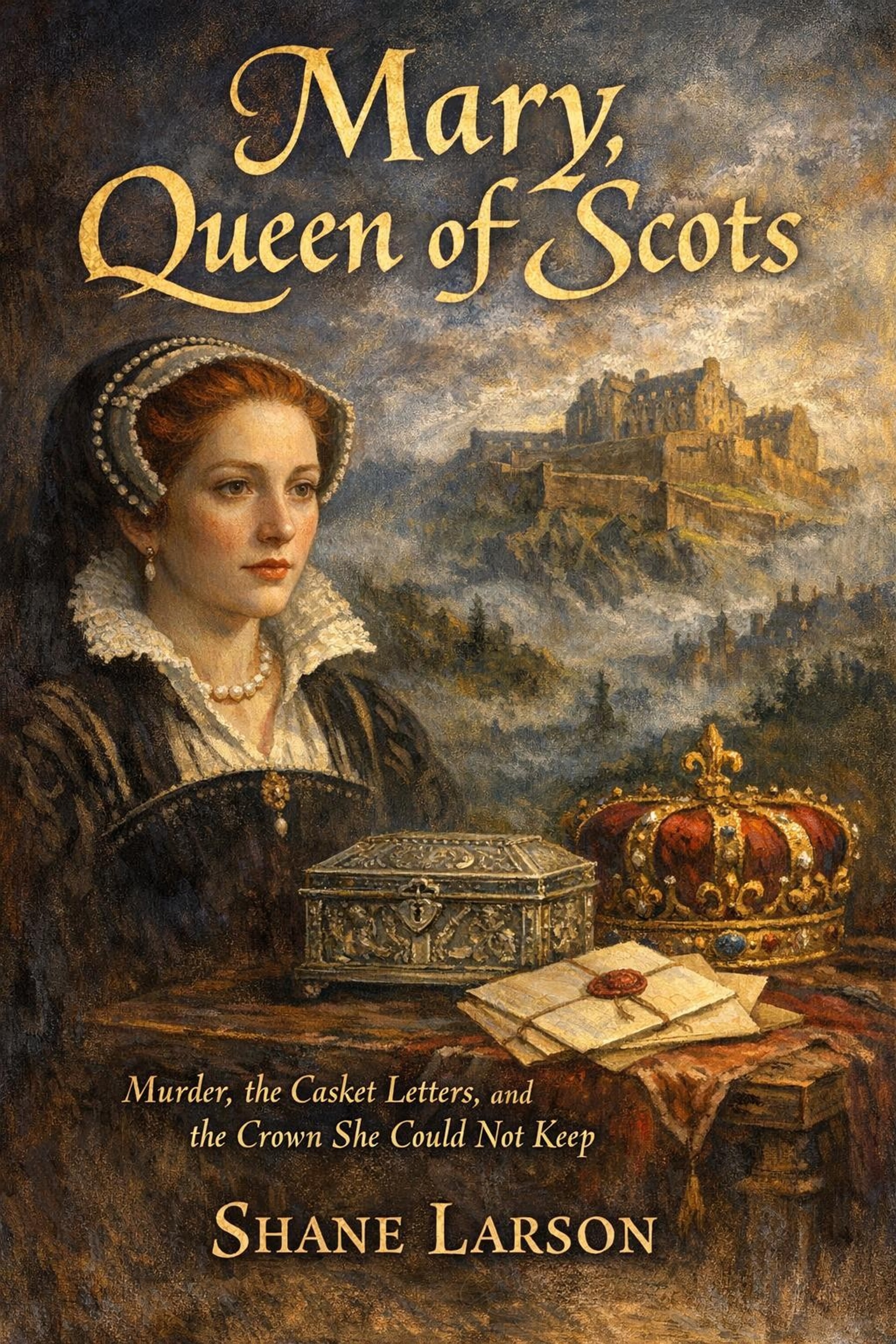
Mary, Queen of Scots
Murder, the Casket Letters, and the Crown She Could Not Keep
By Shane Larson
About This Book
On the afternoon of Sunday 16 May 1568 a small boat put out from the Solway shore below Dundrennan Abbey with sixteen or twenty people aboard. One of them was the Queen of Scots. She had been beaten at Langside three days earlier, had ridden some ninety miles without rest, and the men around her had spent the evening arguing against what she was about to do. A letter had gone ahead to Carlisle and had no reply. She did not wait for one. Four hours later she came ashore at Workington, and the next day she wrote to Elizabeth, in French, that she had brought nothing but what she stood up in.
She was twenty-five and had worn a crown for all but six days of her life. The boat was the last free decision she ever made. The eighteen years and nine months left to her were spent as the prisoner of a cousin she would never once be in a room with.
Mary, Queen of Scots: Murder, the Casket Letters, and the Crown She Could Not Keep follows that life from Linlithgow in December 1542 to Fotheringhay in February 1587, and on to the Westminster tomb her son gave her in 1612. It is told not as a romance or a tragedy but as the best-documented unsolved case of the sixteenth century.
A Case Built on Copies
Every account of Mary, Queen of Scots turns on two questions. Who killed Henry, Lord Darnley, when the house he was sleeping in at Kirk o' Field was blown apart on the night of 9–10 February 1567? And did his wife know it was coming? The prosecution's answer to both was a silver-gilt box set before Elizabeth's councillors on 7 December 1568: eight letters in French, twelve sonnets and two marriage contracts, all said to be in Mary's hand and all pointing at the man she married that May.
Nobody has seen those documents since 1584. Every text we have is a copy or a translation prepared by her accusers, and that is the condition of the whole subject. The men hanged for the murder confessed to her enemies, some under torture. Knox's record of his interviews with her is the only record, and he led the party that wanted her gone. Buchanan wrote the prosecution and her own secretary the defence. On the points that matter most, her letters say nothing.
So the book shows its working. For each disputed episode, Kirk o' Field, the Craigmillar Bond, the twelve days at Dunbar, the letters, the postscript on her reply to Babington, it sets out what each source says, who wrote it and what he stood to gain, and what each serious reading requires you to believe. Where modern opinion has settled, it says so; where it has not, it says that too.
The captivity, usually hurried through, is a full quarter of the book here, told as a long chess game rather than an epilogue, from the Oxburgh hangings to the brewer of Burton and a trial whose jurisdiction she denied before walking into it.
Why I Wrote This
I came to Mary from the other side of the border. After the six queens of Henry VIII and then Elizabeth I, she was the figure every one of those books had to keep stepping around, and I assumed I knew her shape: the romance or the tragedy, depending on who was telling it. What hooked me was realising that the most famous piece of evidence in British history does not exist. The letters that condemned her were shown once, compared with her handwriting in a single day, and gone within twenty years. Four and a half centuries of argument rests on copies made by the men who deposed her. I wanted to write the case the way a reader could actually weigh it, every witness labelled and every missing piece marked as missing. The verdict is not in the documents. The book says so, and lets you look anyway.
Frequently Asked Questions
Did Mary, Queen of Scots kill Lord Darnley?
Nobody knows, and the book says so rather than deciding for you. The reading with the widest support among historians now is a coalition: Bothwell organised the gunpowder, several great lords knew and did nothing, and someone, perhaps the Douglases, met Darnley in the garden. On whether Mary knew in advance there is no convergence, and nothing in her undisputed letters implicates her.
Are the Casket Letters genuine?
The originals were last seen with the Earl of Gowrie, executed in 1584, so no examination can now decide it. Few modern historians accept the letters as produced as entirely what the lords claimed; few think they were invented from nothing. Most recent scholarship sits in between, and the book lays out all three cases and names who holds which.
Did Mary, Queen of Scots and Elizabeth I ever meet?
No. They corresponded for a quarter of a century and spent nineteen years in the same kingdom, Mary as a prisoner, without once coming face to face. The famous confrontation is Schiller's invention of 1800, borrowed by every film since.
Why was Mary, Queen of Scots executed?
Under the Act for the Queen's Safety of 1585, a claimant found privy to a plot against Elizabeth's life forfeited her claim and could be pursued to death. Babington supplied the plot, and in the Crown's reading Mary's reply of 17 July 1586 supplied the privity, though that reply survives only in a decipherment made by the man whose job was to convict her. She was tried at Fotheringhay in October 1586 and beheaded there on 8 February 1587.
Where is Mary, Queen of Scots buried?
In Westminster Abbey, in the south aisle of Henry VII's chapel, opposite Elizabeth. She was first buried at Peterborough Cathedral in August 1587, across the choir from Catherine of Aragon; her son James moved her to Westminster in 1612 under a monument grander than Elizabeth's. The empty grave at Peterborough is still marked.
If You Liked This, You Might Like
- Jane Seymour — the Rough Wooing and Pinkie Cleugh from the English side: the war fought to marry Henry VIII's son to the infant queen this book begins with.
- Catherine of Aragon — Mary's neighbour across the choir at Peterborough, and another anointed queen who refused the jurisdiction of the court that sat to judge her.
- Boudica — a queen known entirely through the writing of her enemies, the problem this book spends two appendices on.
- The Thirty Years' War — the religious war that engulfed Europe a generation after Mary's death, with her granddaughter Elizabeth of Bohemia at the start of it.
Queen at six days old, dead on a scaffold at forty-four, and in between the least-resolved life of her century, here with the evidence laid on the table and the gaps left where they are.
A standalone companion to the series on the six queens of Henry VIII and to Elizabeth I.
What You'll Learn
- **Supper at Holyrood.** On 9 March 1566 David Rizzio was dragged from the six-months-pregnant queen's table and killed under a bond her own husband had signed. Within three days she had turned Darnley and escaped with him to Dunbar.
- **Kirk o' Field, hour by hour.** The powder in the queen's empty chamber, the blast at about two in the morning, the two bodies under a tree with a chair and a rope beside them. Then six suspects side by side, Darnley himself and Mary among them.
- **The Casket Letters, letter by letter.** What each of the eight says, what each was meant to prove, how the lords' description of them slipped from signed to merely written within a month, and why the long Glasgow letter and Thomas Crawford's deposition track each other so closely.
- **The chain of custody.** From a house in the Potterrow to the table at Westminster, the comparison of hands at Hampton Court on 14 December 1568, on to Morton and then Gowrie, and nothing after Gowrie went to the block in May 1584.
- **The beer barrel post.** Gilbert Gifford, the brewer who charged both sides, the nomenclator cipher, the letter of 17 July 1586 with both readings of what it consented to, and the forged postscript whose draft survives in Phelippes's hand.
- **Fotheringhay.** The trial in the Great Chamber, the warrant of 1 February 1587 and the Secretary ruined for sending it, and the execution told from the eyewitnesses without lingering.
New Early Modern History releases and free chapters — no spam, unsubscribe anytime.
More in This Genre
View all →