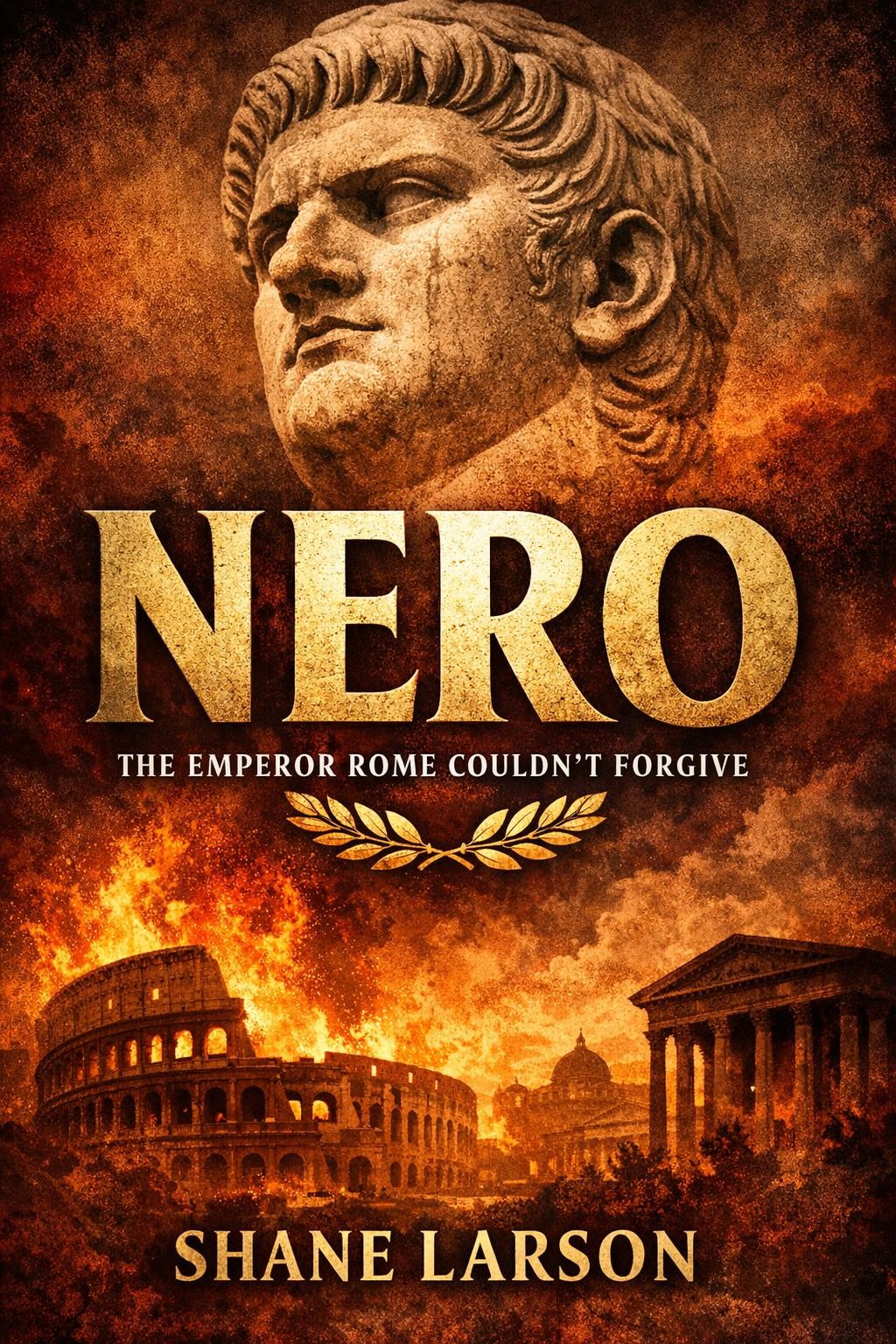
Nero
The Emperor Rome Couldn't Forgive
By Shane Larson
About This Book
The villa belonged to one of his freedmen. He had walked four miles through the countryside to reach it, in disguise, through a thunderstorm, after the Senate declared him a public enemy and the Praetorian Guard defected. He was thirty years old. The Roman cavalry was on the road. He could hear the hoofbeats.
His last coherent command was to his secretary: dig me a grave. His last spoken words were a line of Homer and a Latin lament for his own artistic career. Then, when the riders were close enough that he could see the dust they were kicking up, he drove a dagger into his own throat — with help, because he could not quite bring himself to finish it — and was the last Julio-Claudian emperor of Rome.
He had been placed on the throne by his mother. He had killed her fourteen years later. In between, he had been the most popular emperor in the eastern half of the empire, the target of the first imperial persecution of Christians, the builder of a palace the size of a small city, the star of his own Greek concert tour, and — for nearly a century after his death — the figure whose return three different impostors successfully impersonated, drawing real followings each time.
The Man and the Legend
Nero Claudius Caesar Augustus Germanicus was sixteen when he became emperor and thirty when he died. What happened between those two dates has been argued about for two thousand years, and almost every argument has been downstream of the same three sources: Tacitus, Suetonius, and Cassius Dio. All three were writing decades or centuries after Nero's death. All three worked under dynasties that had overthrown his. Tacitus was a senator who loathed the principate as an institution. Suetonius was an imperial archivist with a taste for bedroom gossip. Dio was a Greek senator writing a hundred and fifty years later who mostly compiled earlier hostile traditions.
Peel their layers apart, read the coins and inscriptions, follow what the provinces actually did with Nero's name in the years after he died — erecting statues, minting commemorative coinage, believing him still alive — and a different figure appears underneath the legend. Not a good man. Not even a stable one. But a vastly more interesting one than the cartoon monster the senatorial tradition handed down.
This book holds both Neros in view at once. The matricide, the forced suicides, the vanity, the erratic cruelty of his final years — these are real, and the book does not soften them. But so is the emperor whose first five years Trajan himself, a century later, called the best administration Rome had ever seen. So is the patron who orchestrated the largest urban engineering project between Augustus and Hadrian after the Great Fire. So is the man the Greek world genuinely mourned.
What's Inside
- The making of an emperor. Agrippina the Younger as political operator — the niece, then wife, of the emperor Claudius; the woman who cleared the Julio-Claudian line of rivals and set her son on the throne at sixteen. What she demanded. What she did not get. How the partnership soured.
- The Seneca years. The philosopher-tutor and the praetorian prefect Burrus as de facto regents. The administrative reforms. The eastern diplomacy. The tax policy debates. The five years Trajan called the best Rome had ever had.
- The death of Agrippina. The pleasure boat at Baiae engineered to collapse at sea. The swim to shore. The assassins sent by night to finish what the sea didn't. The Senate speech afterward in which Nero blamed his mother for plotting against him — and which, astonishingly, the Senate accepted.
- The Great Fire. Six days in July 64 CE. Ten of Rome's fourteen districts destroyed or damaged. Where Nero actually was when it started (Antium, fifty miles away), what he did when he returned, and why the "fiddling while Rome burned" image is almost certainly a misreading of a later satirical tradition.
- Chrestiani. The first imperial persecution of Christians. What the word meant in Rome in 64 CE, why it was politically useful for Nero to scapegoat them, and what the executions at the Vatican hill circus actually involved.
- The Golden House. The Domus Aurea as architectural statement. The artificial lake where the Colosseum would later stand. The colossal bronze statue of Nero that Vespasian would eventually reface as the sun god Sol. The dining room engineered with a revolving ceiling.
- The Pisonian conspiracy. 65 CE. Senator Gaius Calpurnius Piso and the plot that almost worked. The interrogations, the widening circle of accused, and the forced suicide of Seneca — the philosopher, nearly seventy years old, who had been Nero's teacher since he was twelve.
- Greece. The tour of 66–67 CE that has never made it into the standard Roman imperial narrative. Every prize at every festival. An Olympic chariot race in which Nero entered with a ten-horse team, fell off, and still took the crown. The speech at Corinth granting "freedom" to the Greeks.
- The fall. Vindex in Gaul. Galba in Spain. The Praetorian Guard abandoning him. The Senate declaring him a public enemy. The four-mile walk through the night to the freedman's villa, and the dagger.
- After Nero. Three false Neros across three decades. The genuine eastern mourning. The beast of Revelation 13 and the Hebrew numerology behind 666. The slow freezing of Nero into legend by writers who needed him frozen.
Why I Wrote This
I grew up on the cartoon Nero — the fiddle, the fire, the Christians in the arena. Then, years later, I picked up Edward Champlin's Nero at a used bookstore and discovered that the cartoon is almost entirely a construct of the second century and later, and that the man underneath is both worse in some ways and considerably more interesting in all of them.
What Champlin did brilliantly, he did for academics. This book is the same revisionist case — written for people who don't want to wade through four hundred pages of Latin source analysis to find it. I wanted to write the book I would have wanted when I first heard the standard version and suspected there was more to it. I am skeptical of the hostile sources without being sentimental about Nero himself. He killed his mother. He forced his teacher to open his veins. He also, before those things, was briefly the best emperor of his century. All of that is in here.
— Shane Larson
Frequently Asked Questions
Is this a scholarly biography or a narrative one?
It's narrative — written for general readers who like their history readable. The scholarly apparatus lives in the endnotes and appendices. The main text moves at the pace of a good popular history: Mary Beard, Tom Holland, Adrian Goldsworthy. If you want the footnoted academic treatment, Edward Champlin's Nero is the standard work; this book covers the same revisionist argument in a more accessible register.
Does it assume I already know Roman history?
No. Roman political structure, the Julio-Claudian dynasty, and the broader first-century context are explained as they become relevant. If you've read one general book on Rome, you are comfortably over-qualified. If you've read none, you will still be able to follow it.
How long is the book?
About 48,000 words across 14 chapters and 3 appendices — roughly 180 to 200 pages in print. Shorter than a Mary Beard, longer than a single-episode podcast. Readable in a weekend.
Is Nero really the beast of Revelation 13?
The numerology case — that the number 666 is a gematria rendering of "Nero Caesar" in Hebrew letters — is genuinely strong, and it's how most modern biblical scholars read the passage. The book walks through both the calculation and the historical context. Whether you find the identification convincing will depend partly on how you read the book of Revelation as a whole, and the book doesn't try to settle that question for you.
Did he actually compete in the Olympic Games?
Yes, and won. The Olympiad of 67 CE was rescheduled to fit his tour, and he entered the chariot race with a ten-horse team instead of the standard four. He fell off mid-race. The judges awarded him the crown anyway. After his death, his name was struck from the victor lists. The whole episode is extensively documented and has its own chapter in the book.
Is this part of a series?
It's a standalone biography. It sits alongside other Peak Grizzly titles on the Roman Empire and Stoic philosophy — Marcus Aurelius and Epictetus both touch the Neronian court from other angles, and readers of one tend to want the others.
If You Liked This, You Might Like
- Marcus Aurelius: The Emperor Who Chose Wisdom Over Power — the philosopher-emperor who ruled Rome a century after Nero, and who is what Seneca might have become if he had ever been allowed to teach a sane student.
- Epictetus: The Slave Who Taught Emperors — born into slavery in Nero's Rome, exiled under Domitian, and the Stoic voice that would shape Marcus Aurelius two generations later.
- The Fall of Rome — for readers who want the long view: what happened to the empire Nero inherited over the following four centuries.
- Cleopatra's Egypt — the Julio-Claudian prequel. The woman whose children by Mark Antony were Nero's great-great-aunts and uncles, and whose kingdom Augustus absorbed into the empire Nero would eventually rule.
The Emperor Rome Couldn't Forgive
The man is gone. The legend is not. This book is about the distance between them — and the handful of things we can say with reasonable confidence about what actually filled that distance in thirty short years.
A standalone biography from Shane Larson's Ancient History catalog, Peak Grizzly Publishing.
Included with Kindle Unlimited — read it free if you're a member.
New Ancient History releases and free chapters — no spam, unsubscribe anytime.