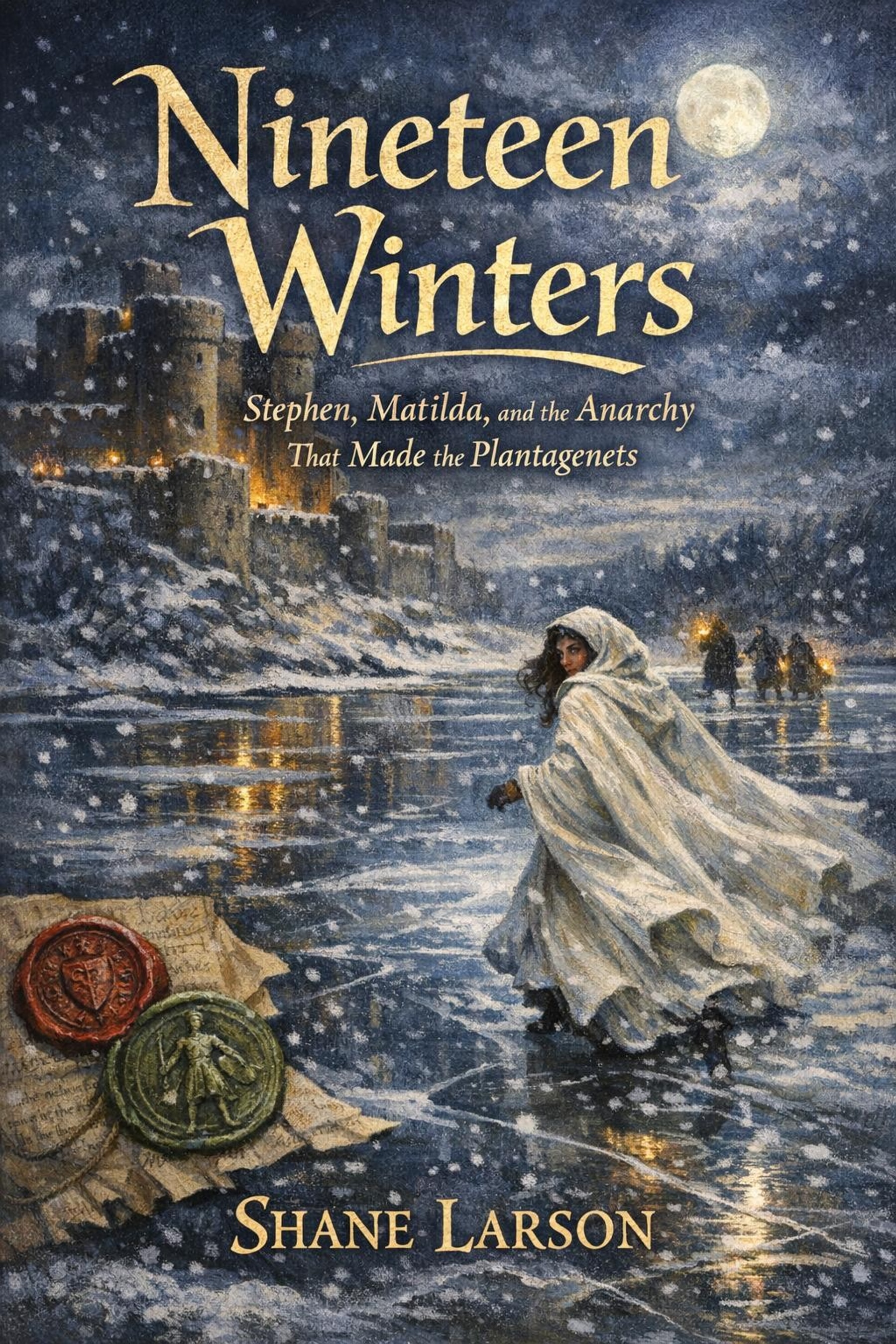
Nineteen Winters
Stephen, Matilda, and the Anarchy That Made the Plantagenets
By Shane Larson
About This Book
Two men farmed in England in 1144. One held land from the Archbishop of Canterbury in Kent, paid a sheriff who still answered to the king, and may have gone the whole reign without seeing a hostile soldier. The other was a tenant of Ramsey Abbey in the Fens, where Geoffrey de Mandeville had thrown out the monks and garrisoned the church; his neighbours were hung up by the thumbs for their savings and the fields went unploughed. Both men lived under King Stephen. Only one of them lived in the Anarchy.
That word is not medieval. A monk at Peterborough, writing around 1155, said that for nineteen winters the land was so ruined that men said openly Christ and his saints were asleep, and Victorian historians took his corner of the Fens for the whole kingdom. Twelve years later the clerks of Henry II's exchequer wrote the word waste against estate after estate in Oxfordshire, Berkshire, Warwickshire and Leicestershire, and hardly at all in Kent. The horrors were real. So were the writs that kept running and the coins that kept circulating. The difference was where you lived and who held the nearest castle.
The War Between the Conquest and the Plantagenets
Nineteen Winters: Stephen, Matilda, and the Anarchy That Made the Plantagenets is a narrative history of England's first great civil war, from the November night in 1120 when Henry I's only legitimate son drowned off Barfleur to the December afternoon in 1154 when the Empress Matilda's son was crowned Henry II. In between lie a sworn succession that failed inside a month, a king taken prisoner, an empress driven out of London by a mob, a decade of castle warfare no one could win, and a treaty no one expected to hold.
The book tells it from both camps. Stephen of Blois is brave, open-handed, and unable to make a decision stick; the chroniclers on both sides agree on the charm and the weakness. The Empress is the only person in the story anyone ever trained to rule, served by writers who did not know what to call a woman who gave orders. The sources are named at every use, with where each man sat, when he wrote and whom he wrote for, because in this war the chronicles disagree about almost every important day.
Its spine is a comparison nobody in the twelfth century knew how to make. There were two Matildas. The Empress, Henry I's daughter, fought for a crown in her own right and lost it in a single London afternoon. The Queen, Stephen's wife Matilda of Boulogne, fought for her husband's crown while he sat in chains at Bristol, and in the autumn of 1141 she brought an army to Winchester, broke the Empress's siege, captured Robert of Gloucester and exchanged him for the king. The pro-Stephen chronicle praised her manly spirit and damned the Empress's pride for conduct that was, set side by side, much the same. The book takes the modern rereading of those verdicts as gendered, then asks what each woman actually did with what she had.
Why I Wrote This
I went into this war to write about the Empress, who seemed to me the most interesting woman in medieval England without a current narrative history, and I came out convinced that the most effective commander on either side was the other Matilda. That reversal is the book. I also could not leave the name alone. I had read the Peterborough monk's lament years ago and taken it, as everyone does, as a description of a country. Then I found H. W. C. Davis's 1903 map of the waste in the 1156 tax roll, which puts the ruin in a band across the Midlands and leaves Kent nearly blank, and the two pictures would not fit until I accepted that both were true and the answer was geography. The novelists have had this war to themselves for a long time; I wanted the history beside them on the shelf.
Frequently Asked Questions
Do I need to read The Norman Conquest before this book?
No. Everything before 1120 is background here and takes a few pages. The Introduction points a reader to the companion volume for the detail, but nothing here depends on it.
Was the Anarchy really anarchy, or is that a myth?
Both, depending on the county. The chroniclers' horrors happened, and the 1156 exchequer roll confirms a belt of wasted land from Wiltshire to Lincolnshire where the two sides fought for a decade. But Stephen's chancery never stopped issuing writs, and his coins circulated across the south and east for the whole reign.
Who were the two Matildas, and is Matilda the same person as Maud?
Maud is the same name in a different mouth, and some older writers use it for the Empress; this book does not. The Empress is Henry I's daughter, widow of the Emperor Henry V and wife of Geoffrey of Anjou, who claimed the crown in her own right. The Queen is Matilda of Boulogne, Stephen's wife. The book calls them the Empress and the Queen on every page and never uses the bare name where it could mean either.
Does this book cover Henry II's reign and Eleanor of Aquitaine?
Only to the coronation of 19 December 1154 and a forward glance. Henry's marriage to Eleanor in May 1152 gets one section, because it made him the most powerful claimant in Europe, and the Conclusion follows the war's consequences into Becket, the loss of Normandy and Magna Carta. The reign itself is another book's business.
If You Liked This, You Might Like
- The Norman Conquest — the making of the Anglo-Norman realm that Stephen and the Empress tore in half; this book begins where that one ends.
- The Hundred Years' War — Edward III claimed France through his mother, on the principle the Treaty of Winchester established without meaning to: a woman could carry a claim she could not exercise.
- Zenobia of Palmyra — another woman who ruled in a world with no word for it, judged by writers with one vocabulary for men who gave orders and another for women.
- The Crusades — Stephen's father deserted the siege of Antioch in 1098 and died in the Holy Land making up for it.
A sworn succession, nineteen years of war, and a peace that held because the men who wrote it had watched every question it answered go unanswered in 1135. The Empress never wore the crown; the dynasty that came out of the wreck was hers in every sense but the name on the charter.
A standalone history on the English shelf, between The Norman Conquest and the Angevins.
What You'll Learn
- **The White Ship as the chroniclers told it**, down to the lone survivor, a Rouen butcher in a sheepskin, and the man who left the ship before it sailed: Stephen of Blois, with a stomach complaint and a dislike of the drunk crowd on deck.
- **Why the oath failed**: a promise made to a person rather than a settlement, no husband the barons could stomach, and no castles or share of power for the heir while the old king lived.
- **The Queen's war**: Kent and Boulogne as her base, the Flemish mercenaries nobody else could manage, and the Rout of Winchester on 14 September 1141.
- **Four versions of the ice**: what the *Gesta Stephani*, William of Malmesbury, Henry of Huntingdon and the Peterborough Chronicle each say about the Empress's escape from Oxford in December 1142, and the one thing all four agree on.
- **Castles and coins as evidence**: Robert of Torigni's 1,115 unlicensed castles tested against the archaeology, and the coin hoards laid over the 1156 waste map to draw the war's actual footprint.
- **The settlement that worked**, from the barons at Wallingford who refused to fight to the Treaty of Winchester of 6 November 1153, and why it held in 1154 when the same model failed in nine weeks in 1460.
- **Two appendices**: every chronicler with his patron, dates and lean, with the contested episodes set side by side; and a timeline and who's who that sorts out the several Matildas a reader meets.
New Medieval History releases and free chapters — no spam, unsubscribe anytime.
More in This Genre
View all →