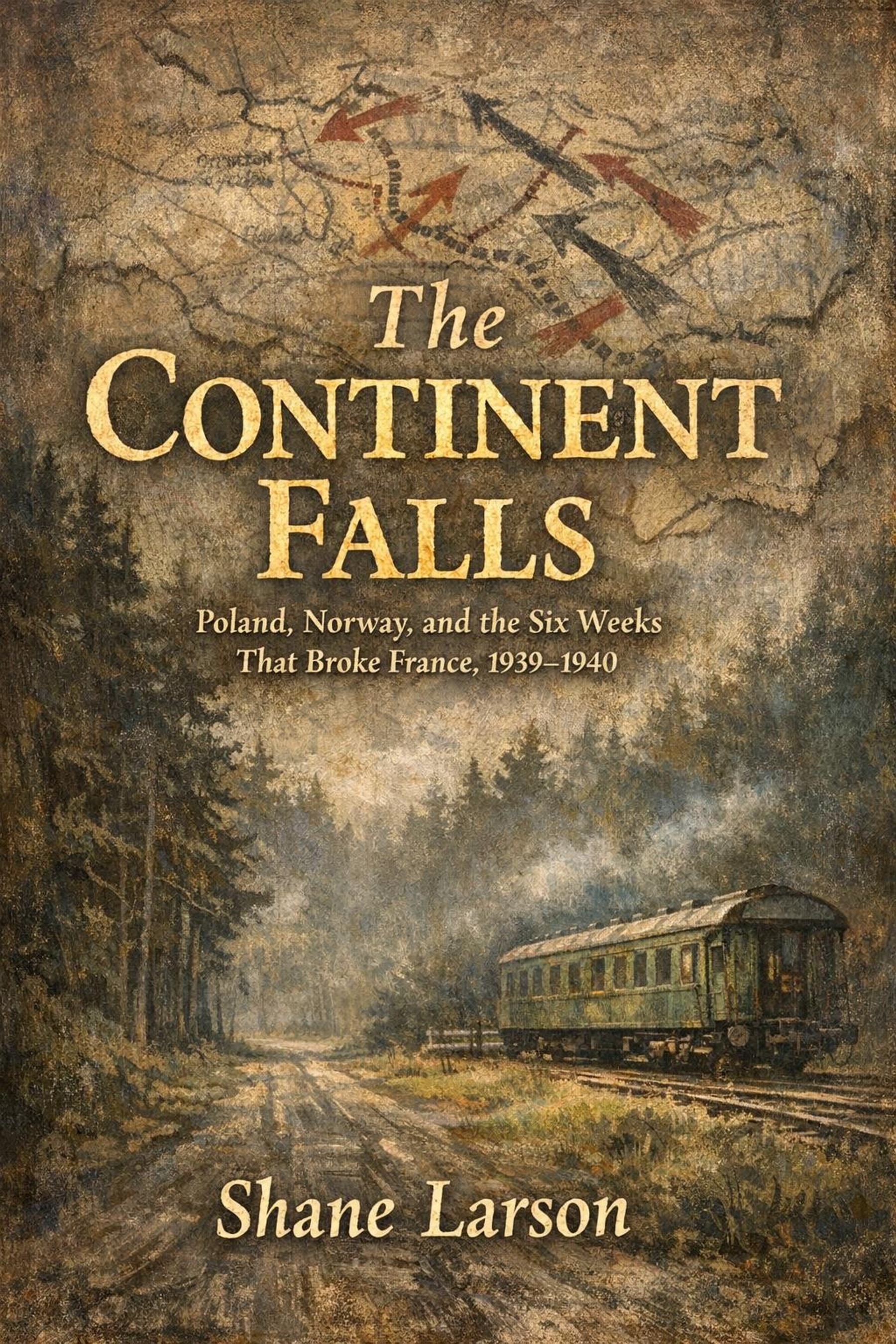
The Continent Falls
Poland, Norway, and the Six Weeks That Broke France, 1939-1940
By Shane Larson
About This Book
For the better part of three days in the middle of May 1940, the greatest traffic jam Europe had ever produced stood inside a Belgian forest. Panzer Group Kleist's 41,140 vehicles — the striking force of the entire German campaign in the west — sat in columns reaching back a hundred and fifty miles, stationary for long stretches, in daylight, on a handful of narrow Ardennes roads. German staff assessments had named this passage, without qualification, as the point of maximum risk in the whole operation. Allied reconnaissance aircraft flew over the columns, saw them, and reported them.
No attack came. The bombers were spent elsewhere, in small parcels, against defended bridges in Belgium, where the Allied high command was certain the real blow was falling. The column rolled out of the forest on schedule, reached the Meuse at Sedan, and crossed.
Three days after the crossing, Winston Churchill flew to Paris and asked the French commander-in-chief where the strategic reserve was — the mass of manoeuvre every army keeps behind its line for the moment the line breaks. The answer, one word long in Churchill's account of it, was that there was none.
The Argument
In the spring of 1940 the French army was rated the best in the world by the people paid to judge such things. Alongside its British ally it fielded more tanks than the force coming against it, and the best of them — the Char B1 bis, the Somua S35 — carried armour and guns the standard German anti-tank weapon could not answer. The attacker was mostly a marching army, its supplies drawn by horses, executing a plan its own General Staff had repeatedly rejected as reckless and adopted only after a courier crash-landed the original in a Belgian field four months before the offensive.
What decided the campaign was tempo. The French command system moved information by courier and liaison officer and turned events into orders in about two days. The German system did the same work in hours — and at the level of the tank crew, three men in a turret with a wireless set in every vehicle, in minutes. The French tanks were better weapons; the German tanks were part of a nervous system. And behind the French front there was nothing, by design: the mass of manoeuvre had marched into Belgium on the first morning, to meet an attack that was not coming there.
The fastest defeat ever suffered by a great power in the field was read, then and ever since, as proof of an irresistible machine. This book argues from the records — the German records above all — that it was proof of something else. An institution with no slack anywhere, no reserve, no spare channel for information, no tolerance for the improbable, fails faster than anyone believes possible; and the speed of the failure is then mistaken for the strength of the blow.
Why I Wrote This
I have spent several books on the question of how institutions fail — financial systems, empires, systems people trusted. The fall of France in 1940 is the cleanest case of it I know. An army rated the best in the world, holding more and better tanks than its enemy, ceased to exist in six weeks — and everyone concluded, then and afterwards, that the blow must have been extraordinary. It wasn't. The records, the German records above all, show a gamble the men executing it expected to fail, beating an institution that had no reserve, no second channel for information, and no way to learn at the speed events were moving. The speed of a failure gets mistaken for the strength of the blow. That is the same argument the Collapse Pattern books make across centuries, compressed here into six weeks — and I wanted to write the version where you can watch it happen day by day.
Frequently Asked Questions
Do I need to read Volume 1 before this book?
No. The introduction opens with a compressed recap of the twenty years covered in The Peace That Wasn't — Versailles, the credit withdrawal that killed Weimar, the four failed tests of collective security, Munich, and the Pact. If you want that story argued at full length, it is Volume 1; this book needs only the summary it provides.
Is this a book about Dunkirk?
No. Dunkirk gets one chapter of fourteen, sized honestly: the destroyers did most of the lifting, the halt order came from the German side, and the French rearguard and the cabinet crisis in London get their due. It is one week of a ten-month story that runs from a Polish river line to the armistice carriage at Compiègne.
Did France really surrender without fighting in 1940?
No, and the arithmetic disposes of the idea. French military dead in the six weeks lie somewhere between 50,000 and 90,000 — even the low end is a rate of loss comparable to the worst passages of the First World War — and German medical returns show June costing the attacker more per day than May. Stonne changed hands seventeen times.
What is wrong with the word "blitzkrieg"?
It names a doctrine that did not exist in 1940. The word barely appears in German military writing of the period; it came from the English-language press and was adopted by German propaganda after the victory it was invented to explain. The commanders it supposedly describes spent the decisive week of the campaign arguing about whether to stop their own spearhead.
Does this book cover the Battle of Britain?
No. This volume ends at the armistice of June 1940 and the fleet question that Mers-el-Kébir would answer within a fortnight. The air battle over England, the Blitz, and the Atlantic belong to Volume 3, The Island Holds, which opens exactly where this book stops.
If You Liked This, You Might Like
- The Peace That Wasn't — Volume 1: the twenty years this book's first pages compress, argued at full length.
- Economic Collapse Pattern — the same anatomy of sudden institutional failure, applied to financial systems instead of armies.
- The Institutional Collapse Pattern — the general theory of how trusted systems fail, of which the French high command of 1940 is as clean a case as exists.
- The Empire Collapse Pattern — the two-century version of the argument France compressed into six weeks.
Six weeks was fast enough to look like destiny, and it was not. What broke France is knowable, documented, and stranger than the legend — and worth knowing exactly, because the pattern did not retire in 1940.
Volume 2 of The Second World War Chronicles.
What You'll Learn
- The Bzura: the Polish counter-offensive that stopped the entire German advance for a week — and the German army's own internal critiques of the Polish campaign, the strongest evidence that no finished doctrine existed.
- The occupation of Poland, stated directly and without euphemism: the Einsatzgruppen, the targeting of the Polish leadership class, and Katyn — with the fifty-year denial named and dated.
- The eight months of "phoney" war that were anything but empty: a French offensive that advanced five miles and turned around, and an Allied high command seriously planning to bomb Soviet oilfields at Baku while the German offensive massed against it.
- Mechelen, 10 January 1940: the staff flight that came down in Belgium with the German operational plan aboard, putting a rejected gamble in its place.
- Norway: the lost campaign that cost Germany a third of its destroyer strength, broke Chamberlain's majority in the Norway Debate, and put Churchill in Downing Street on the very morning the western offensive opened.
- Sedan, hour by hour — including the panic at Bulson, where a French artillery line abandoned its guns over a rumour of tanks that did not exist.
- The halt order and Dunkirk by the honest numbers, including the French troops that British accounts long undercounted — and the London cabinet crisis of late May, when a negotiated peace was seriously discussed.
- Fall Rot, the second campaign most accounts skip: a French army that had already lost its best formations inflicting heavier German casualties per day in June than in May.
- Three appendices: a ten-month timeline in strict chronological order across all combatants; the tank question in narrow tables — numbers, armour, guns, radio fit; and orders of battle with an annotated source list.
Included with Kindle Unlimited — read it free if you're a member.
New Military History releases and free chapters — no spam, unsubscribe anytime.