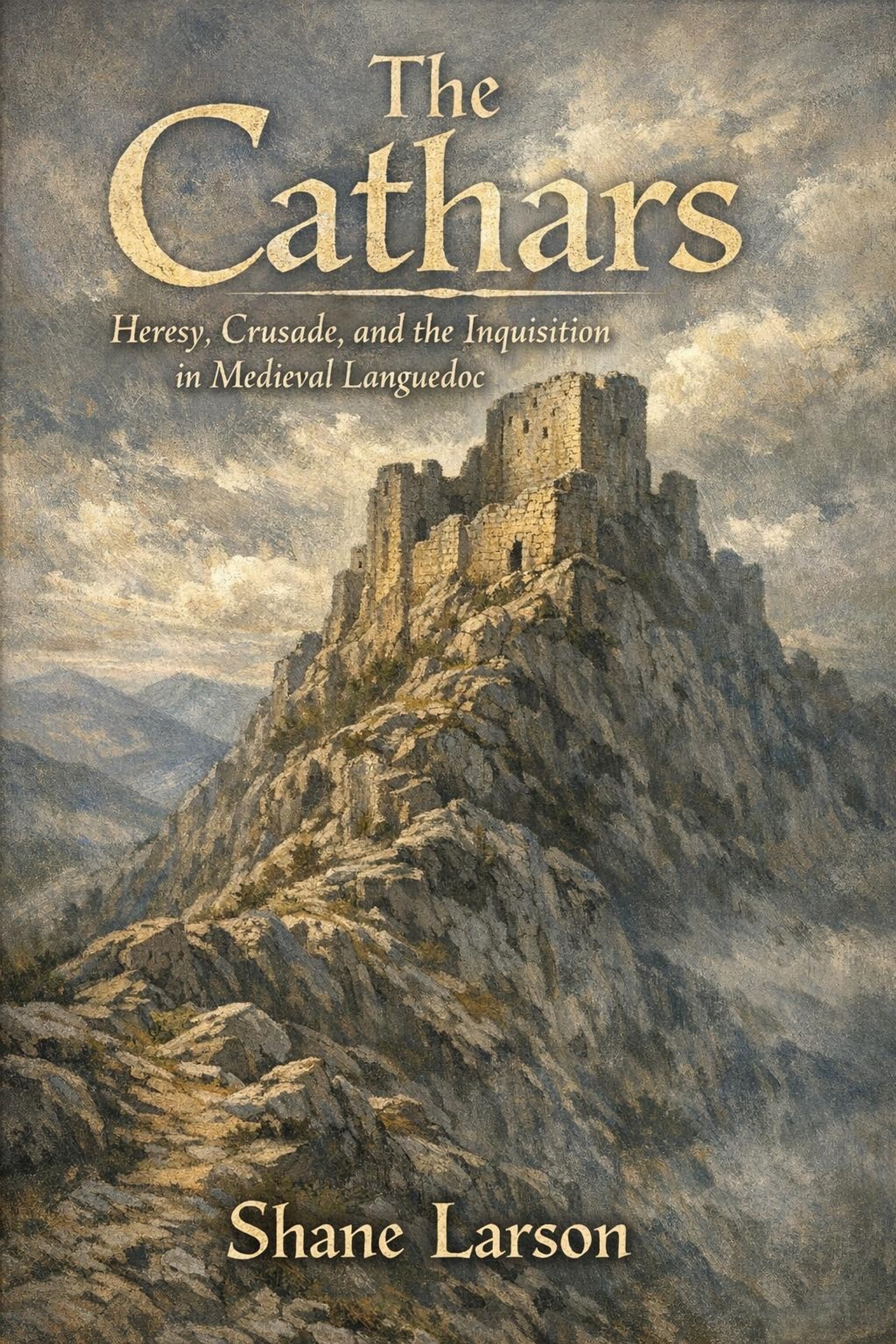
The Cathars
Heresy, Crusade, and the Inquisition in Medieval Languedoc
By Shane Larson
About This Book
In the spring of 1245 two Dominican friars set up a court in the cloister of Saint-Sernin in Toulouse and began summoning the countryside to it. Parish by parish, the villagers of the Lauragais walked in, swore an oath, and were asked the same short list of questions. Had they seen heretics? Where, and with whom? Had they bowed to them, eaten with them, believed them to be good men? A notary turned each answer into Latin. More than five thousand of those answers survive, in a single manuscript in the city library of Toulouse.
That manuscript is one of the main reasons anything is known about the people usually called Cathars. It is also the centre of an argument. The friars were not conducting a survey. They were looking for heresy, with a set form of words, and what a frightened farmer says to a judge is shaped by what the judge asks. Read one way, the answers describe a hidden church with its own clergy and rites. Read another way, they describe villages where certain respected men and women were greeted with a bow, and where nobody thought of that as belonging to anything.
This book is about what happened in southern France between 1145 and 1321, and about how far the records of the people who did it can be trusted.
The Story
Around 1200 the lands between the Rhône and the Garonne answered to no single ruler. The count of Toulouse, the Trencavel viscounts, the count of Foix and the king of Aragon shared and disputed them, and the towns largely ran themselves. In those towns and castles lived men and women who had given up property, meat, oaths and marriage, travelled in pairs, and were called by their neighbours simply good men and good women. Noble families sent their daughters to live in their houses. The Church sent preachers against them for sixty years, including Bernard of Clairvaux and the future Saint Dominic, and got nowhere.
In January 1208 a papal legate was murdered on the bank of the Rhône. Pope Innocent III blamed the count of Toulouse and offered the rewards of a crusade to anyone who would fight in the south. The army that came the next summer sacked Béziers and took Carcassonne within a month. A minor northern baron named Simon de Montfort was left to hold the conquest, and he spent nine years doing it, siege by siege, until a stone from the walls of Toulouse killed him in 1218. The French crown finished what he started. By the Treaty of Paris in 1229 the count of Toulouse kept his title for his lifetime and signed away his dynasty.
The war had beaten the lords. It had not removed the good men. That work fell to a new instrument: judges with a papal commission, mostly Dominicans, who went from town to town taking sworn testimony, writing it down, and cross-checking it against what the neighbours had said. Montségur, the mountain stronghold where the remaining leaders had gathered, fell in March 1244, and a little over two hundred people were burned below it. The last known good man, Guillaume Bélibaste, was burned in 1321.
Why I Wrote This
I came to this subject through its most famous line, and through finding out that the line is hearsay recorded in a German monastery. That is a small discovery, but it kept happening. The name was imposed from outside. The castle is later. The council that supposedly organized the heretic church survives in one printing from 1660. Every solid-looking fact had a seam in it.
What held me was that the seams do not make the story smaller. People were burned at Minerve, Lavaur and Montségur whatever they believed, and the court that sentenced their neighbours kept working for a century. I wanted a book that could say "we are not sure what they were" and "we know exactly what was done to them" in the same breath, and let the reader see the documents behind both sentences.
Frequently Asked Questions
Did the Cathars really exist?
People who were called heretics, who were known locally as good men and good women, and who were hunted for a century certainly existed. Whether they formed an organized church with bishops and a shared dualist theology is disputed among specialists. The book gives the evidence on both sides and tells you where each piece comes from.
Who said "Kill them all, God will know his own"?
The line is attributed to the papal legate Arnaud Amalric at Béziers in 1209, but the only medieval source is Caesarius of Heisterbach, a Cistercian in Germany writing around 1220, who reports it as something the abbot was said to have said. The legates' own letter to the pope, which does survive, says that no one was spared.
Is Montségur castle the one the Cathars defended?
No. The fortified village that was besieged in 1243–44 was cleared away, and the ruin on the summit today is largely a later fortress built for the new lords of the place. The same is true, in different ways, of most sites marketed as Cathar castles.
Is this book anti-Catholic?
It reports what popes, legates and inquisitors did from their own documents, and it reports the believers' ideas from the sources that describe them. It does not argue for or against either faith, and it gives the Church's reasons as the Church stated them.
Does the book cover the Holy Grail and the Cathar treasure?
Only as a later invention. One chapter traces how nineteenth- and twentieth-century writers attached the Grail to Montségur. The depositions of the survivors mention men leaving the fortress with money and valuables, and nothing more.
If You Liked This, You Might Like
- The Crusades — the two centuries of holy war in the East from which the pope borrowed the machinery he turned on southern France.
- The Poor Knights — the Templars, destroyed a century later by the same combination of royal ambition and interrogation records.
- Al-Andalus — the world just across the Pyrenees, including the king of Aragon who died at Muret.
- The Hundred Years' War — what the French monarchy became after it absorbed the south.
The records made to destroy these people are the only reason their names are known. This is a history of what those records say, and of how to read them.
What You'll Learn
- The problem with the name. "Cathar" was coined by a German monk in the 1160s for people in the Rhineland. The book uses it because readers search for it, and explains on the first pages why almost nobody in Languedoc did.
- The debate, at full strength. One chapter sets out the case that the Church's writers and inquisitors largely constructed the heresy, and the case that a real dualist church existed, each with the evidence its supporters rely on. The book does not pick a winner.
- The crusade from all three chroniclers. The war is told from the two authors of the Song of the Crusade, who took opposite sides, and from a Cistercian who rode with Montfort, with each writer's loyalties stated.
- Béziers, examined. The order of events on 22 July 1209, the casualty claims, and where the "Kill them all" story does and does not come from.
- How an inquisition worked. The period of grace, the summons, the oath, the notary, the public sentencing, the yellow crosses, the prison called "the wall", confiscation, and the trials of the dead.
- One deposition read both ways. A typical piece of testimony from the 1245–46 inquest, taken apart line by line and then interpreted as each school of historians would interpret it.
- Montaillou and the last revival. The Autier brothers, Bishop Jacques Fournier's register, and the village whose kitchens and quarrels are known in more detail than any other in medieval Europe.
- The Cathars after the Cathars. Protestant ancestors, Occitan martyrs, Grail-seekers, and the "Cathar castles" that were in fact built by the French crown on the Aragonese frontier.
- Three reference appendices. A chronology, a guide to every major source and whose side its author was on, and a gazetteer of what a visitor to each site is actually looking at.
New Medieval History releases and free chapters — no spam, unsubscribe anytime.
More in This Genre
View all →