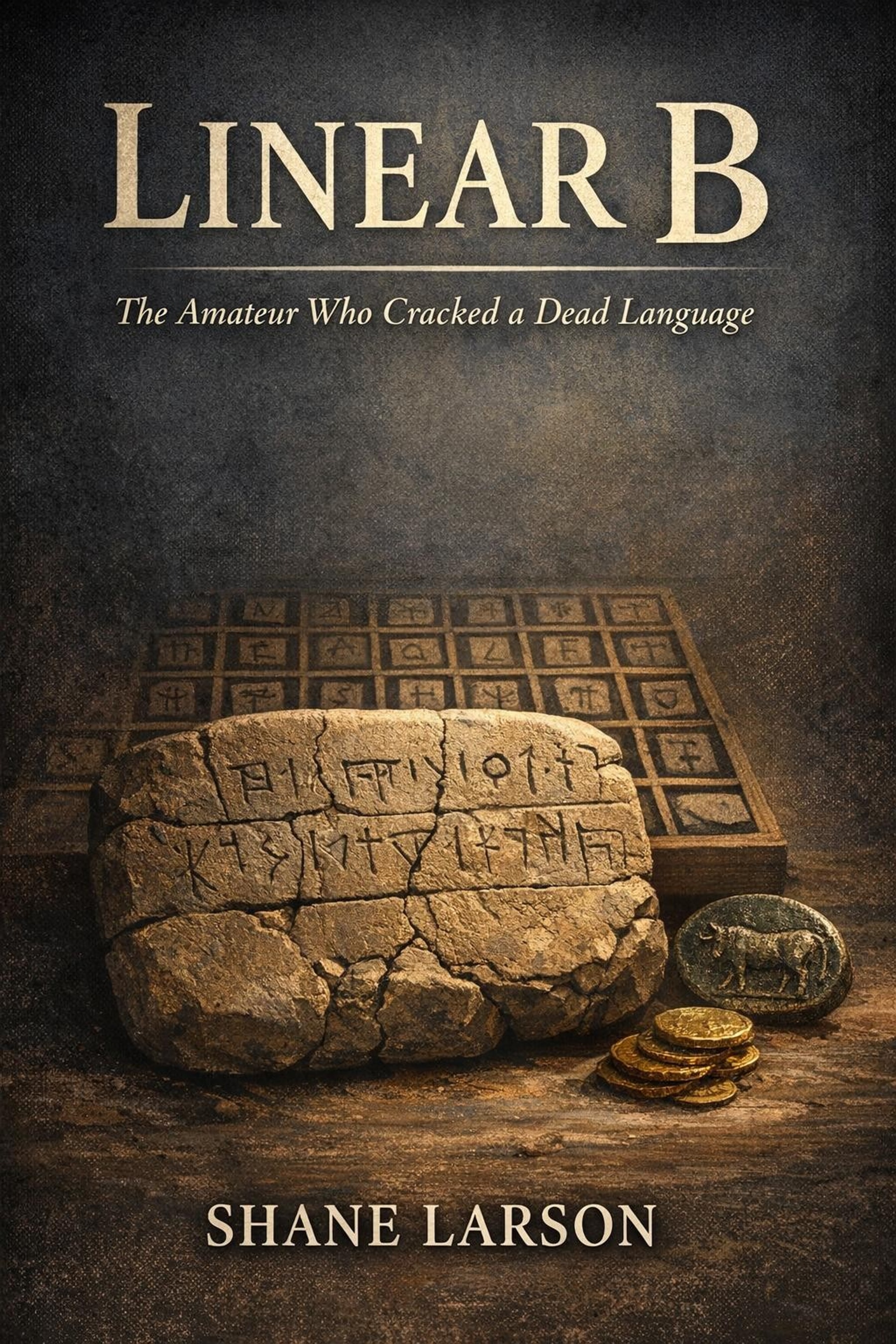
Linear B
The Amateur Who Cracked a Dead Language
By Shane Larson
About This Book
In the spring of 1900, on a hill outside Heraklion, workmen under Arthur Evans lifted the first clay tablets out of a burned palace. They were small and grey-brown, the size of a hand or a strip of leaf, covered in tiny incised characters nobody alive had ever seen. Evans knew immediately what he had: writing, on European soil, older than anything the Greeks left behind. What he did not know, and would not know when he died forty-one years later, was what a single word of it said.
Consider what a decipherer faced. Champollion had the Rosetta Stone, with a Greek translation printed obligingly under the hieroglyphs. The men who broke cuneiform had a trilingual inscription carved into a cliff at Behistun. Linear B — the name Evans gave the later of the two scripts he found — had nothing of the kind. No bilingual, no related language, not even agreement on what family its words belonged to. It was a locked room with no door, and for fifty-two years the best-trained philologists in the world stood outside it.
The man who got in was not one of them. He was thirty years old, held no doctorate and no academic post, and had done the work at his dining table in the evenings after a full day's work as an architect.
The Argument
This is a book about three people, and the argument it makes is that the decipherment belonged to all of them — that the lone-genius version is not only inaccurate but less interesting than what actually happened.
Arthur Evans found the tablets and then, with complete sincerity and enormous charm, sat on them. He published a fraction of the Knossos archive across a long life, controlled access to the rest, and used his prestige to enforce one conviction: that the civilization he had discovered was not Greek, and neither, therefore, was its language. He was wrong, and the weight of his authority delayed the answer by decades.
Alice Kober built the method. A classicist at Brooklyn College carrying a full teaching load, she worked at night, in wartime paper shortages, on slips cut from exam papers and library checkout forms and filed in empty cigarette cartons — a hand-made database that grew to something near 180,000 pieces. With it she proved the first structural facts anyone had established about the language: that it inflected, and that the way its word endings changed revealed which signs must share a consonant and which must share a vowel — all without knowing the sound of a single sign or the meaning of a single word. Structure first, meaning later, guessing never. She died of cancer in May 1950, at forty-three, two years before the breakthrough her work made possible.
Michael Ventris finished it. He had asked Evans the obvious question at that 1936 exhibition and been told no, then spent twelve years arguing in print that the language was probably related to Etruscan. In the spring of 1952 the grid of sign relationships he had built began producing Cretan place names, and the words that followed them were Greek. Confronted with the answer he had staked his reputation against, he tested it, watched it hold, abandoned his own theory, and said so plainly to the same audience. That reversal is the moral center of this book.
And then the anticlimax that turns out not to be one. The tablets contain no epic poetry. They contain inventories: sheep counted in the tens of thousands, wool quotas, chariot wheels marked serviceable and unserviceable, bronze issued by weight to named smiths, ration lists for gangs of women textile workers with their children counted beside them. It is the office paperwork of a palace administration, baked hard by the fires that destroyed everything around it — and worth more than any poem, because a poem records what a culture wanted remembered and an inventory records what was there.
What's Inside
- The method, taught properly. The grid technique step by step — how sign relationships get mapped, how consonant columns and vowel rows emerge from alternation patterns alone, and how values get assigned without assuming a language. An appendix works it through on an invented example.
- Kober restored to the center. A full chapter and a continuous presence rather than a corrective footnote, because that is where the evidence puts her.
- Why fifty years of clever people failed. The Etruscan readings, the Basque readings, the nationalist readings that found each investigator's own ancestors in the tablets — and the structural mistake they all share.
- What actually counts as proof. The Pylos tablet read as Greek before anyone had looked at the ideograms drawn beside the words, and why a prediction confirmed by unseen evidence differs in kind from anything the guessers produced.
- The economy in the archives. Sheep, smiths, weavers, chariots, and land disputes — a Bronze Age palace reconstructed from its own filing system, plus divine names in the offering lists that a classical Greek would still have recognized.
- Homer, controlled. What the tablets confirm about the world the epics describe, and the longer list of things they flatly contradict.
- The last year at Pylos. Rowers, coastal watchers, requisitioned bronze — and an honest dismantling of the reading of those tablets as a kingdom bracing for invasion.
- Linear A, still unread. The older script Linear B was adapted from, which can largely be pronounced and belongs to no language anyone can identify.
Why I Wrote This
I have written a fair amount about the Mycenaeans and the Minoans, and every one of those books leans on Linear B evidence — the sheep totals, the titles, the place names — without ever telling the reader where any of it came from. That started to bother me. The evidence has a history, and the history is better than most of the events it describes.
What kept me on it was Ventris's twelve years of being wrong. He argued the Etruscan case confidently and publicly, to an audience of specialists, from the age of eighteen. Then his own method returned an answer he had staked his reputation against, and he took it. I do not think most people would have. That is a harder and rarer thing than being clever, and it is the part of this story I most wanted to get down accurately.
Frequently Asked Questions
Do I need to know Greek or any linguistics to follow this book?
No. Nothing is assumed beyond curiosity. The grid method is built up from scratch, in plain English, using ordinary reasoning about patterns rather than specialist vocabulary. Appendix A works it through on an invented example precisely so you can follow the logic with no background at all.
Should I read about the Mycenaeans or the Minoans first?
Not necessary. This book explains who the Mycenaeans were, what Knossos was, and why any of it matters as it goes. If you have already read about either civilization, this is the book that shows you where that evidence came from — a good reason to read it second rather than first.
Is this a biography of Michael Ventris?
Partly. The book runs from the 1936 exhibition to the crash in 1956 and Ventris is its spine, but Kober gets a full chapter, Evans gets the blame he has earned, and roughly a third is about what the tablets turned out to say rather than the people who read them.
Does it explain why Linear A still has not been deciphered?
Yes, in the closing chapter. Because Linear B was adapted from Linear A and the two share many signs, Linear A can largely be read aloud — and the resulting words belong to no identifiable language. The chapter explains why the Ventris method cannot simply be repeated on it.
How long is the book?
About 78,000 words — an introduction, fourteen chapters in three parts, a conclusion, and three appendices covering the grid method, how to read a tablet, and a dated who's-who.
If You Liked This, You Might Like
- The Mycenaeans — the civilization whose language the tablets turned out to record, and the palace world the archives describe from the inside.
- The Indus Script — the counterpart case, still unread after a century. The solved problem and the unsolved one together show what a decipherment needs and why some scripts will not give it.
- The Minoans — Knossos, Evans, and the civilization that invented the parent script, Linear A, which nobody can read to this day.
Fifty-two years of failure, an architect working evenings, and a woman with a shoebox of index cards who did not live to see it pay off. What they recovered was six hundred years of Greek, a working economy, and the only direct evidence of how the Bronze Age Aegean governed itself.
What You'll Learn
- How an unknown script in an unknown language actually gets cracked — the grid method, built up step by step until the logic clicks
- Why Alice Kober's 180,000 hand-cut index cards were the foundation of the solution, and how she was written out of the story
- What Michael Ventris's twelve-year Etruscan mistake, and his public reversal, reveal about how hard problems really get solved
- Why fifty years of capable scholars failed, and the single structural mistake nearly all of them shared
- What actually counts as proof in a decipherment — and why a prediction confirmed by evidence the decipherer never saw is different in kind from a clever reading
- What the tablets say: the sheep, smiths, chariots, enslaved weavers, kings and gods of a working Bronze Age palace economy
- What the decipherment confirmed about Homer's world, and the longer list of things it flatly contradicts
- Why Linear A, the older script Linear B was adapted from, can be read aloud and still cannot be understood
Included with Kindle Unlimited — read it free if you're a member.
New Ancient History releases and free chapters — no spam, unsubscribe anytime.
More in This Genre
View all →