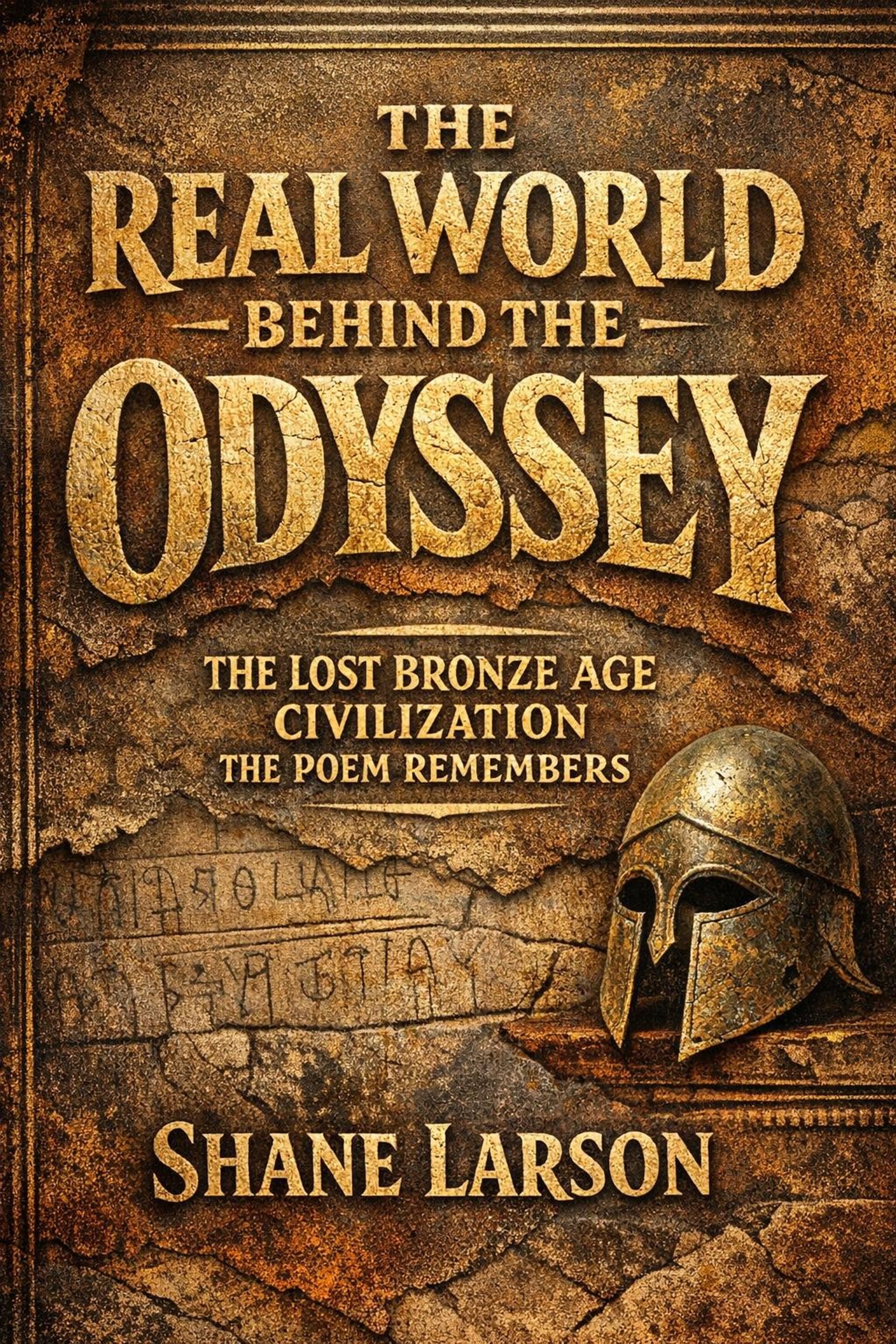
The Real World Behind the Odyssey
The Lost Bronze Age Civilization the Poem Remembers
By Shane Larson
About This Book
On the morning of April 4, 1939, an American archaeologist named Carl Blegen cut a trench into an olive-covered hilltop called Epano Englianos, above the Bay of Navarino in the southwestern Peloponnese. He was hunting for the palace of Nestor, the talkative old king of Greek legend. His first trench, on the first day, went down through the topsoil and into the archive room of a Bronze Age palace — stone walls, fresco fragments, and clay tablets covered in an unreadable script. By the end of that first season he had hundreds of them.
The tablets survived for one reason: the fire that destroyed the palace around 1200 BC baked its clay records hard. The catastrophe that killed the civilization was the same event that preserved its paperwork. When the script was finally deciphered in 1952 and turned out to be Greek — the oldest Greek anyone had ever read — the documents were not epics or chronicles. They were inventories. Rations, chariot wheels, sheep tallies, textile quotas, offerings to gods whose names you already know.
Somewhere between that filing cabinet and the poem about a wandering hero lies one of the strangest stories in ancient history — and it is the story this book tells.
The Real World Behind the Odyssey is an evidence-first investigation into the question every reader and every filmgoer eventually asks about Homer: what actually existed? The answer requires rebuilding an entire lost civilization — the Late Bronze Age Mediterranean, roughly 1600 to 1200 BC, when Mycenaean Greece sat at the table of an interconnected system of great powers alongside Egypt, the Hittites, Assyria, and Babylon. Palaces at Mycenae, Tiryns, and Pylos ran command economies through professional scribes. Trading vessels moved copper, tin, glass, amber, and ivory between kingdoms on regular routes; one of them, wrecked off Uluburun on the Turkish coast, still held cargo from at least seven civilizations three thousand years later. In the Hittite capital, kings kept a diplomatic file on a troublesome Aegean power they called Ahhiyawa, and on a contested western city called Wilusa — a name most scholars now connect to Ilios. Troy.
Then the whole system went down. Within a generation or two the palaces burned from Greece to the Levant, trade died, and Greece lost writing itself for roughly four hundred years. Nothing crossed that gap except memory — carried by illiterate singers, in verse, warping as it went. The bureaucratic palaces blurred into golden halls. Generations of coastal raiding compressed into a single ten-year war. A trader's sea became a haunted one. The book's second half follows that transformation mechanism by mechanism, because oral tradition did not only distort: it also conserved, embedding genuine Bronze Age fossils — boar's-tusk helmets, tower shields, bronze weaponry — in a poem composed centuries after all three vanished.
The destination is a verdict: an element-by-element ledger separating confirmed history from plausible echo from pure invention, so that when you return to the poem you know exactly what you are looking at.
What's Inside
- Pylos, Mycenae, and Tiryns as archaeology actually reveals them — megaron halls, painted hearths, cyclopean fortifications — and why the ruins alone, without the tablets, could never have told us what these places really were.
- Linear B decoded: how an architect named Michael Ventris cracked a script that had defeated professional scholars for fifty years, and what the tablets record — down to the chariot wheels logged as unfit for use.
- The great irony at the heart of the book: the society remembered as an age of heroes operated as an administrative state, and it was four centuries of forgetting that turned its record-keepers into legends.
- One shipwreck as a portrait of a global economy: the Uluburun vessel and her manifest, proof that the sea Odysseus wanders was already a crowded commercial highway centuries before the poem — plus how the real ships sailed, and how their hard limits shaped every voyage story told afterward.
- The nine cities stacked inside the mound at Hisarlik, from Schliemann's reckless trench to Korfmann's lower city, and which layer has the strongest claim to be Homer's Troy.
- The Hittite dossier: the Tawagalawa letter, the Alaksandu treaty, and what independent imperial correspondence says about real Greek conflict on the Anatolian coast.
- The collapse and the silence: how the destruction of c. 1200 BC created the four-century amnesia that made mythologizing possible — no gap, no golden age, no poem.
- The final ledger: the poem's major claims sorted by evidentiary status, with the supporting tablet, site, or dig layer named for each ruling.
Why I Wrote This
I have been circling one event for years without quite admitting it. Sea Peoples, Ancient Apocalypse, The Bronze Age World, Iron Age Dawn — every one of those books touches the collapse of 1200 BC from a different side: who did it, how it happened, what came after. This book is where the circling stopped, because I finally saw what the collapse actually produced. It did not just end a civilization. It severed a poem from its world. The four dark centuries that followed the burning of the palaces are the exact gap across which the Odyssey traveled, losing its bureaucrats and gaining its monsters along the way. The catastrophe I kept writing about is the reason the West's founding poem exists in the form it does — so I had to write the keystone book, the one that holds world and poem up against each other and reads the result honestly.
Frequently Asked Questions
Was the Trojan War a real historical event?
Probably not in the form the poem describes. Troy was real — a fortified Late Bronze Age city at Hisarlik — and Hittite records document genuine, repeated conflict involving Greeks on that coast across generations. But the evidence supports raids and proxy struggles, not a unified ten-year siege by a coalition of kings. The book delivers a careful, honest verdict on what the destruction of Troy VIIa does and does not prove.
Do I need to read The Search for Ithaca first?
No. This is Book 2 of the Homer's World series, but each volume stands alone. The Search for Ithaca follows a single thread — the three-thousand-year hunt for the hero's island — while this book builds the entire world those threads run through. Read them in either order.
How is this different from Eric Cline's 1177 B.C.?
Cline's book is the definitive popular account of the collapse itself. Here the collapse is the hinge, not the subject: the story runs from the living Bronze Age world, through the catastrophe, and out the other side into the Dark Ages, tracking how memory of that world became the Odyssey. If 1177 B.C. ends where the lights go out, this book follows what survived in the dark.
Do I need to know Greek or have read the Odyssey to follow it?
No background is assumed. Every passage of the poem discussed is retold in plain prose, technical material like Linear B and stratigraphy is translated into ordinary language, and the argument is built for a general reader meeting this material for the first time.
Does the book cover Christopher Nolan's film?
Briefly and deliberately. The final chapter looks at what the adaptation gets right and what any adaptation has to invent, but this is a work of history, not a movie companion — the film is the doorway, not the destination.
If You Liked This, You Might Like
- The Mycenaeans — a full-length portrait of the palace civilization this book reconstructs, for readers who want to stay inside the world before the fire.
- Sea Peoples: Raiders of the Bronze Age — the mysterious maritime raiders who appear at the center of the collapse this book turns on.
- Ancient Apocalypse — the complete anatomy of the c. 1200 BC catastrophe that Chapter 10 of this book can only compress.
- Iron Age Dawn — what rose from the wreckage: the recovering world in which the singers of the Odyssey actually lived and performed.
A real civilization, a real catastrophe, and the four silent centuries that turned one into the other's legend — recovered here so you can read the oldest voyage in literature with open eyes.
Book 2 of the Homer's World series.
Included with Kindle Unlimited — read it free if you're a member.
New Ancient History releases and free chapters — no spam, unsubscribe anytime.