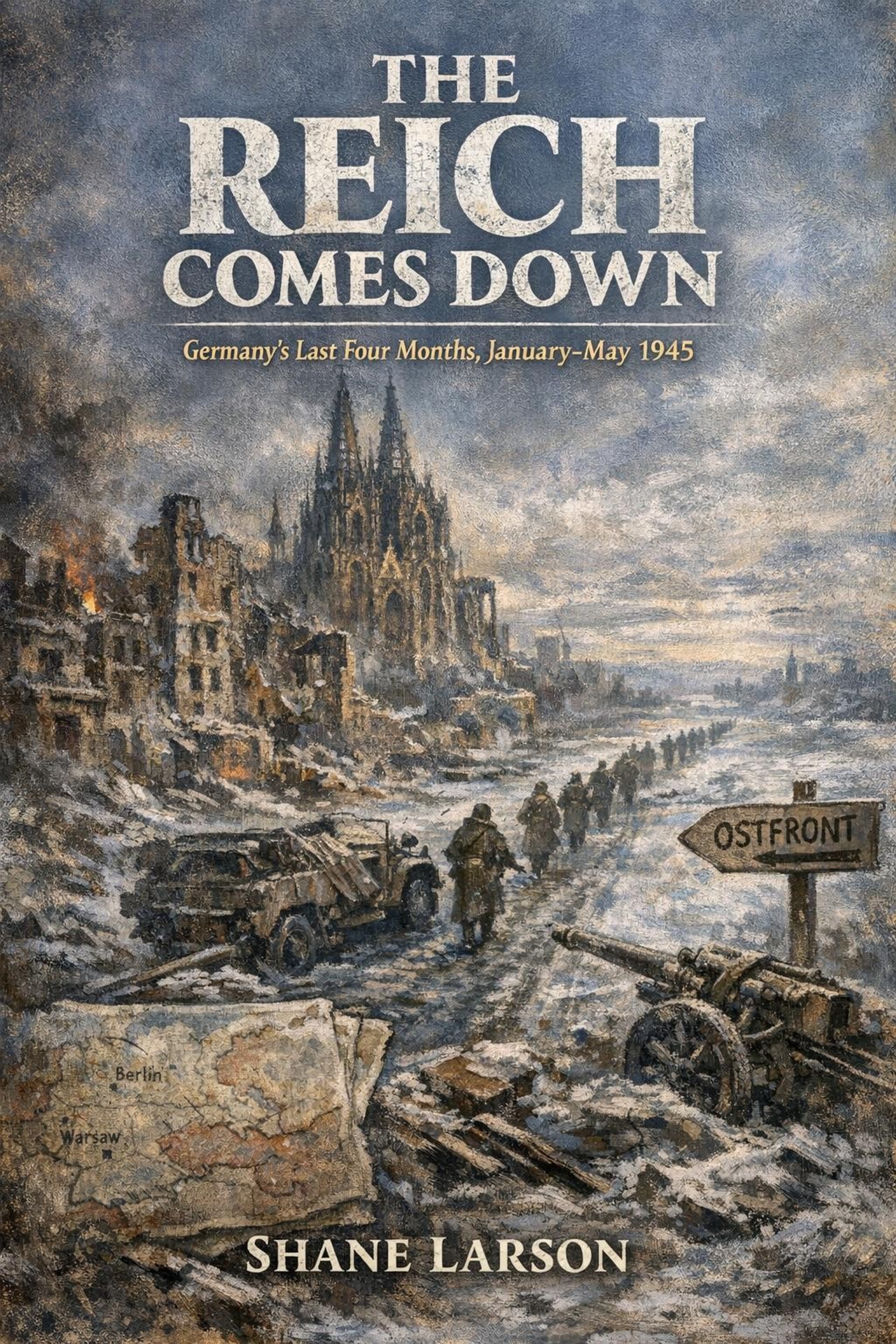
The Reich Comes Down
Germany's Last Four Months, January–May 1945
By Shane Larson
About This Book
In the last days of April 1945, roving German military tribunals were still condemning soldiers to death for defeatism on Berlin streets that Soviet assault groups had already entered. The men who carried out those sentences did not think the war could be won. Neither did the men they hanged. Neither did anyone above them: the general staff had put the arithmetic in writing back in January, and the armaments minister had twice told Hitler, on paper, that the economic basis of the war was gone.
The fighting went on for four more months anyway, and those months were the costliest of the entire European war. January 1945 alone was the deadliest single month the German army experienced in the whole conflict. Civilians died on the frozen roads out of East Prussia, in the firestorms of a bombing campaign reaching its greatest weight just as its justification grew thinnest, and at the hands of a regime that kept killing prisoners and its own soldiers to the last week.
This is the end of the Second World War in Europe treated as a problem to be solved rather than a countdown to be narrated. The question is not who won — that was settled before this volume opens — but why the war did not therefore stop.
The answer the book builds, chapter by chapter, has three parts. Ideologically, a regime founded on the premise that defeat meant national annihilation had written capitulation out of its own vocabulary in advance; for Hitler, whose fixed reference was 1918, the destruction of Germany itself was preferable to signing. Structurally, the Nazi state of 1945 was not a government but a cluster of rival baronies — the party, the SS, the services, the Gauleiters — with no body capable of a collective decision, which is why every peace feeler of the final months was personal, secret, and treated as treason on discovery. Coercively, what still worked was compulsion turned inward: flying courts-martial with authority to try and hang within the hour, and roughly fifteen thousand German soldiers put to death by their own side, against forty-eight such executions in the Kaiser's army across the whole of the First World War.
Braided through all of it runs an asymmetry the book follows to the end: the same German army that gave up in whole formations in the west fought to annihilation in the east, and everyone involved knew exactly why. What the Wehrmacht and the SS had done in the Soviet Union between 1941 and 1944 shaped the winter flight of millions, the conduct of the Red Army when it arrived, the westward geography of the last fortnight's surrenders, and the map of the Europe that came out the other side.
What's Inside
- The Vistula–Oder offensive, the largest and fastest advance of the war, and a proper examination of why the Red Army stopped forty miles from Berlin at the end of January.
- The winter flight and the sea evacuation: two million people moved out of the eastern provinces by ship, and the sinkings of the Wilhelm Gustloff, Goya, and Steuben — the three largest losses of life at sea in history.
- Yalta as it actually worked: three leaders conferring about a Europe whose shape was already being settled by where the armies stood.
- The bomber offensive with the ledger open on both sides — German production rising until mid-1944, the decisive oil campaign, and aircrew loss rates among the worst of any service in the war.
- The biography of a number: Dresden's toll traced source by source, from the wartime civil-defence counts through the propaganda falsification, the figures that circulated for fifty years, and the German historical commission finding of 2010.
- The camps at liberation and the death marches, established as record with sourced figures — including the killings that continued after surrender orders had been issued.
- The Reich disintegrating from inside: the Nero Decree, Speer's self-serving account of countermanding it tested against the documents, and the Werwolf resistance that never materialised.
- Berlin, from the Seelow Heights to the Reichstag — including the competition Stalin deliberately staged between his own marshals, and the staging of the famous flag photograph.
- Two surrender ceremonies in two cities, the reason there were two, the fighting that continued after both, and a country-by-country accounting of the European war's dead with the ranges and caveats intact.
Why I Wrote This
Everything I write circles the same preoccupation: how institutions fail. This volume is the purest case I have ever worked on. A war that everyone in authority privately understood to be lost ran on for four more months, at the highest cost of the entire conflict — not because anyone decided it should, but because the state had stripped itself of every mechanism by which it could have decided anything else. Ending a war turns out to require working machinery, and by 1945 Germany had none.
What finally convinced me the book was worth writing, though, was a pair of numbers. The most fought-over figure in these pages — Dresden's death toll — has been contested for eighty years, largely by people who needed it to be large. The largest figure in these pages — the Soviet Union's roughly twenty-seven million dead — is barely disputed and barely known. When the two most important numbers in a subject are distorted in opposite directions, the accounting itself becomes the story.
Frequently Asked Questions
Do I need to read the earlier Second World War Chronicles volumes first?
No. The Introduction carries a substantial "War So Far" section compressing Volumes 1–8 into the position on the board as of 12 January 1945, so the book stands alone; the callbacks — to Stalingrad especially — are explained where they occur.
Does this book cover the Holocaust in full?
No, and the book is explicit about this. One chapter establishes the Holocaust's scale and mechanism with sourced figures, covers the liberations from Majdanek through Dachau, and marks the point at which the crime became undeniable to the world; a second covers the death marches. The full treatment belongs to a planned companion volume, and the chapter says so rather than pretending a chapter is the account.
What was the actual death toll of the Dresden bombing?
The honest answer is a range with a history. The book sets out every layer of it: the wartime civil-defence figures, the Nazi propaganda operation that inflated them roughly tenfold, that inflated figure's fifty-year afterlife in Western publishing, and the German historical commission that concluded in 2010 that the toll was up to about 25,000. It also covers, factually and without heat, what the larger numbers have been used for since, and by whom.
How does the book handle the camps, the death marches, and the mass rapes?
As established fact, with sourced figures and stated ranges, and with no graphic detail beyond what the record requires — none of it is written for atmosphere. Soviet crimes against German civilians are stated as crimes and located in the record of what German forces had done in the Soviet Union first; the book is equally explicit that this is context, not justification, and that neither set of crimes cancels the other.
Does this volume cover the end of the war against Japan?
No. It closes with Germany's surrender in May 1945, the Pacific war still running and the first atomic test seven weeks away. That war's ending — island hopping, Okinawa, and the bomb — is Volume 10.
If You Liked This, You Might Like
- The Thirty Years' War — the other war that devastated Germany, three centuries earlier; the two books bracket the same landscape.
- The Institutional Collapse Pattern — the general anatomy of institutions that lose the capacity to act, of which this volume is the most extreme historical case.
- The Empire Collapse Pattern — how great powers come apart from within rather than at their enemies' hands — the pattern this volume documents hour by hour.
A war's ending usually has to be signed before it can be finished. This one had to be finished — building by building — before anyone was left with the authority to sign it; The Reich Comes Down: Germany's Last Four Months, January–May 1945 is the account of what that cost. Volume 9 of The Second World War Chronicles.
Included with Kindle Unlimited — read it free if you're a member.
New Military History releases and free chapters — no spam, unsubscribe anytime.