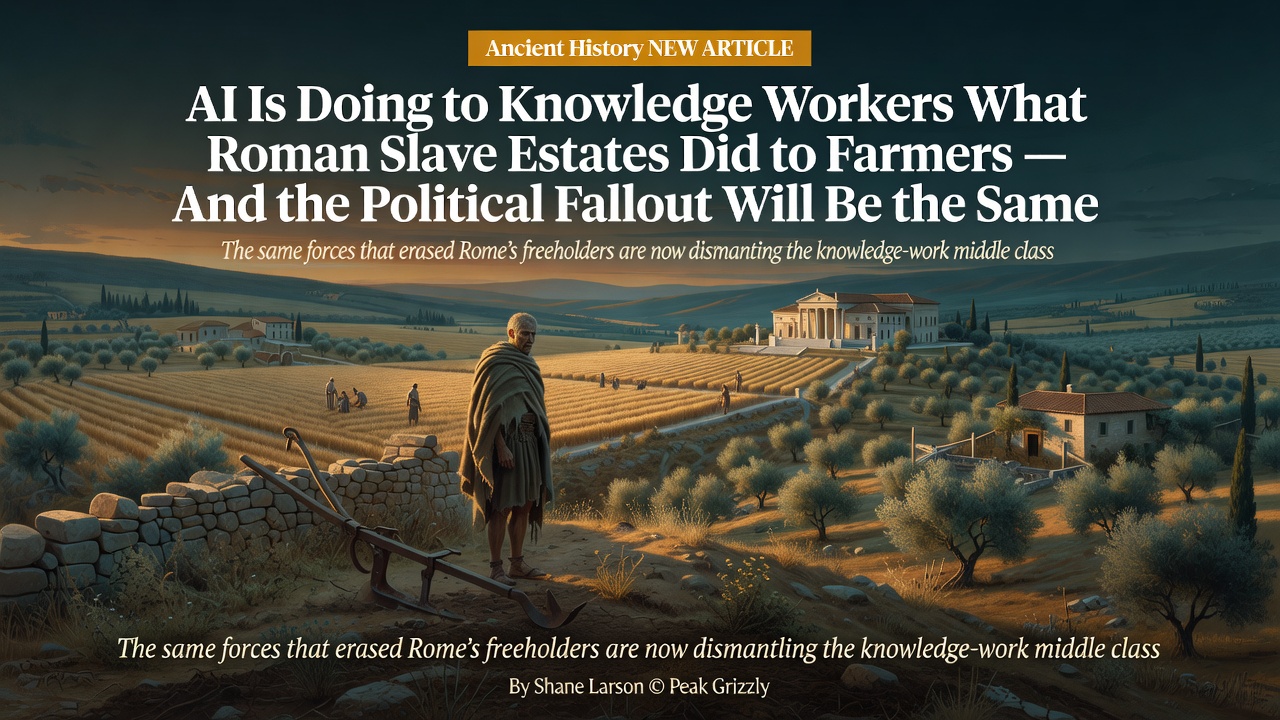
AI Is Doing to Knowledge Workers What Roman Slave Estates Did to Farmers — And the Political Fallout Will Be the Same
March 25, 2026 · 5 min read
In the third century BCE, the backbone of the Roman Republic was a class of people nobody writes epics about. Small freeholders — citizens who owned modest plots, farmed them with their own hands, paid the taxes that funded Rome's armies, and served in those armies themselves. They were not wealthy or glamorous. But they were the Republic.
Within a century, they were gone. Not because of drought or invasion, but because of a new technology for producing food more cheaply: the latifundium. Massive agricultural estates worked by slave labor that had effectively zero marginal cost. The crops still grew. The food was still produced. But the humans who had produced it for generations found that their labor was worth less than the cost of feeding a slave.
If you work in knowledge work in 2026, this should sound familiar.
The Economics of Zero-Cost Labor
The latifundia math was simple and devastating. A small freeholder farming twenty acres of grain with family labor had thin margins. In a good year, he had enough surplus to pay taxes and set a little aside. In a bad year, he borrowed.
A latifundium of two thousand acres, worked by hundreds of slaves, operated on entirely different economics. Slaves required food and shelter but no wages. They could be worked dawn to dusk, year-round. They could be specialized — one crew for plowing, another for harvesting, another for processing. The estates achieved economies of scale that small farms could not match and produced at costs small farms could not undercut.
The quality was not necessarily better. Columella, the first-century agricultural writer, complained that slaves were careless and wasteful. But the output was cheaper. And "cheaper but good enough" was all it took to destroy a social class.
The AI parallel is precise. A junior copywriter costs an employer $50,000 to $70,000 per year in salary plus benefits and overhead, and produces ten to twenty polished pieces per week. An AI writing system costs a few hundred dollars per month and produces hundreds of pieces per day. The human is better at certain tasks — genuine creativity, deep domain knowledge, subtle emotional intelligence. But for a large category of routine work, the AI output is good enough.
"Good enough at near-zero marginal cost" is the latifundia dynamic. It does not matter that the replacement is not as skilled as the human. It matters that the replacement is cheap enough to make the human economically uncompetitive.
The structural parallel extends further. The latifundia replaced human labor with a cheaper alternative (slaves) that had effectively zero marginal cost. AI replaces human labor with a cheaper alternative (software) that has effectively zero marginal cost. The latifundia displaced a specific class of worker (small freeholders) whose function could be replicated cheaper. AI is displacing a specific class of worker (knowledge workers performing routine cognitive tasks) whose function can be replicated cheaper.
The Political Earthquake That Followed
Rome's displaced farmers did not disappear. They migrated to the cities and became the urban proletariat — proletarii, literally "those who contribute nothing but their offspring." Citizens with voting rights and legal protections, but no land, no steady income, no trade, and no realistic prospect of returning to the life that had sustained their families for generations.
The Digital Colosseum
By the late second century BCE, Rome's population had ballooned to hundreds of thousands, a significant fraction landless and unemployed. The city had no industrial base to absorb them. The proletariat survived on occasional labor, patronage, and increasingly, direct grain distributions from the state.
A young aristocrat named Tiberius Gracchus understood the structural threat. Rome's military depended on property-owning citizens. The latifundia were destroying this class. If the trend continued, Rome would have soldiers with no stake in the Republic's survival — men loyal to any commander who promised them land. This was not theory. It was a prediction that proved accurate within a generation.
Gracchus proposed moderate land reform — enforce existing limits on public land holdings and redistribute the excess. The Senate murdered him on the Capitoline Hill. His brother Gaius attempted more radical reforms a decade later. He was killed too, along with three thousand supporters.
The Gracchi failed. The latifundia expanded. The proletariat grew. And within fifty years, the Republic was consumed by civil wars fought by exactly the kind of strongmen Tiberius had warned about — Marius, Sulla, Pompey, Caesar — generals whose armies owed loyalty to their commander, not the state.
The Republic died, in significant part, because it could not solve the labor displacement problem.
The Question Is Not Whether AI Will Transform Civilization
Modern displaced knowledge workers have advantages Rome's farmers lacked — savings, education, professional networks, social capital. The displacement will not produce destitution overnight. But the structural dislocation is real and the political consequences are already visible.
Tiberius Gracchus understood something most modern policymakers have not yet grasped: mass labor displacement is not primarily an economic problem. It is a political problem. Rome's displaced farmers were not just unemployed. They were disenfranchised in everything but the formal sense — voting rights without economic stake, citizenship without productive role. This combination is inherently unstable. It creates populations susceptible to demagogic promises, loyal to individuals rather than institutions, volatile in political behavior.
The modern parallel is uncomfortably clear. Populations of educated workers who feel economically displaced are already reshaping political landscapes across democracies worldwide. The rise of populist movements in the 2010s and 2020s correlates strongly with economic disruption from automation and technological change. AI-driven displacement is accelerating these dynamics.
But Rome's story has a second ending. The Eastern Roman Empire — Byzantium — survived for a thousand years after the West collapsed. Same legal system, same administrative tradition, same cultural heritage. The divergence was not random. It was structural: different decisions about economic inclusion, institutional adaptation, and the management of technological change.
The question is not whether AI will transform civilization. It will. The question is whether we navigate it like Rome — or like Byzantium.
The Digital Colosseum
New posts and releases, straight to your inbox. No spam, unsubscribe anytime.