The Fourth Great Power: The Ancient Empire That Got Erased From Your Textbook
June 2, 2026 · 5 min read
Sometime around the year 240, a Persian prophet named Mani — the founder of a religion that once stretched from Spain to China — wanted to make a point about how important his own faith was. So he compared it to the great kingdoms of the world, the ones whose dominance no one would dispute. He named four.
Persia. Rome. China. And Aksum.
Three of those names you could place on a map in your sleep. The fourth probably draws a blank. And that blank is the single most interesting fact about the kingdom of Aksum — because Mani was not guessing, and he was not being generous. He was a well-traveled man stating something that, in his world, was simply obvious. The empire of the Ethiopian highlands belonged on the list. We are the ones who lost it.
What Aksum actually was
Start with the hard evidence, because the achievement is the thing the forgetting has hidden.
Aksum sat in the highlands of what is now northern Ethiopia and Eritrea, with a port called Adulis on the Red Sea. That location was everything. The Red Sea is the hinge between two of the ancient world's great economic zones — the Mediterranean on one side, the Indian Ocean on the other — and Aksum sat on the seam. Roman gold flowed south through Adulis. African ivory, gold, and exotic goods flowed north. Indian and Arabian spices, silk, and incense passed through in transit. Aksum taxed the traffic and grew rich, and a contemporary Greek merchant's handbook to the region, written in the first century, already names an Aksumite king and describes the trade in working detail.
How rich? Rich enough to mint its own coins in gold, silver, and bronze starting in the late third century — and minting gold was not something just any kingdom did. In that era, the states striking their own gold coinage could be counted nearly on one hand: Rome, Persia, and Aksum among them. The coins were stamped with the king's portrait and, for the international market, legends in Greek. They have been found as far away as India.
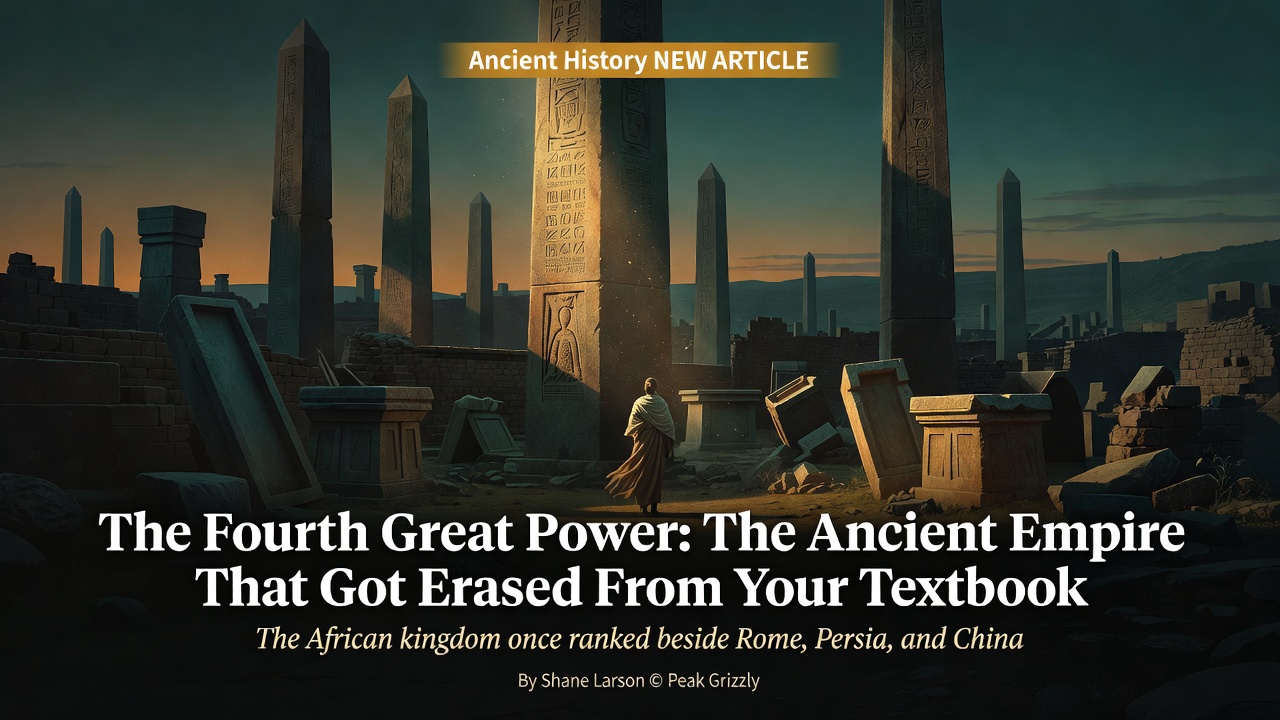
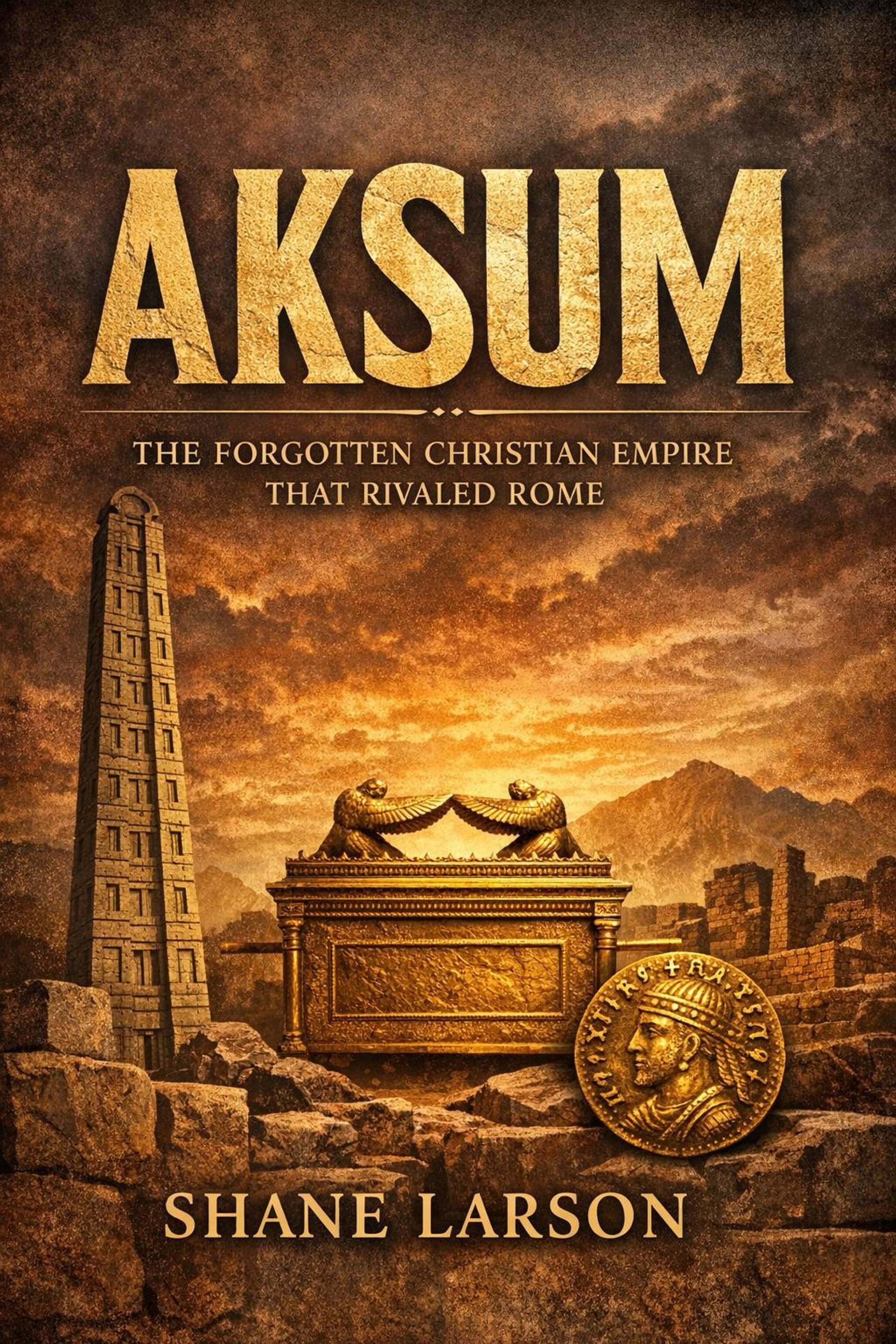
And then there are the obelisks. The Aksumites quarried single pieces of stone, carved them to look like multi-storey towers complete with false doors and windows, and stood them upright over the tombs of their kings. The largest was over thirty meters tall and weighed something north of five hundred tons — the biggest single stone any human society ever attempted to raise as a standing monument, larger than anything in Egypt. It was so ambitious that it appears to have broken and crashed down during the attempt to erect it. It is still lying there, in pieces, where it fell some seventeen centuries ago.
Christian before Rome
Here is the part that tends to stop people.
Around the year 330, the Aksumite king Ezana converted to Christianity. We are not relying on legend for this — we can watch it happen on his coinage, where the old pre-Christian symbol of a disc and crescent is replaced by the cross. Aksum thus became one of the very first states anywhere on earth to adopt Christianity officially, around the same time as — by some measures a little ahead of — the Roman Empire's own long conversion under and after Constantine.
Aksum
And unlike Rome, Aksum never let go. The Ethiopian Orthodox Tewahedo Church traces an unbroken line from Ezana's conversion straight through to the congregation that gathered this past Sunday. Its liturgy is still chanted in Ge'ez, the language of Aksum. The script Ezana's scribes used is the script on shop signs in Addis Ababa and Asmara today. This is the thing that makes Aksum genuinely different from almost every other ancient civilization we study. With Rome, with Persia, with Babylon, we are always reaching across a broken thread — reconstructing a dead world from ruins and dead languages. With Aksum the thread was never cut. It is not only a chapter of late antiquity. It is a piece of late antiquity that is still alive.
Why it disappeared — twice
So how does a great power vanish from the story?
The first disappearance was real and economic. When Islam rose in the seventh century and the surrounding seas and the rich province of Egypt passed into Muslim hands, the Red Sea stopped being Aksum's highway and became someone else's. An empire built on controlling a trade route cannot survive losing the route. Aksum was never conquered into oblivion — it was marooned. The gold coinage stopped. The great port emptied. The kingdom turned inward and uphill, out of the sightline of the chroniclers who were writing the history the West would inherit, and shrank into what scholars honestly call the dark centuries. It did not die — it later produced the astonishing rock-hewn churches of Lalibela, eleven churches carved downward into solid rock as a new Jerusalem — but it dropped out of the international story.
The second disappearance was ours, and less innocent. Even after European scholarship "rediscovered" Aksum, the old habit of treating Africa as a continent without history — a blank space to be explained by outside influence — kept a first-rank civilization filed under footnote. The clearest symbol of it came in 1937, when Fascist Italy, fancying itself the heir of Rome, looted one of the great standing obelisks of Aksum and carted it back to display in the capital. It took until 2008 to get it home and stand it up again. Take the monument, deny the achievement, let the silence do the rest. That is the whole pattern in one object — and the obelisk standing once more at Aksum is the answer to it.
Reading the whole map
The reason to recover Aksum is not charity, and it is not box-ticking. It is accuracy. The ancient world was not a Mediterranean lake with some barbarians around the rim. It was a connected, trading, believing, arguing world that ran from the Atlantic to the South China Sea — and for several centuries, one of its four beating hearts was in the highlands of Africa, looking out over the Red Sea at a world it was busy getting rich from.
Mani knew that. He wrote the four names down without feeling any need to defend the fourth, because in his day it needed no defending. Somewhere between his century and ours, we mislaid it. The work — and the pleasure — is in putting it back.
Persia. Rome. China. And Aksum.
Aksum
New posts and releases, straight to your inbox. No spam, unsubscribe anytime.