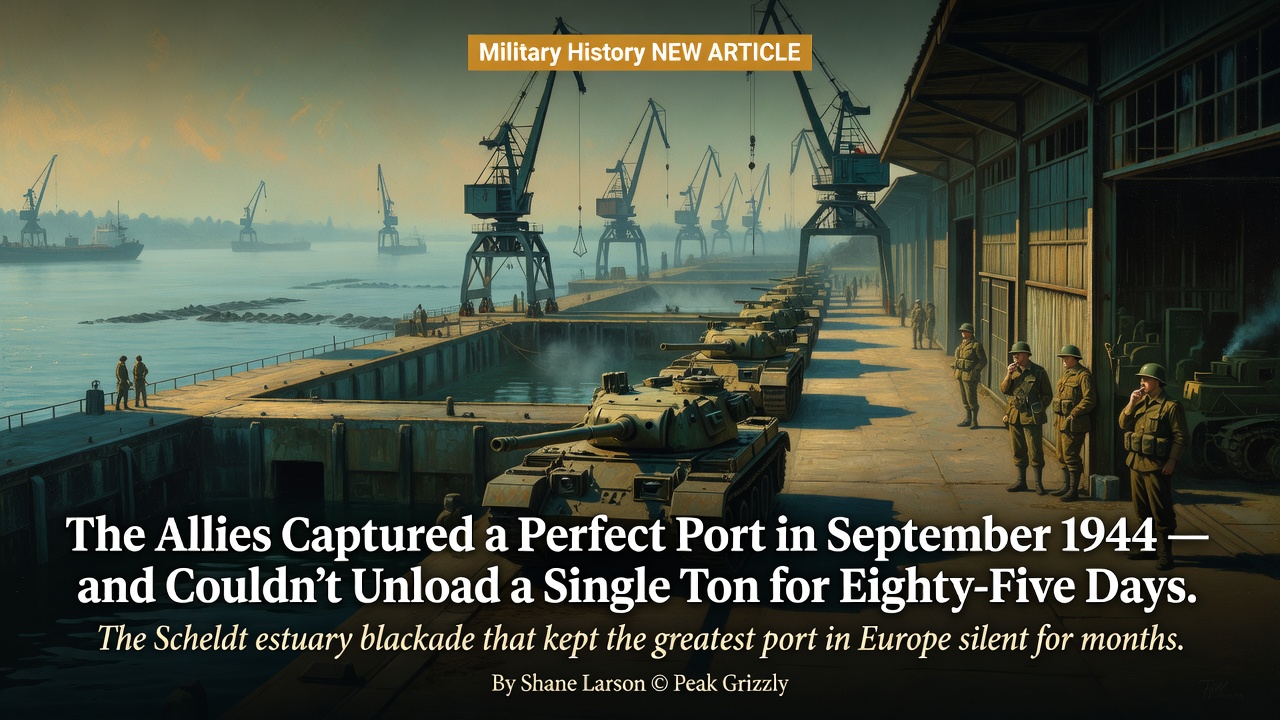
The Allies Captured a Perfect Port in September 1944 — and Couldn't Unload a Single Ton for Eighty-Five Days
September 15, 2026 · 7 min read
On the afternoon of 4 September 1944, tanks of the British 11th Armoured Division rolled into Antwerp and took possession of the greatest port in north-western Europe — intact. This was not luck. The Belgian resistance had risen ahead of the advance, seized the sluice gates and lock machinery before German demolition parties could reach them, and sent guides to lead the British columns through the city by the fastest streets. By that evening the Allies held miles of deep-water quays, hundreds of electric cranes, dry docks, oil storage, warehouses, and railway lines running east toward Germany. Allied planners rated the port at roughly 40,000 tons of cargo a day — enough, by itself, to sustain an entire army group.
The first Allied cargo ship did not tie up at an Antwerp quay until 28 November. Eighty-five days.
Almost nobody outside the Netherlands, Belgium, and Canada can name the battle that fills that gap, or place it on a map. Which is remarkable, because a serious argument can be made — and this article makes it — that those eighty-five days are the reason the Second World War in Europe did not end in 1944.
A port without its water is a warehouse
The reason is on the map, for anyone who looks. Antwerp is not on the sea. It lies roughly seventy miles up the Scheldt, a broad tidal estuary whose shores were still German on the day the port fell: the Breskens pocket on the south bank, the South Beveland peninsula and the fortified island of Walcheren on the north. German coastal batteries commanded the channel. German mines filled it. Hitler had designated the estuary's strongpoints as fortresses, to be held precisely so that the port behind them would be useless, and the German Fifteenth Army — bypassed and written off in the euphoria of the pursuit — was ordered to hold them.
Cranes do not matter if ships cannot reach them. Until the estuary's banks were cleared and its waters swept, Antwerp was the best-equipped warehouse in Europe, and nothing more.
What the port was worth
To understand what idle meant, look at where Allied supply actually stood in September 1944. Every ton of fuel, ammunition, and food sustaining the armies in the west was still being landed over the Normandy beaches and through the wrecked port of Cherbourg — three hundred miles and more behind a front that had lately been moving east at fifty miles a day. The gap was being bridged by trucks: the Red Ball Express, running a one-way loop around the clock, and burning petrol by the hundred thousand gallons a day in order to deliver petrol. That is not a supply system. That is a supply system consuming itself.
The arithmetic caught the armies one by one. Patton's Third Army put its lead tanks on the Meuse at the end of August and then watched its fuel allocation collapse. First Army was rationing artillery ammunition by October. The pursuit that had carried the Allies from Normandy to the German frontier in a month did not stop against a German defensive line; there barely was one. It stopped against arithmetic. And in the pause the arithmetic imposed, the German army in the west — which in the first week of September had effectively ceased to exist as a coherent force — rebuilt itself, manned its frontier, and began secretly hoarding fuel and armour for an offensive of its own.
Antwerp was the answer to all of it: a deep-water port already connected by rail to the front, seventy miles of water away from solving the entire problem.
The week the door stood open
Here is the painful part. In the first days of September, the Scheldt's defences were thin. The 11th Armoured Division's tanks stood in Antwerp with fuel in them; the neck of the South Beveland peninsula — the corridor along which the estuary's north shore was reinforced — lay a short drive beyond the city. The division was halted to rest and refit. The corps commander responsible conceded, in a memoir written decades later, that not pushing on was a mistake — though whether a few days' further advance in early September could actually have unhinged the estuary's defences is a question historians still genuinely dispute, and the honest answer is that no one can know.
From the Beaches to the Rhine
What is not in dispute is what happened instead. Attention, fuel, and airlift went elsewhere. On 17 September the Allies launched Market Garden, the airborne carpet toward the Rhine bridge at Arnhem — a bold operation aimed at ending the war quickly, which consumed precisely the resources and the weeks in which the Scheldt could have been cleared cheaply. And while Arnhem was being fought and lost, the German Fifteenth Army conducted one of the least famous successful evacuations of the war, ferrying itself across the mouth of the Scheldt from the south bank to Walcheren and South Beveland — German records put it at more than 80,000 men, with hundreds of guns and thousands of vehicles. The army that had been trapped against the coast in early September spent October defending the estuary in strength, and part of it went on to fight at Arnhem's back door as well.
Whether Market Garden was worth that trade is one of the enduring arguments of the campaign, and it deserves to be conducted with tonnage figures rather than personalities. But the sequence itself is plain: the port fell on 4 September, the estuary was left for later, and later turned out to be very expensive.
What the Canadians paid
The bill came due in October, and it was presented to the First Canadian Army. The Battle of the Scheldt — five weeks of fighting from early October to 8 November — was waged across some of the worst attacking ground of the western war: polder country, reclaimed land below sea level, which the Germans deliberately flooded, leaving the attackers to advance along exposed dyke tops or wade through freezing water toward entrenched guns.
The Canadians and their British, Polish, and other Allied comrades cleared the Breskens pocket on the south bank, fought up the flooded neck of South Beveland, and finally took Walcheren itself — an island the RAF had bombed at its dykes in early October, breaching them and flooding the interior to drown the defence; well over a hundred Dutch civilians drowned at Westkapelle alone, a cost the tidy versions of this story omit. The final assault went in from the sea against coastal batteries that were still firing. The campaign cost the Allies nearly 13,000 casualties — killed, wounded, and missing — roughly half of them Canadian. Outside Canada, almost no one has heard of it.
The last German resistance ended on 8 November. Then came three more weeks nobody remembers at all: minesweepers — more than a hundred of them — working the seventy miles of channel, lifting well over two hundred mines. On 28 November the first convoy reached the city, led, fittingly, by a Canadian-built freighter, the Fort Cataraqui.
What changed, and what it proves
Within weeks of the port opening, the Allied supply position was transformed — tens of thousands of tons a day landing at quays with rail lines running straight toward the front, instead of over sand three hundred miles behind it. The Germans understood exactly what that meant. The great Ardennes offensive of 16 December — the Battle of the Bulge — had Antwerp as its objective: the same port, approached from the other side, by an enemy who had grasped its value all along and now spent his last mobile reserve trying to take it back. He never came close. The V-weapons aimed at the city month after month made the same point in a different register.
But the counterfactual cuts the other way, too. Had Antwerp opened in early October instead of late November — had the estuary been cleared in mid-September, when its garrison was a fraction of what the Canadians eventually faced — the fuel and ammunition famine that halted the front would have lifted before the German army in the west finished rebuilding itself. No Hürtgen Forest as it was fought. Quite possibly no Ardennes offensive, because the offensive's premise was an Allied supply system still too thin to respond quickly. The war would still have had to be won by fighting. But the winter campaign, as it actually happened, was the price of eighty-five days — and the eighty-five days were the price of a single unglamorous task left for later during the most intoxicating month of the war.
It is the least cinematic decisive battle in the western campaign: no beach, no bridge, no famous general attached to it. Just water, mud, mines, and arithmetic. Which may be exactly why it decided so much.
The Scheldt is the hinge of my book From the Beaches to the Rhine: Normandy to the Bulge, 1944, Volume 8 of The Second World War Chronicles — the story of a campaign decided by logistics twice, in opposite directions: an invasion that succeeded because the Allies solved an unprecedented supply problem in advance, and an autumn lost because the same alliance failed an easier version of the same problem in reverse. If a port that couldn't unload sounds like your kind of military history, the book gives the full arithmetic — and lets you reach your own verdict on Market Garden, the broad front, and the eighty-five days.
From the Beaches to the Rhine
New posts and releases, straight to your inbox. No spam, unsubscribe anytime.