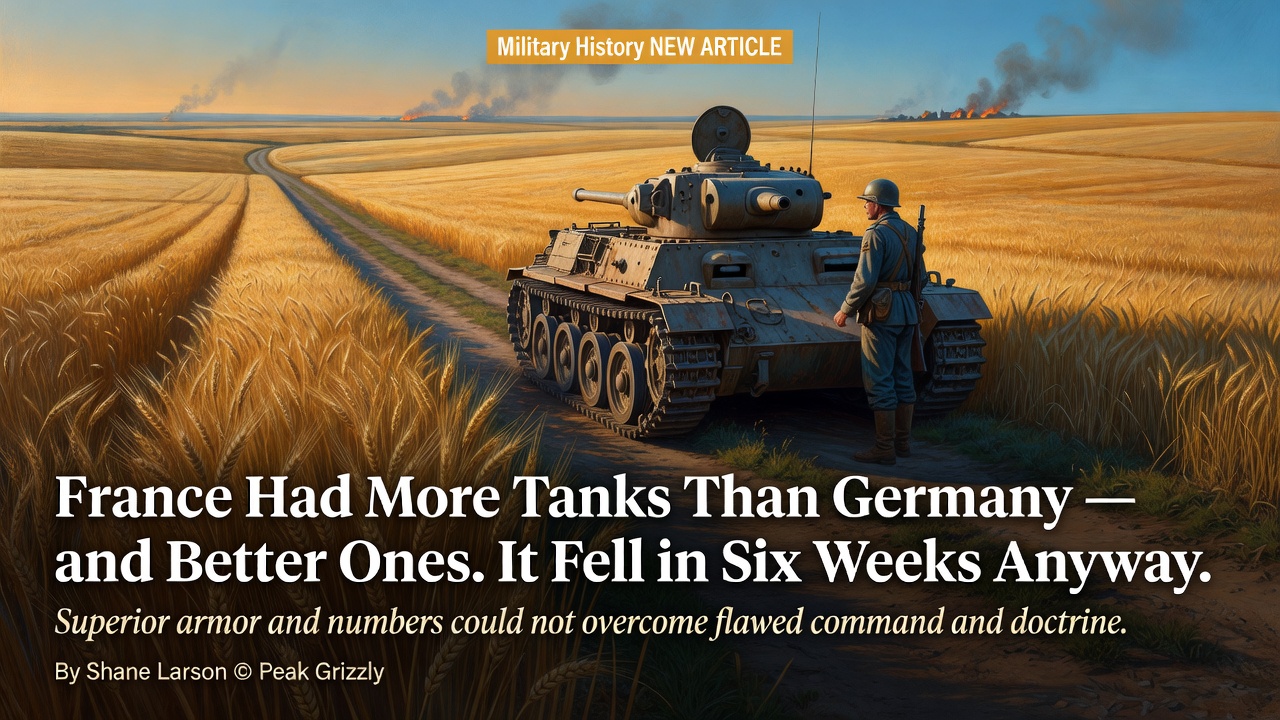
France Had More Tanks Than Germany — and Better Ones. It Fell in Six Weeks Anyway.
September 9, 2026 · 7 min read
The Blitzkrieg Myth: Why the Fall of France in 1940 Wasn't What You Think
Start with the number, because the number is the problem. In May 1940, the Allied armies facing Germany had more tanks than the force coming at them — roughly 3,400 French and British machines against some 2,400 German, and every serious reconstruction of the totals puts the order the same way. They also had better ones. The French Char B1 bis carried armour the standard German anti-tank gun could not penetrate at fighting ranges, and a heavier gun than anything in the panzer divisions. The Somua S35 was, by most measures, the best medium tank in Europe. The French army stood behind a fortified frontier that worked exactly as designed — no German assault ever broke through the Maginot Line — and it was backed by the British Expeditionary Force, the Royal Navy, and the Belgian and Dutch armies.
Six weeks after the German attack opened on 10 May, that army had ceased to exist, and a French delegation was sitting in a railway carriage at Compiègne being handed terms.
The explanation everyone reaches for is blitzkrieg: a new German way of war, mechanised and irresistible, against which nothing could have been done. The explanation has everything going for it except the record.
There Was No Blitzkrieg Doctrine in 1940
The word barely appears in German military writing of the period. It was popularised by the English-language press in the autumn of 1939, then adopted by German propaganda after the victory it was invented to explain — and the officers who ran the campaign mostly disliked it. This is not a fringe revision. The demolition of the blitzkrieg legend is now some forty years old in the scholarship, much of it German, built from the German army's own war diaries and correspondence; the fullest reassessment, Karl-Heinz Frieser's work on the 1940 campaign, came from within the Bundeswehr's own military history office in the 1990s. It has simply never reached the shelf where most readers meet the story.
Here is what the record shows instead. The Wehrmacht that invaded France was, in the main, a marching army: ten panzer divisions in a force of about 135, the rest moving on foot with their guns and supplies hauled by horses — more than half a million of them. And the plan it used was not even the General Staff's plan. The General Staff wanted a cautious wheel through Belgium toward an eventual battle in the north. That plan died on 10 January 1940, when a courier aircraft carrying a copy of it crash-landed in a field near Mechelen, Belgium, and forced a rewrite. Only then was a proposal the high command had repeatedly rejected as reckless — an armoured thrust through the Ardennes — adopted, in part because the man at the top liked its audacity.
The most telling witnesses against the legend are the German commanders themselves, before the fact. Their spring 1940 diaries and letters are not the documents of men wielding a perfected instrument; they are the documents of men who thought the plan too dangerous, said so in writing, and were overruled. One army group commander confided to his diary his fear that the armoured thrust would be caught strung out and cut to pieces. On 17 May — a week into a campaign going better than any plan had dared project — the armoured group's parent command was trying to halt its own spearhead. An army that believed it possessed an irresistible doctrine would not have needed to argue with itself in the middle of executing it.
Better Weapons Lost to a Nervous System
If the tanks were counted and the French counted higher, what decided it? Three things, all organisational, none of them steel.
The decision cycle. The French command system of 1940 moved information by courier and liaison officer, and it took something like forty-eight hours to convert an event at the front into an order responding to it. The German system did the same work in an afternoon — and at the level of the tank crew, in minutes. The panic at Bulson on 13 May compresses the whole difference into six hours: a rumour that German tanks had crossed the Meuse sent a French artillery line displacing rearward without ever being attacked, because in an army where no officer could pick up a handset and ask whether the tanks at Bulson existed — they did not — a rumour and an intelligence report are the same object arriving at the same speed.
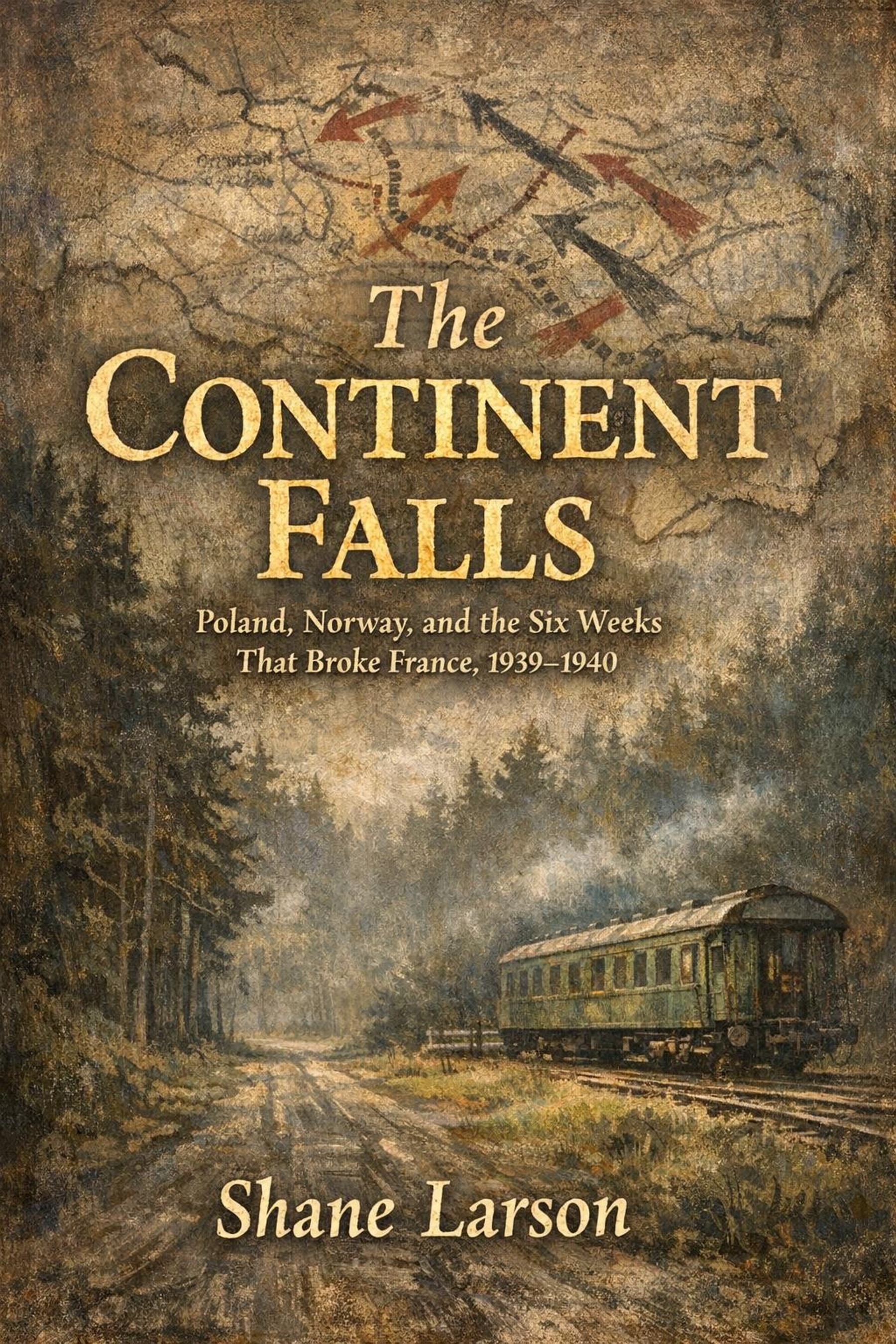
The Continent Falls
The armour. The French distributed most of their tanks along the whole front in independent battalions tied to the infantry's pace; the Germans concentrated theirs into ten divisions and placed all ten at the point of decision. And the comparison of the machines inverts at the level of the system. At Stonne — a village that changed hands seventeen times — a single Char B1 bis absorbed around a hundred and forty hits and knocked out thirteen German tanks. But its commander fought alone in a one-man turret, commanding, aiming, loading, and firing, and in most French tanks he did all of it without a radio. A German tank carried three men in the turret sharing the work, and a wireless set connecting it to every tank around it. One was a better weapon; the other was part of a nervous system. Weapons lose to nervous systems.
The reserve. When Winston Churchill flew to Paris on 16 May and asked the French high command where the strategic reserve was, the answer — there is none — was not a confession of negligence. The mass of manoeuvre had been spent, by design, on the first morning, when the best French and British formations wheeled into Belgium to meet an attack that was not coming there. That was the plan working. French doctrine had an answer for every contingency except the one where the front broke faster than a new front could be assembled, and it treated that contingency as impossible rather than as expensive.
What the Myth Was Built to Hide
None of this diminishes what happened to the men who fought it. French military dead in the six weeks lie somewhere between 50,000 and 90,000 — the range turns on how the wartime returns were kept — and even the low end, in forty-six days, is a rate of loss comparable to the worst passages of the First World War. German casualties in June ran heavier per day than in May, against a French army that had already lost its best formations. A half-brigade of colonial machine-gunners at Monthermé held up a panzer corps for two days. Whatever those facts describe, it is not an army that declined to fight.
The legend of the irresistible machine was not an accident of sloppy history. It was manufactured, promptly, by every party with standing to build it. German propaganda needed the victory to be a new way of war rather than a gamble the professionals had opposed. The men who governed defeated France from July 1940 needed it more: a France beaten by an unstoppable novelty had merely been unlucky, while a France beaten by its own command arrangements had questions to answer — and they were the ones who would have had to answer them. British accounts had their incentive too, because the miracle of Dunkirk is sized by the machine it escaped from. Every teller of the story had a use for the myth. Nobody had a use for the truth, because the truth implicated the tellers.
The real lesson is harsher and more portable than the legend. The French army of 1940 carried no slack of any kind — no reserve, no spare channel for information, no tolerance in its estimates for the improbable — and an institution without slack shatters fast, whoever swings the hammer. The speed of the shattering is then read as the strength of the blow. That inference feels irresistible, and it is false.
The full case — Poland, where the new methods were first used and first misread; the strange eight months of the Phoney War; Norway, the lost campaign that put Churchill into Downing Street on the very morning the attack in the west began; and the six weeks themselves, hour by hour at Sedan and Dunkirk — is made in The Continent Falls: Poland, Norway, and the Six Weeks That Broke France, 1939-1940, the second volume of The Second World War Chronicles. It follows the documents, names the disagreements, and gives the legend the burial the record has owed it for eighty years.
The Continent Falls
New posts and releases, straight to your inbox. No spam, unsubscribe anytime.