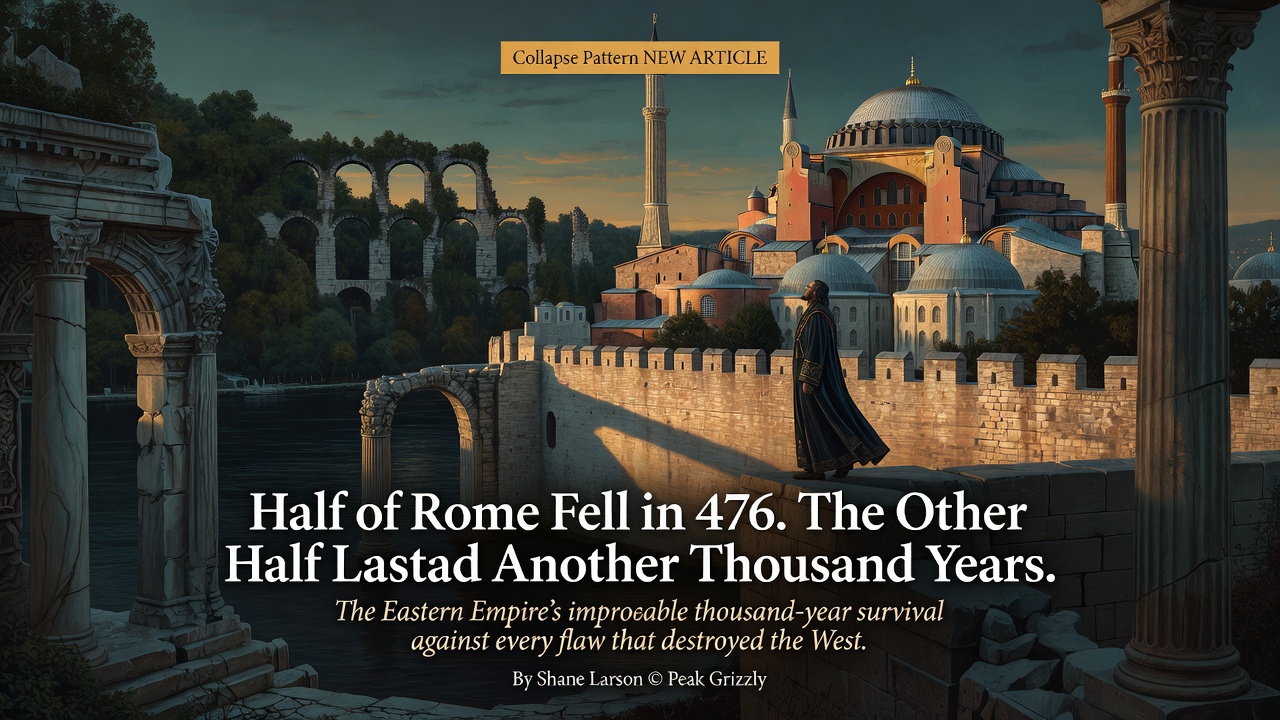
Half of Rome Fell in 476. The Other Half Lasted Another Thousand Years.
August 5, 2026 · 6 min read
In 476 AD the Western Roman Empire ended. A Germanic commander deposed a teenage emperor, and nobody replaced him. The roads decayed, the aqueducts stopped, and Western Europe fragmented for centuries.
Meanwhile, in Constantinople, the Eastern Roman Empire carried on. Not limping — functioning. Collecting taxes, fighting wars, codifying law, projecting power across the Mediterranean, for another thousand years.
The scale of that is easy to skim past. When the West fell, the Eastern Empire went on to survive for longer than the entire Roman Empire had existed up to that point. Its people never called themselves Byzantines; they called themselves Romans, right up until Constantinople fell to the Ottomans in 1453.
Which makes Byzantium the most useful case in the study of imperial collapse — not because it escaped, but because it postponed. If the structural flaws that kill empires are genuinely structural, how did one empire hold them off for ten centuries?
What Actually Kills Empires
Start with what the flaws are, because the popular answer — barbarians, decadence, moral decline — is mostly wrong.
Overextension. An empire expands until the cost of holding the frontier exceeds what the frontier produces. This point arrives quietly. The last provinces conquered are usually the poorest and hardest to defend, which is precisely why nobody had taken them earlier.
Extraction outrunning production. Maintaining the military and the administration requires revenue, and revenue comes from the provinces. When the take rises faster than the productive base, you get flight, evasion, and the abandonment of land — which lowers the base further and raises the required rate again.
Elite capture. Over time the people who benefit from the imperial system acquire enough power to exempt themselves from paying for it. Late Roman senatorial estates were substantially untaxable. The burden shifts onto those who cannot escape it, which is also the group whose loyalty the empire most needs.
Succession failure. Almost no empire ever solved this. Hereditary succession produces incompetents. Merit-based succession produces civil wars. Rome oscillated between both and got the worst of each — the third century alone burned through emperors at a rate that made long-term policy impossible.
Loss of legitimacy. Empires run on the belief, in the provinces, that being ruled is preferable to the alternative. That belief is cheap to maintain and expensive to rebuild. When it goes, the frontier does not need to be breached; it simply stops being defended by the people living on it.
Note what is absent: external enemies. Rome's opponents in 400 were not stronger than the ones it had crushed in 100. Something inside had changed.
What Byzantium Did Differently
Constantinople faced all five and blunted each of them, and the specific mechanisms are the interesting part.
It gave up territory deliberately. This is the big one. Byzantium repeatedly abandoned provinces it could not profitably hold, and treated the contraction as strategy rather than humiliation. Under Heraclius, after catastrophic losses to the Persians and then the Arabs, the empire reorganised around a defensible core in Anatolia and let the rest go. Empires almost never do this. The political cost of losing territory is immediate and the benefit is a solvency that shows up years later, which is exactly the trade every ruling class refuses.
It tied military service to land. The theme system settled soldiers on plots they farmed and would personally lose if the frontier failed. This solved two problems simultaneously: the army cost far less in cash, and the men defending a region had a direct stake in it. Compare the late Western practice of hiring federate troops whose loyalty ran to whoever paid last.
The Empire Collapse Pattern
It kept a functioning tax administration. Byzantium maintained a professional civil service, a literate bureaucracy, and a stable gold coinage — the solidus held its weight for centuries, which is a remarkable statement about fiscal discipline. Where Rome had let collection devolve onto local elites who captured it, Constantinople kept the machinery central.
It treated diplomacy as the primary instrument. Byzantine statecraft became a byword for intrigue because paying one enemy to attack another was standard practice, and vastly cheaper than campaigning. The empire bought off, married into, converted, and played its neighbours against each other for centuries. It is not romantic. It worked.
It had an ideology that survived defeat. Orthodox Christianity fused with imperial identity gave Byzantium a story about itself that a lost battle could not falsify. Legitimacy did not have to be re-earned every generation by conquest.
The reason this matters is that none of it is exotic. Contract the perimeter, align the defenders' interests with the thing defended, keep the fiscal machinery honest, substitute diplomacy for force, and maintain a source of legitimacy independent of momentum.
And It Fell Anyway
The end came, and how it came is as instructive as the survival.
The decisive blow was not Ottoman. It was 1204, when the Fourth Crusade — a Western Christian army — sacked Constantinople, installed a Latin regime, and carried the wealth of the city back to Venice and elsewhere. The empire was restored in 1261 but never recovered its revenue base, its fleet, or its position. It spent its final two centuries as a small state around a great city, granting trade concessions to Italian republics that captured its commerce.
By 1453 the walls that had held for a thousand years faced artillery, and the defenders numbered in the thousands against an army many times larger.
The lesson is not that Byzantium failed. It is that every adaptation buys time rather than exemption, and a long enough run of good decisions can still be ended by one catastrophic external event arriving when the margin is gone.
The Reform Paradox
Which raises the question that hangs over the whole subject: if the flaws are this predictable and this visible, why does nobody fix them?
Because the reforms that would save an empire require dismantling the arrangements that make it an empire, and each of those arrangements has a constituency that will fight to keep it.
Tax the elite properly and you are opposed by the people who control the process by which taxes are changed. Contract the frontier and you are the leader who lost the provinces — a charge that has ended careers and lives. Fix succession and you are asking the current ruling family to give up its claim. Reduce the military and you antagonise the one institution capable of removing you.
The Gracchi tried land reform in Rome and were killed. Diocletian's price controls collapsed within years. Ottoman modernisation ran for a century against the Janissaries, who twice deposed sultans over it. Gorbachev's reforms were substantively correct about what was wrong with the Soviet system and accelerated its dissolution, because a system held together by the appearance of inevitability cannot survive being publicly diagnosed.
That last case is the sharpest. The Soviet Union fell in 1991 with its military intact and no invasion. It failed on extraction outrunning production, elite exemption, and a collapse of belief — the classic three, run on a twentieth-century timetable.
So the honest conclusion is uncomfortable. The problems are legible well in advance. The solutions are known. And the political systems that would have to implement them are constructed, specifically, out of the people who would lose.
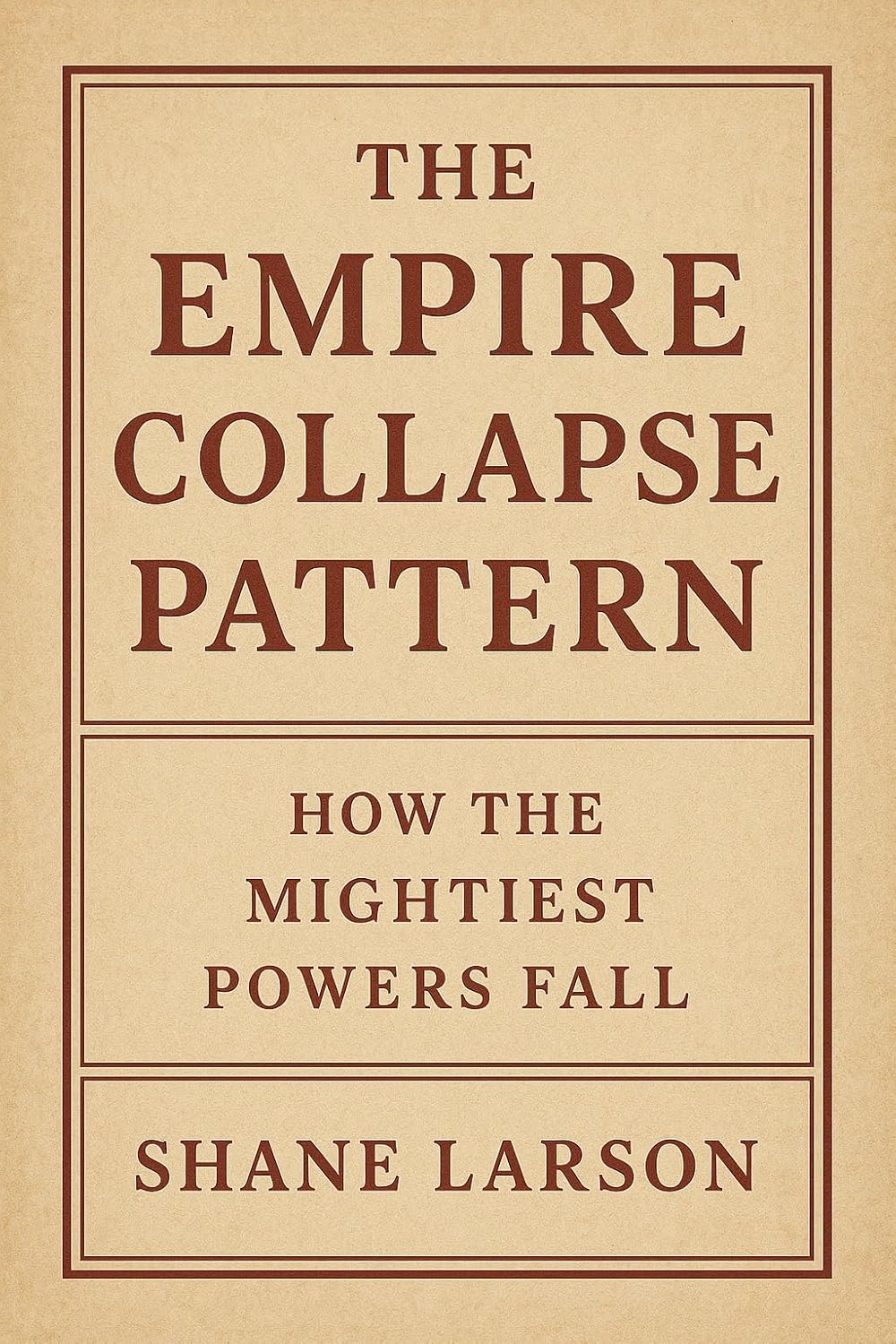
The Empire Collapse Pattern: How the Mightiest Powers Fall works through Rome, Byzantium, the Mongols, the Ottomans, Spain, Britain and the Soviet Union — the five fatal flaws, the ten warning signs, and why reform almost never arrives in time.
The Empire Collapse Pattern
New posts and releases, straight to your inbox. No spam, unsubscribe anytime.