The Reason Almost Nothing Survives Is That Survival Doesn't Pay
August 5, 2026 · 6 min read
The average lifespan of a company on the S&P 500 has fallen from about sixty-one years in 1958 to under twenty today. Most businesses that have ever existed lasted less than a decade. Even among large, professionally managed, diversified corporations, reaching a century is exceptional.
So an organisation that runs for five hundred years is not a better version of a normal company. It is a different category of thing, and worth explaining.
Kongō Gumi, a Japanese construction firm specialising in Buddhist temples, was founded in 578 AD and operated continuously for more than fourteen hundred years. It outlasted the Tang dynasty, the samurai, and the Second World War.
Nintendo was founded in 1889 to make handmade playing cards. Before it made video games it tried taxis, instant rice, love hotels, and a toy business. Its identity was not a product. It was a company that made things people play with, which turns out to survive technology shifts that a company defined by its product cannot.
The interesting question is not what these organisations did right. It is why almost nobody copies them, given that the principles have been published for decades.
The answer is that resilience has a price, it is charged continuously, and the thing you are buying is invisible until the year you need it.
What Long Survival Actually Requires
Slack. Reserves of cash, capacity, inventory, and people that are not doing anything right now. This is what allows a system to absorb a shock without breaking, and it is the first thing every efficiency programme removes, correctly identifying it as unused. A supply chain optimised to eliminate buffer stock is cheaper every quarter and fails completely the first time a supplier is late. The buffer was not waste. It was the mechanism.
Redundancy. Two suppliers when one is cheaper. Two people who understand the critical system. A second facility. Every duplicated function is money spent on a capability you already have, and it is indefensible in a spreadsheet until the primary fails.
Identity above product. Kongō Gumi built temples for fourteen centuries because it defined itself by a craft rather than by a market. Nintendo has survived by defining itself as a play company rather than a card company, a toy company, or a console company. The organisations that die pinned to a product are the ones that could describe themselves precisely.
Ownership structures that permit patience. The great majority of century-plus organisations are family-held, foundation-owned, mutual, or otherwise insulated from quarterly capital markets. This is not incidental. The behaviours that produce longevity look like underperformance on any short measurement window, and a structure that must justify itself every ninety days cannot sustain them.
Deliberate contraction. Byzantium survived a thousand years partly by abandoning provinces it could not hold. Microsoft's recovery from its lost decade required conceding markets it had spent enormous sums trying to win — mobile, search-as-primary, the phone platform — and rebuilding around cloud infrastructure. Giving something up while it still generates revenue is the rarest organisational act there is.
Why the Bill Is So Hard to Pay
Resilience is insurance, with the same accounting asymmetry, and that asymmetry explains nearly everything.
The cost is visible daily, itemised, and attributable to a named decision-maker. The benefit is invisible, arrives at unknown intervals, and is measured by things that did not happen. Nobody has ever received credit for a crisis they prevented, because the counterfactual is not observable.
Collapse Proof
Worse, the two firms are indistinguishable during good times except in one respect: the resilient one has lower returns. It carries more inventory, more cash, more staff, more duplication. Quarter after quarter it is outperformed, visibly, by competitors doing the obvious thing. Capital flows to the leaner one. Executives are compensated on measures the leaner one wins. Consultants are hired to explain why margins trail the industry.
So the market actively selects against the trait, for years at a time, until a shock arrives — at which point the fragile firms fail and everyone writes about how obvious it was.
This is the entire explanation for why the principles do not spread. It is not ignorance. Every executive can recite them. It is that adopting them means accepting a permanent, measurable performance penalty in exchange for a benefit that may not materialise during your tenure, and may not be attributable to you if it does.
The Costs Nobody Mentions
Beyond the financial, resilience imposes three things that are genuinely unpleasant.
Slower growth. Capital held in reserve is capital not deployed. A resilient organisation grows more slowly than a leveraged one in every expansionary period, which is most periods. It wins only over intervals long enough to include a disaster, and most careers are shorter than that.
Foregone opportunity. Resilience means declining things — the acquisition that would work if nothing goes wrong, the expansion that requires the good case. Every one of those refusals is a real cost, and some of them would have paid off spectacularly.
Cultural friction. Organisations that maintain redundancy have to defend it constantly against intelligent people making correct-sounding arguments about waste. The pressure never stops, and each individual argument for trimming is usually right in isolation. Holding the line requires someone senior repeatedly saying no for reasons that will not be validated for years.
Note that even Kongō Gumi eventually went. After fourteen hundred years, the firm took on substantial debt during Japan's asset bubble, expanded into real estate, and was absorbed by a larger construction group in 2006. It survived a millennium and a half of war, famine, and political upheaval, then failed the way ordinary modern companies fail — by borrowing to chase a growth market outside its craft.
Which is the sharpest lesson available. Resilience is not a state you attain. It is a set of behaviours you have to keep choosing, and abandoning them for one profitable decade is sufficient.
What This Is Worth
The honest version is not inspiring, and that is why it is worth saying.
The survivors are not smarter. Their advantage is structural — ownership that permits patience, an identity broader than any product, and a willingness to hold resources that look idle. Every one of those is available to any organisation and refused by most, for reasons that are individually rational at every decision point.
If you want to build something that lasts, the practical question is not which principles to adopt. It is whether you can construct a situation — ownership, governance, measurement, incentives — in which paying for resilience is not career suicide for the person who has to authorise it.
Almost nobody can. That is why almost nothing survives.
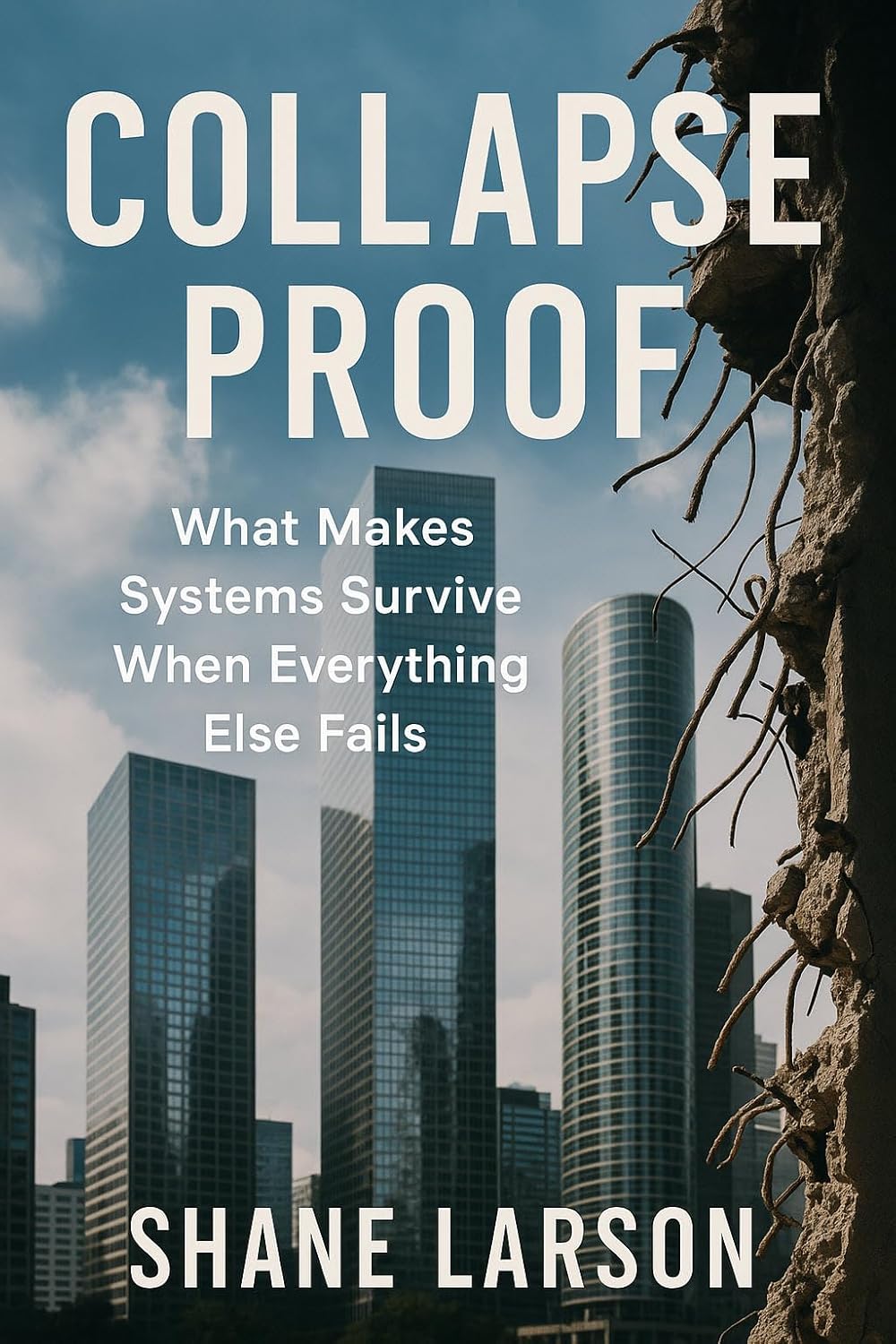
Collapse Proof: What Makes Systems Survive When Everything Else Falls is the final book in the Collapse Pattern series — the civilizations, companies, technologies and institutions that endured, the ten principles they share, and the reasons most systems cannot adopt them.
Collapse Proof
New posts and releases, straight to your inbox. No spam, unsubscribe anytime.