The Most Famous Collapse Story Might Be Wrong
August 19, 2026 · 7 min read
You already know the story, even if you've never read a word about the South Pacific.
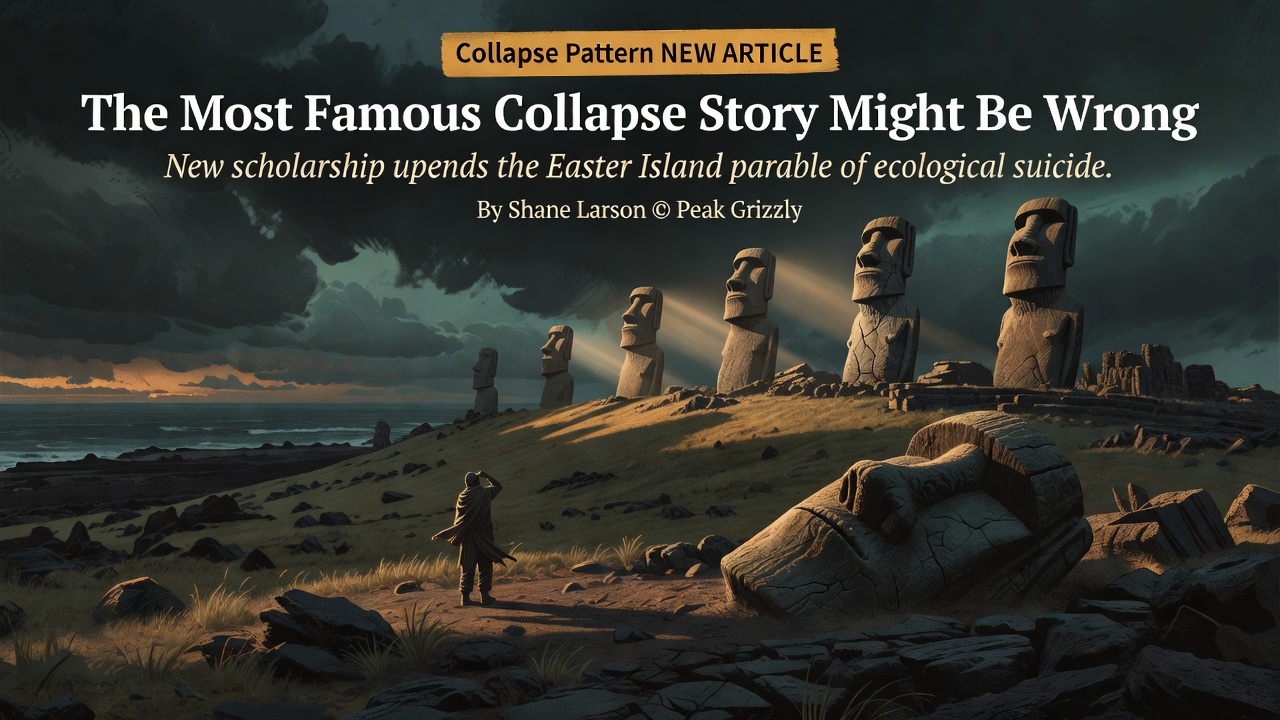
A remote island. A people so obsessed with carving and hauling giant stone heads that they cut down every last tree to do it. No more wood meant no more canoes, no more fishing, no more soil holding the hills together. The society tore itself apart in famine and war, and when Europeans arrived they found a ruined civilization sitting among the silent statues it had died building.
It is the perfect parable. It has a moral you can deliver in one sentence: this is what happens to a people too foolish to see they're destroying their own foundation. It has appeared in bestselling books, documentaries, and roughly a million conference slides. It has become the go-to shorthand for humanity's environmental future — a whole species standing on its own Easter Island, chainsaw in hand.
There's just one problem. The researchers who actually dig on the island have spent the last twenty years arguing that large parts of this story are wrong.
I want to walk through what they've found, because it's genuinely fascinating on its own terms. But I also want to make a sharper point by the end — one that has nothing to do with statues and everything to do with how we reason about the future. When our single most famous example of "civilizations destroy themselves" turns out to be the one the experts can't agree on, we should be a lot more careful about the confident lessons we draw from it.
How a Fable Gets Built
The classic version of the Easter Island collapse — call it the ecocide model — has a clean narrative shape. Polynesians arrive on a forested island. The population booms. Statue-building becomes a competitive obsession between clans. Forests fall to move the moai and to feed a growing population. Deforestation strips the topsoil, wrecks the food supply, and the society crashes into starvation and violence long before any outsider shows up. Self-inflicted, start to finish.
You can see why it caught on. It's teachable. It's dramatic. It flatters our sense that we're smarter than the poor fools who did this to themselves. And it slots perfectly into a certain kind of environmental sermon, where Easter Island becomes a scale model of planet Earth.
But a good story and a proven one are not the same thing, and the ecocide model was always doing a lot of work with a little evidence. When you press on the specifics, several of its load-bearing claims wobble.
Start with the trees. Nobody disputes that Rapa Nui was once forested with a now-extinct giant palm and that the forest is gone. The question is why. The ecocide model puts axes and statue-hauling at the center. But archaeologists Terry Hunt and Carl Lipo pointed to a quieter culprit: the Polynesian rat, which arrived with the first settlers and has no predators on a remote island. Rats eat palm seeds. In gnawed palm-nut shells across the island, you can read the evidence that the seeds were being destroyed faster than the forest could regenerate. The islanders certainly cleared land too — but a forest that can't reseed is doomed regardless of how many trees anyone deliberately cuts.
Then there's the supposed population crash. The ecocide model needs a large population that overshoots and collapses before European contact in 1722. But estimates of the island's peak population vary wildly, and some researchers argue there's little hard evidence for a dramatic pre-contact die-off at all. The islanders, on this reading, weren't blindly starving. They were adapting to a hard, deforesting island — building rock gardens called manavai to shelter crops, using lithic mulch to hold moisture and nutrients in poor soil. That's not the behavior of a society sleepwalking off a cliff. It's the behavior of people managing a genuinely difficult place, and doing it for centuries.
So when did the catastrophe happen? Here the revisionist account is at its most damning. The sharpest, best-documented population collapse on Rapa Nui lines up not with statue-building but with the arrival of outsiders: European diseases the islanders had no immunity to, and — devastatingly — the Peruvian slave raids of the 1860s, which abducted a large fraction of the population, including much of its leadership and cultural memory. On this timeline, Rapa Nui didn't commit ecological suicide. It was a functioning society, adapted to a diminished environment, that was then hit by external catastrophe.
The Ecological Collapse Pattern
What the Honest Answer Actually Is
Here's where I have to be careful, because the revisionist story is seductive in its own way — the twist ending, the villagers vindicated, the smug parable overturned. It would be just as lazy to swap one tidy narrative for another.
The honest answer is that this is contested. Serious scholars still defend versions of the ecocide model. The counter-revisionists argue the rat's role is overstated, that deforestation was more human-driven and more consequential than Hunt and Lipo allow, and that "adaptation" can coexist with real population decline. The evidence — pollen cores, radiocarbon dates, obsidian tools, skeletal remains — is fragmentary and genuinely open to more than one reading. Nobody has a time machine.
What you can say with confidence is this: the popular version, the one in the slide deck, is far more certain than the science underneath it. The parable has hardened into fact in the public mind while the actual specialists are still arguing about first-order questions like when the population fell and what killed the forest.
That gap — between public certainty and scholarly doubt — is the thing worth paying attention to. Because it's not unique to Easter Island. It's how a lot of our "settled" collapse stories work. A dramatic narrative gets locked in early, becomes useful for making a broader point, and then keeps getting repeated long after the people closest to the evidence have moved on to a messier, more interesting picture.
(If you want the deeper dive into how Rapa Nui's environment actually worked — the rock gardens, the palm forest, the rat — I've collected further reading and sources over at shanelarson.com, including how this case connects to the rest of the collapse research.)
Why Getting This Wrong Is Expensive
You might reasonably ask: so what? If Easter Island still teaches us to respect ecological limits, does it matter whether the details are exactly right?
It matters a great deal, for a simple reason. When you treat a contested case as settled, you draw confident lessons from a situation you don't actually understand — and then you apply those lessons somewhere they don't fit.
The ecocide parable teaches a specific and, I'd argue, misleading lesson: that collapse is fundamentally about stupidity. About a people too blind to notice they were killing themselves. It flatters us. It implies that as long as we're smart enough to see the problem, we'll be fine.
But the revisionist Rapa Nui teaches something far more useful and far more uncomfortable. It suggests a society can be reasonably adaptive, reasonably intelligent about a hard environment — and still be brought down, not by its own foolishness, but by a shock it never saw coming and had no defense against. Disease. Slavers. Forces from outside the frame.
That reframing changes the whole diagnosis. If collapse is about stupidity, the cure is awareness. If collapse is about brittleness — about how much shock-absorbing capacity a system has left when the shock arrives — then awareness alone won't save you. You need slack. Redundancy. Reserves. Room to absorb a blow.
This is the pattern I keep finding everywhere I look at collapse, ecological or otherwise: the trigger is never really the cause. Droughts hit resilient societies and they survive. The same drought hits a society that has already spent down its ecological reserves, and it falls. The trigger doesn't create the weakness. It just finds it, and sends the invoice. Collapse is compound interest on ignored feedback, and the ledger stays open until the trigger arrives.
Read that way, Easter Island — whatever actually happened there — stops being a story about idiots with axes and becomes a question you can ask about any system, including your own: how much reserve do you have left before the next shock lands? And the honest answer, the one the specialists model instead of the parable we all memorized, is the only one worth building a future on.
That's the whole reason I don't let a great story off the hook just because it's memorable. The memorable version of Easter Island might make you feel wise. The contested, uncertain, argued-over version might actually make you safer.
The Ecological Collapse Pattern: How Civilizations Destroy Their Own Foundations is available now on Amazon Kindle.
The Ecological Collapse Pattern
New posts and releases, straight to your inbox. No spam, unsubscribe anytime.