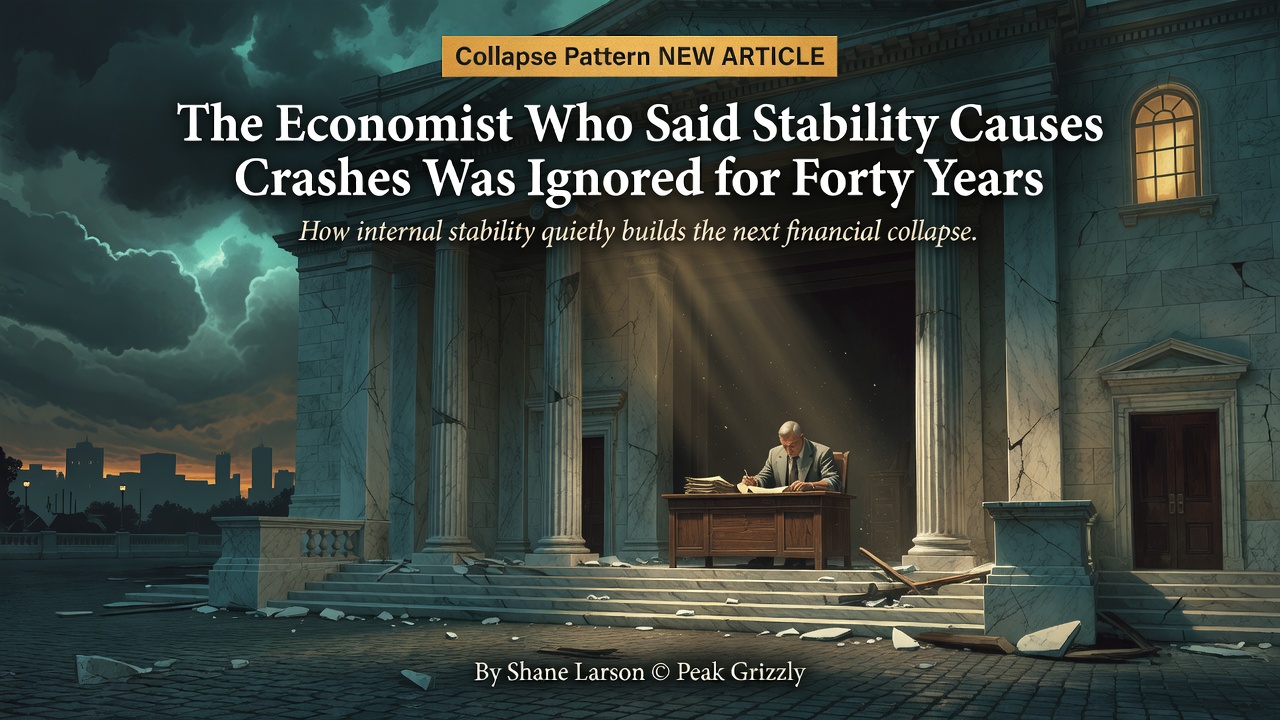
The Economist Who Said Stability Causes Crashes Was Ignored for Forty Years
August 5, 2026 · 6 min read
Hyman Minsky died in 1986 in relative obscurity.
He had spent decades at Washington University in St. Louis publishing work his colleagues largely ignored. Mainstream economics at the time treated financial crises as external shocks — asteroids striking an otherwise sound economy. Bad luck, bad policy, a war, an oil embargo. Something from outside.
Minsky said the opposite. The instability is generated internally, and it grows during good times, because things are going well.
In 2008, everyone remembered him at once. "Minsky moment" entered the vocabulary within weeks. Economists who had spent careers not citing him began citing him in every other paper. Which was useful, in the way that reading the manual after the fire is useful.
Why Good Times Are the Problem
The mechanism is unglamorous, which is part of why it kept getting overlooked.
When an economy has been stable for a long stretch, being cautious stops paying. The firm that borrows conservatively is out-earned by the firm that borrows aggressively — every quarter, visibly, in front of its investors. Nothing bad has happened in years, so the risk premium built into conservative behaviour looks like money left on the table.
So leverage rises. Not because anyone is reckless, but because caution has become expensive and its benefits are invisible. Lending standards loosen for the same reason: the loans that would have been refused five years ago have all been performing, so the underwriting model updates on the evidence and refuses fewer of them.
Minsky described the resulting progression in three steps. Hedge finance, where borrowers can service both interest and principal from income. Speculative finance, where income covers interest but the principal must be rolled over. Ponzi finance, where income covers neither, and the whole position depends on the asset appreciating.
An economy does not choose to move down that ladder. It drifts, because each rung is only slightly more aggressive than the last and the last one kept working. And at the bottom, the system requires prices to keep rising in order to remain solvent — which means any pause becomes a decline, and any decline becomes a collapse.
Stability produces the behaviour that ends stability. That is the whole thesis, and forty years of professional economics could not find room for it.
The Five Stages
Combine Minsky with Charles Kindleberger's historical work and you get a stage map that fits an unreasonable number of cases across four centuries.
Displacement. Something genuinely new arrives and changes what is possible — a technology, a market opening, a shift in interest rates. This is real. Bubbles almost always start with something true.
Boom. Prices rise on the strength of the real thing. Credit expands to fund participation. Early entrants make money for entirely defensible reasons.
Euphoria. The valuation detaches from the underlying asset and attaches to the expectation of resale. New buyers arrive who cannot explain the asset but can see the chart. This is the stage that produces the famous phrase in each era — this time is different, a permanently high plateau, new economy metrics, number go up. Anyone pointing at fundamentals is out of touch and, more damningly, has been wrong for two years running.
Profit-taking. The people who understand the asset best begin quietly selling. Insider distribution rises. The price often keeps climbing, because retail buying more than absorbs it — which is why "smart money is selling" never works as a public warning.
Economic Collapse Pattern
Panic. Something small breaks the assumption that a buyer will always be there. Then the leverage runs in reverse: margin calls force sales, sales lower prices, lower prices trigger more margin calls. The descent is faster than the climb every time, because the climb was optional and the descent is not.
Tulip contracts in 1637. The South Sea Company in 1720. American equities in 1929. Japanese real estate in 1989. Thai baht in 1997. Dot-com stocks in 2000. American housing in 2007. Cryptocurrency exchanges in 2022. Different assets, different centuries, different regulatory regimes, same sequence.
Regulation Arrives Late and Leaves Early
The other half of the pattern is institutional, and it runs on a clock you can almost set.
In 1933, Congress passed the Glass-Steagall Act, separating commercial banking from investment banking in direct response to the bank failures of the early Depression. It worked. For sixty-six years the American banking system had no systemic collapse.
In 1999, Congress repealed it. Nine years later the banking system failed in substantially the way Glass-Steagall had been written to prevent.
That arc — crisis, reform, stability, complacency, deregulation, crisis — is the actual cycle, and each step has a constituency that makes it nearly inevitable.
Reform passes because a crisis has just made the costs vivid and the industry's political capital is temporarily spent. Then stability arrives, and the rules begin to look like pure friction: they impose visible costs every year and prevent a disaster that, by definition, does not happen. There is no line item for the crisis that did not occur.
Meanwhile the people regulated by the rules are permanently, professionally motivated to change them, while the public that benefits is diffuse and busy. Twenty years of that asymmetry has a predictable result.
And underneath it, financial innovation moves faster than rulemaking by construction. Regulation describes instruments that exist. New instruments are designed by people who have read the regulation, and quite often designed specifically to sit outside its definitions — which is not usually fraud. It is a structuring exercise, done by lawyers, in the open.
So regulation is always fighting the previous crisis with rules that are being lobbied against from the day they pass.
What This Buys You
Not prediction. The pattern tells you what stage you are in; it tells you nothing about timing, and the euphoria stage has historically run for years after becoming obvious. Being early is financially indistinguishable from being wrong.
What it buys is a diagnostic. Leverage rising while lending standards loosen. Valuations justified by expected resale rather than expected income. A new class of buyer who cannot describe the asset. Insiders distributing into retail demand. And, reliably, an argument for why the historical measures no longer apply to this case.
The last one is the most consistent signal in four hundred years of financial history. Every bubble produces a genuinely sophisticated case for why comparison to past bubbles is naive — and the argument is usually made by intelligent people, with real evidence, about a real innovation.
That is what makes the pattern hold. It is not that people are foolish. It is that at the top of every cycle, the sceptics have been demonstrably wrong for several years running, and the evidence supports the optimists right up until the week it doesn't.
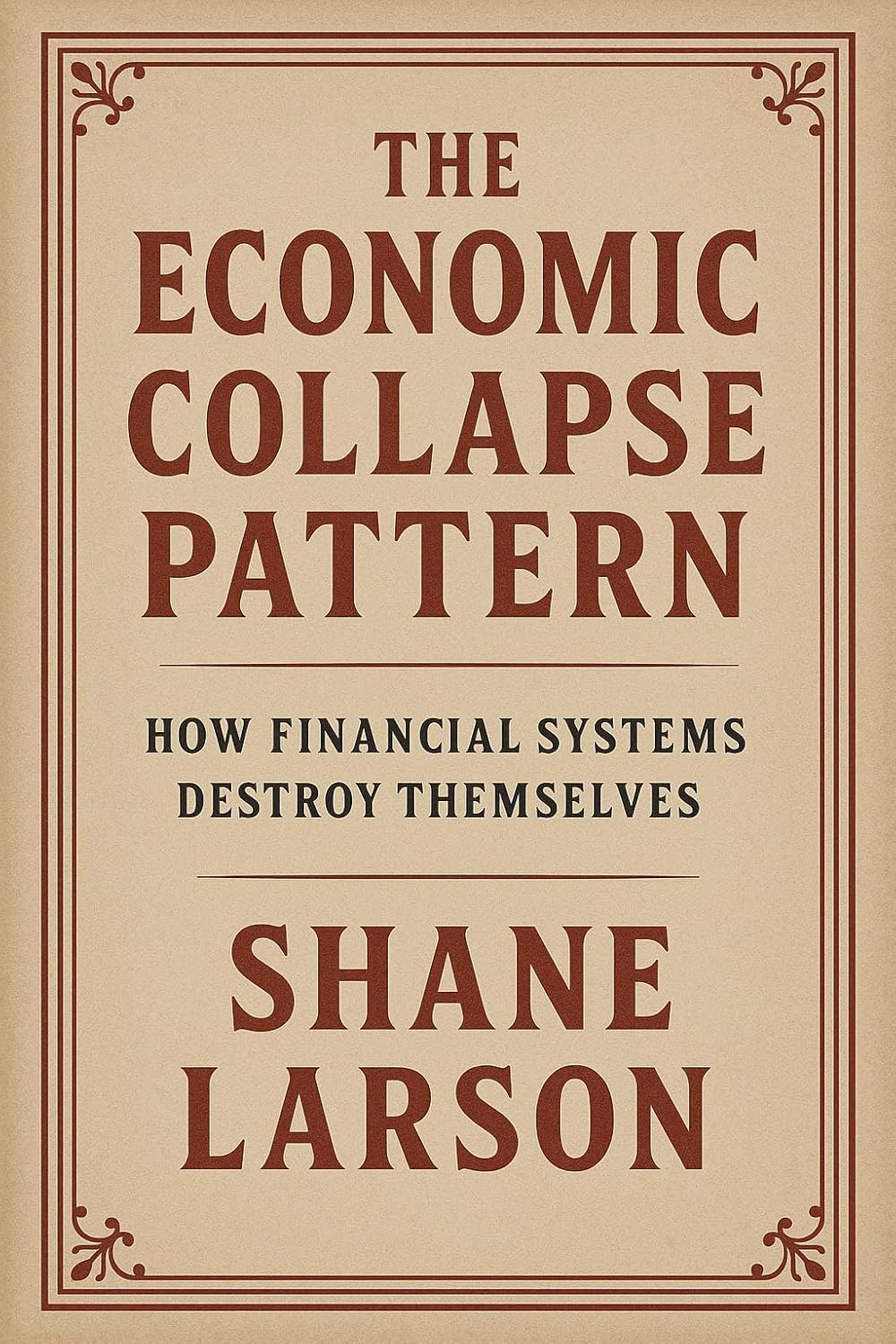
The Economic Collapse Pattern: How Financial Systems Destroy Themselves runs the full sequence — tulips, the South Sea Company, 1929, hyperinflation, the S&L crisis, Asia in 1997, dot-com, 2008, the crypto collapses, sovereign debt — and the twelve warning signs they share.
Economic Collapse Pattern
New posts and releases, straight to your inbox. No spam, unsubscribe anytime.