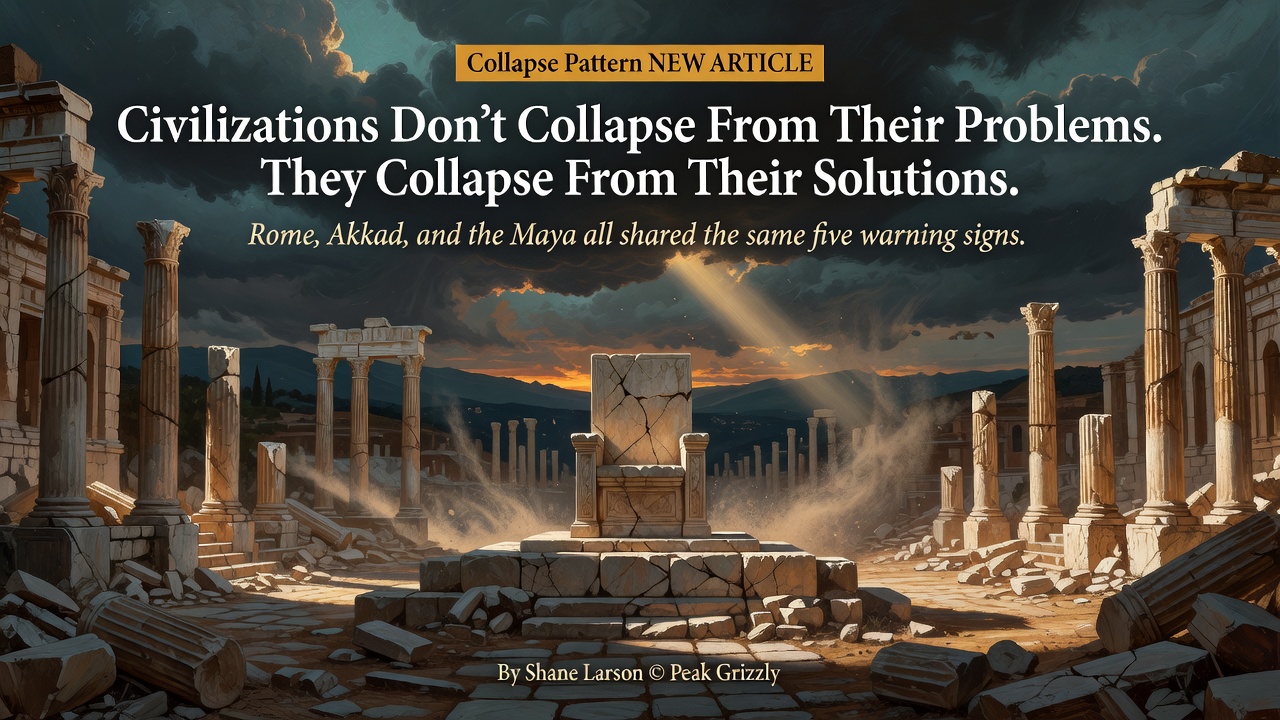
Civilizations Don't Collapse From Their Problems. They Collapse From Their Solutions.
August 5, 2026 · 6 min read
In 301 AD, the Emperor Diocletian tried to fix inflation by making it illegal.
The Edict on Maximum Prices set ceilings on more than a thousand goods and services — wheat, wool, haircuts, lion meat — and prescribed death for violators. It failed almost immediately. Goods vanished from markets rather than being sold below cost. Enforcement across an empire that size was impossible. Within a few years the law was quietly abandoned.
The interesting question is not why it failed. It is why the most powerful man in the world thought it was a reasonable idea.
The answer is that by 301, every simpler option had already been used. Rome had spent three centuries solving problems, and each solution had generated the conditions for the next problem. Diocletian was not being stupid. He was operating at the end of a very long chain of sensible decisions, at the point where the only remaining moves were bad ones.
That is the shape of collapse, and it recurs.
The Ratchet
The archaeologist Joseph Tainter set this out in The Collapse of Complex Societies in 1988, and it remains the most useful single idea in the field.
Societies invest in complexity because complexity works. A drought threatens the harvest, so you build irrigation. Irrigation supports a larger population, which needs administration, so you build a bureaucracy. The bureaucracy needs funding, so you elaborate taxation. A larger, richer territory attracts raiders, so you expand the army. Every step is a rational response to a real problem, and every step succeeds.
But the returns diminish. The first irrigation canal transforms agricultural output. The hundredth adds a marginal amount at considerable cost. The first layer of administration makes a kingdom governable. The fifth mostly manages the other four.
Eventually a society reaches the point where maintaining its existing complexity consumes nearly everything it produces, and further investment returns less than it costs. It has no slack. And it is at exactly that point — not before — that an ordinary shock arrives.
The shock is rarely the cause. A drought that a society could have absorbed in its second century destroys it in its fifth, because by then there is nothing left over. This is why collapse so often looks disproportionate to its trigger. The trigger is not what killed it. The trigger is what arrived after the margin was gone.
Nobody decides to make a society unsustainably complex. It accumulates, one reasonable decision at a time, and every individual decision is defensible right up to the end.
The Environment Always Votes
The second recurring factor is climate, and it is worth being careful about how it works, because the naive version — drought killed them — is almost always wrong.
The Akkadian Empire, the first empire in history, fell apart around 2200 BC, in close correspondence with an abrupt aridification event recorded in sediment cores across the Near East. The Akkadians themselves explained it theologically: The Curse of Akkad attributed the fall to divine punishment for an act of sacrilege. They knew something catastrophic had happened. They reached for the explanatory framework available to them.
The Late Bronze Age kingdoms went down around 1200 BC amid a decades-long drought registered in pollen records from the Levant, in a system so interdependent that the failure of a few nodes propagated everywhere.
The Maya lowland cities were abandoned across the ninth and tenth centuries during a sequence of severe multi-year droughts documented in lake sediments and speleothem records.
In none of these cases did climate act alone, and that is the point. Each of these societies had survived droughts before. What made these different is that the drought arrived when the political system was already rigid, the agricultural base already stressed, the elite already extracting at maximum rate. Environmental stress is a multiplier applied to existing fragility. Where there is slack, it is weather. Where there is none, it is history.
The Five Signs
Comparing Akkad, the Bronze Age kingdoms, Rome, the Maya, and the Ancestral Puebloans — societies separated by thousands of years and thousands of miles, with nothing in common structurally — the same five conditions keep appearing before things come apart.
The Collapse Pattern
Elite isolation from consequences. In every case, the people making decisions became progressively insulated from the results. Late Roman emperors ruled from fortified palaces through courtiers selected for agreeableness. Maya kings commissioned larger monuments as the agricultural base supporting the monuments eroded. Bronze Age palace scribes kept meticulous inventories of a trade network that was ceasing to exist. A decision-maker who does not experience the outcome of a bad decision has no mechanism for learning it was bad.
Short-term thinking. Costs deferred, maintenance skipped, capital consumed to meet this year's crisis. Rational under pressure, and each deferral makes the next year's pressure worse.
Unsustainable extraction. Taking more from the land, or the population, than can be replaced. Soil exhaustion, deforestation, tax rates that drive farmers off their land — the extraction rises precisely because the system is under strain, which accelerates the strain.
Loss of institutional knowledge. The people who understood how the system actually worked die, retire, or are purged, and the knowledge is not transmitted. What remains is people operating machinery they cannot repair. This shows up archaeologically as a sudden decline in the quality of construction, of record-keeping, of manufacture — the forms persist, the competence does not.
Cascading dependencies. Systems so interlocked that failure propagates. The Late Bronze Age is the extreme case: an economy where Cypriot copper, Afghan tin, Egyptian grain and Mycenaean shipping were all load-bearing for each other, so that disruption in a few places took down everything at once.
None of these predicts collapse. Societies show them and recover. But they recur with enough consistency across enough unrelated civilizations to be worth taking seriously as a diagnostic.
What Collapse Actually Looks Like
One correction worth making, because the popular image is wrong in a specific way.
Collapse is usually not an event. It is a process, generally spanning generations, and the people living through it mostly did not know that was what they were doing. Rome's decline ran centuries. The Maya cities emptied over a century and a half. What the archaeology shows is not a catastrophe layer but a gradual simplification — fewer imported goods, smaller buildings, shorter-range trade, less writing, then none.
And "collapse" in the technical sense means the loss of complexity, not the loss of people. The Maya did not disappear; millions of Maya people live in Mexico and Central America today. What ended was a particular political and economic order — the divine kingship, the monumental construction, the long-distance elite exchange. The cities were abandoned. The population dispersed into a simpler arrangement and continued.
For a great many ordinary people, that simplification was an improvement. Less extraction, less forced labour, less war. The collapse of a complex society is a catastrophe for the people who ran it and a mixed outcome for everyone underneath. That is not a comforting observation, but it is what the evidence supports, and it is missing from nearly every popular account.
Why It Matters Now
The obvious reading is that we are next, and the honest answer is that the pattern does not license that prediction. Every case in the record is a pre-industrial society, with a fraction of our energy availability, information flow, and agricultural yield. The analogy is not tight.
What survives the analogy is the mechanism. Complexity has a cost curve. Slack is what lets a system absorb a shock. And the five warning signs describe a state of institutional decay rather than a stage of a fixed cycle — which means they describe something a society can notice about itself and act on.
The societies that recovered did so by simplifying deliberately rather than waiting to be simplified. That is the only real lesson the pattern offers, and it is not a comfortable one, because deliberate simplification means someone gives something up while everything still appears to be working.
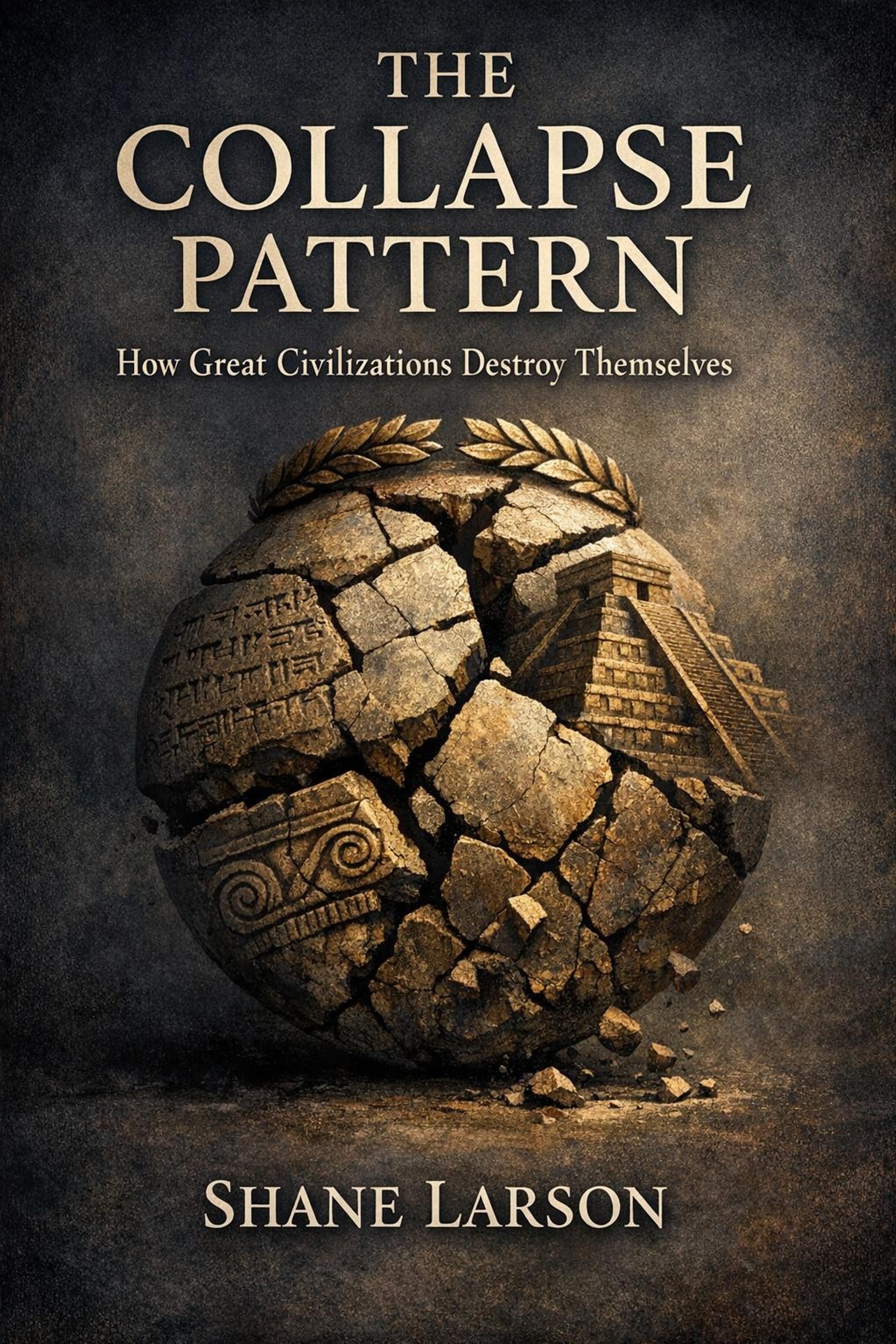
The Collapse Pattern: How Great Civilizations Destroy Themselves works through Akkad, the Bronze Age, Rome, the Maya, and the Ancestral Puebloans — what the archaeology actually shows, which societies survived, and what they did differently.
The Collapse Pattern
New posts and releases, straight to your inbox. No spam, unsubscribe anytime.