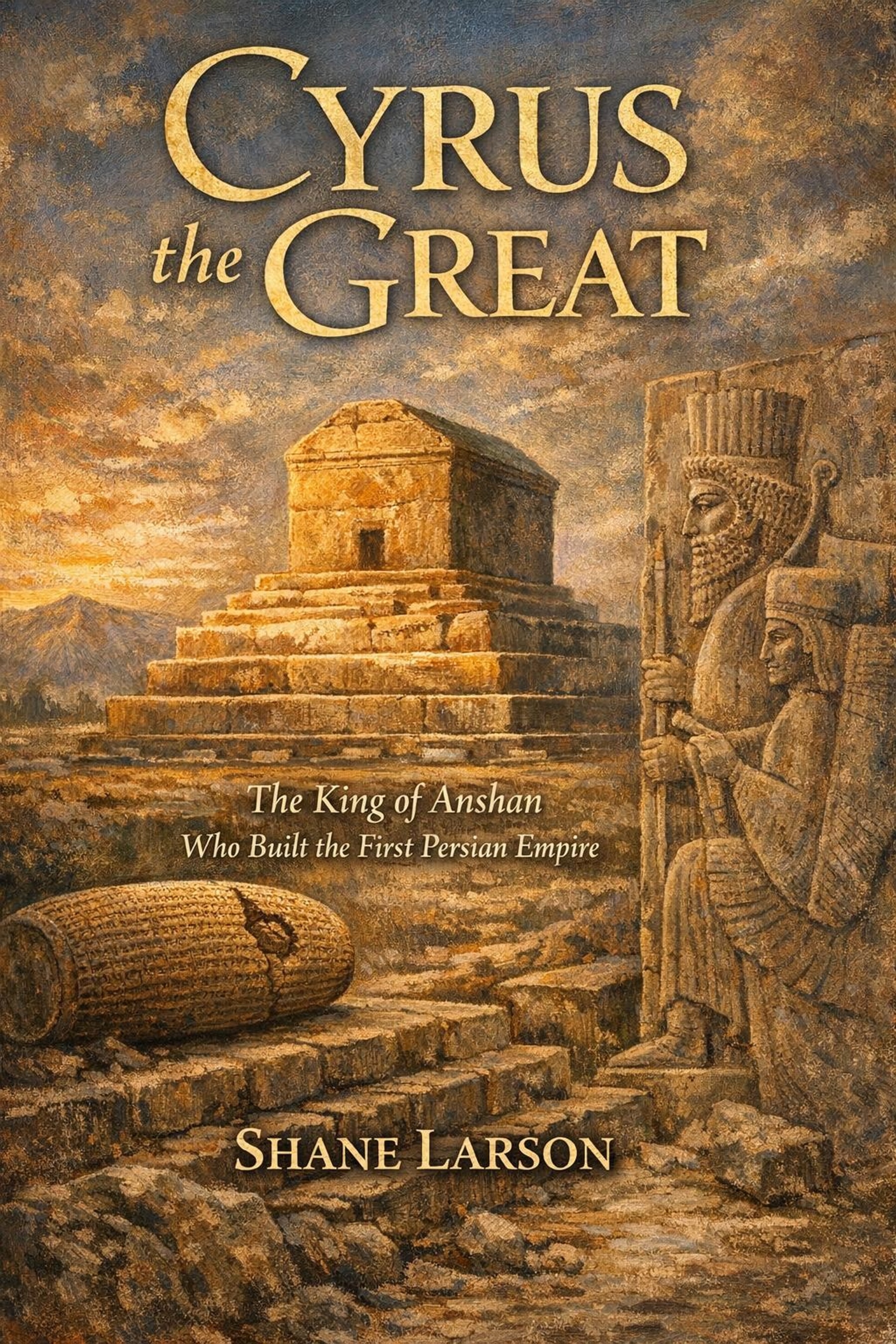
Cyrus the Great
The King of Anshan Who Built the First Persian Empire
By Shane Larson
About This Book
In the winter of 324 BC, Alexander of Macedon came back from India by way of Pasargadae and went to look at a tomb. It was a small stone house with a gabled roof, set on a stepped platform in what had been a royal garden. He had visited it six years earlier, when it still held a golden coffin, a couch, a table and robes in the Persian style. This time the door had been forced. The grave goods were gone, the coffin lid was missing, and the body had been tipped out on the floor.
Alexander, who had spent a decade destroying the Persian empire, was furious. He had the tomb's guardians questioned, and he gave one of his officers the job of putting everything back: the remains gathered, the coffin repaired, the doorway walled up and sealed with the royal mark.
The man in the tomb was Cyrus, who had founded that empire two centuries before. Alexander was neither the first conqueror nor the last to decide that Cyrus the Great was someone worth being associated with. The harder matter, and the subject of this book, is what kind of king had actually been lying there.
The Story
Cyrus began as the ruler of Anshan, a minor kingdom in the highlands of ancient Persia that answered to the Medes. Around 550 BC he overthrew his Median overlord, apparently with the help of the Median army itself. Within a few years he had beaten Croesus of Lydia, the richest king in the Greek imagination, and his generals were taking the Greek cities of the Aegean coast one siege at a time. He then disappears eastward for several years into campaigns that left almost no written trace. In 539 BC he came back for Babylon, the greatest city in the world, and his troops walked into it without a fight. He died in 530 BC somewhere on the northeastern frontier, and nobody in antiquity could agree how.
That is the outline, and nearly every line of it comes from someone with a use for him. Herodotus, a century later, tells a story about a royal baby ordered killed and raised in secret by a herdsman, a tale told about founders from Mesopotamia to Rome. Xenophon made Cyrus the hero of a long work on leadership that is, by any fair description, a novel. The priests of Babylon wrote that their own god had gone looking for a just king and picked the Persian. A Hebrew prophet called him the Lord's anointed. And Darius, who took the throne eight years after Cyrus died, may have attached the dead king to his own family tree.
Cyrus the Great: The King of Anshan Who Built the First Persian Empire reads these witnesses against each other. Where they agree, there is probably history. Where they part, the reasons they part are usually more revealing than either version. The Cyrus who comes out of that process is not the philosopher-king of later legend. He is a conqueror who kept what worked: the Median nobles, the Lydian treasury, the Babylonian scribes and temples. He let conquered elites go on being elites under him, and they repaid him with a reputation no other ancient conqueror enjoyed.
Why I Wrote This
Earlier I wrote a general history of the Persian empire, and Cyrus got one chapter in it. I repeated what most books say: that he ruled by tolerance, and that the Cylinder shows it. Then I read the Cylinder properly, with the older Assyrian and Babylonian inscriptions beside it, and found that nearly every phrase in it had been used before by kings nobody calls tolerant.
That did not make Cyrus less interesting to me. It made him more so. If the mild policy was not a philosophy, it was a choice, made repeatedly by a man with an army who could have done otherwise. I wanted to know why he made it, and why people who had every reason to resent him wrote so well of him. This book is my attempt at an answer, with the evidence shown and the guesswork labelled.
Frequently Asked Questions
Is the Cyrus Cylinder really the first declaration of human rights?
That depends on what is meant. The text records that Cyrus returned certain gods and peoples to named sanctuaries in Mesopotamia and eased burdens on the citizens of Babylon, and some scholars see in that a real precedent. It contains nothing about slavery, freedom of belief or individual rights, and it follows a traditional form for royal building inscriptions. The book presents both readings and the popular quotations that appear nowhere in the text.
Do I need to read The Persian Empire before this book?
No. This is a standalone biography that ends at Cyrus's death in 530 BC. The Persian Empire covers the two centuries that followed, so it works well as the next book, but neither depends on the other.
Is Xenophon's Cyropaedia a reliable source for the life of Cyrus?
Not as biography. Xenophon wrote it around 360 BC as a study of ideal leadership, and he changed the record freely to suit the lesson, including the manner of Cyrus's death. The book explains what it is, why it was so widely read, and why lines from it are often quoted as though Cyrus had said them.
Does the book cover Cyrus in the Bible?
Yes. One chapter is devoted to Isaiah, Ezra and Chronicles, and Daniel's account of Babylon's last night appears in the chapter on the city's fall. Scripture is quoted only from the King James Version, and scholarly and traditional views are both set out without the book choosing between them.
How long is the book?
About 77,000 words, 245 pages in print: fourteen chapters in four parts, an introduction and conclusion, and three reference appendices.
If You Liked This, You Might Like
- The Persian Empire — what Cambyses, Darius and Xerxes made of the realm Cyrus left them, told from the Persian side.
- Elam — the three-thousand-year-old kingdom whose highland capital gave Cyrus his first royal title.
- The Babylonian Exile — the Judean deportees whose descendants were living in Babylonia on the day Cyrus's army arrived.
- Alexander the Great — the Macedonian who ended the empire Cyrus began, and then repaired its founder's tomb.
A life pieced together from a storyteller, a novelist, a priesthood and a prophet will never be complete. It can be honest about its joins, and this one is.
What You'll Learn
- The Cylinder, read whole. The clay barrel from Babylon that has been called the first charter of human rights is a building inscription in a centuries-old Mesopotamian form. The book goes through it section by section, then sets out the modern claim and the scholarly replies to it, each in its strongest version.
- Anshan before Persia. Cyrus's own titles call him king of an old Elamite city, not king of Persia. A full chapter covers the mixed Elamite and Persian world he came from, which most biographies pass over in a page.
- A Median "empire" that may not have existed. The state Cyrus is supposed to have overthrown is known almost entirely from Herodotus. The book lays out the argument over how much of a state there was.
- Babylon, October 539 BC. The city fell without a siege, but a Babylonian chronicle records a battle and a slaughter at Opis shortly before. The chapter sets the chronicle beside Herodotus's diverted river and the feast in the book of Daniel.
- The eastern years, left undocumented. Roughly five years of campaigning toward Central Asia survive as a few place names. The book says so and shows how historians reason from the shape of the empire afterward.
- Isaiah, Ezra and the return. What the biblical texts say Cyrus did for the exiles of Judah, what the Persian-period evidence can confirm, and where traditional and critical readings differ.
- Pasargadae. The palaces, the stone water channels of the oldest known garden of its type, and an inscription calling Cyrus an Achaemenid that he may never have seen.
- Three deaths. Killed by a steppe queen who took his head, wounded in a different war entirely, or dying at home in bed after a speech to his sons.
- Three appendices. A table of what each source says on each episode, a structured paraphrase of the Cylinder with the common fake quotations identified, and a chronology with a who's who.
New Ancient History releases and free chapters — no spam, unsubscribe anytime.
More in This Genre
View all →