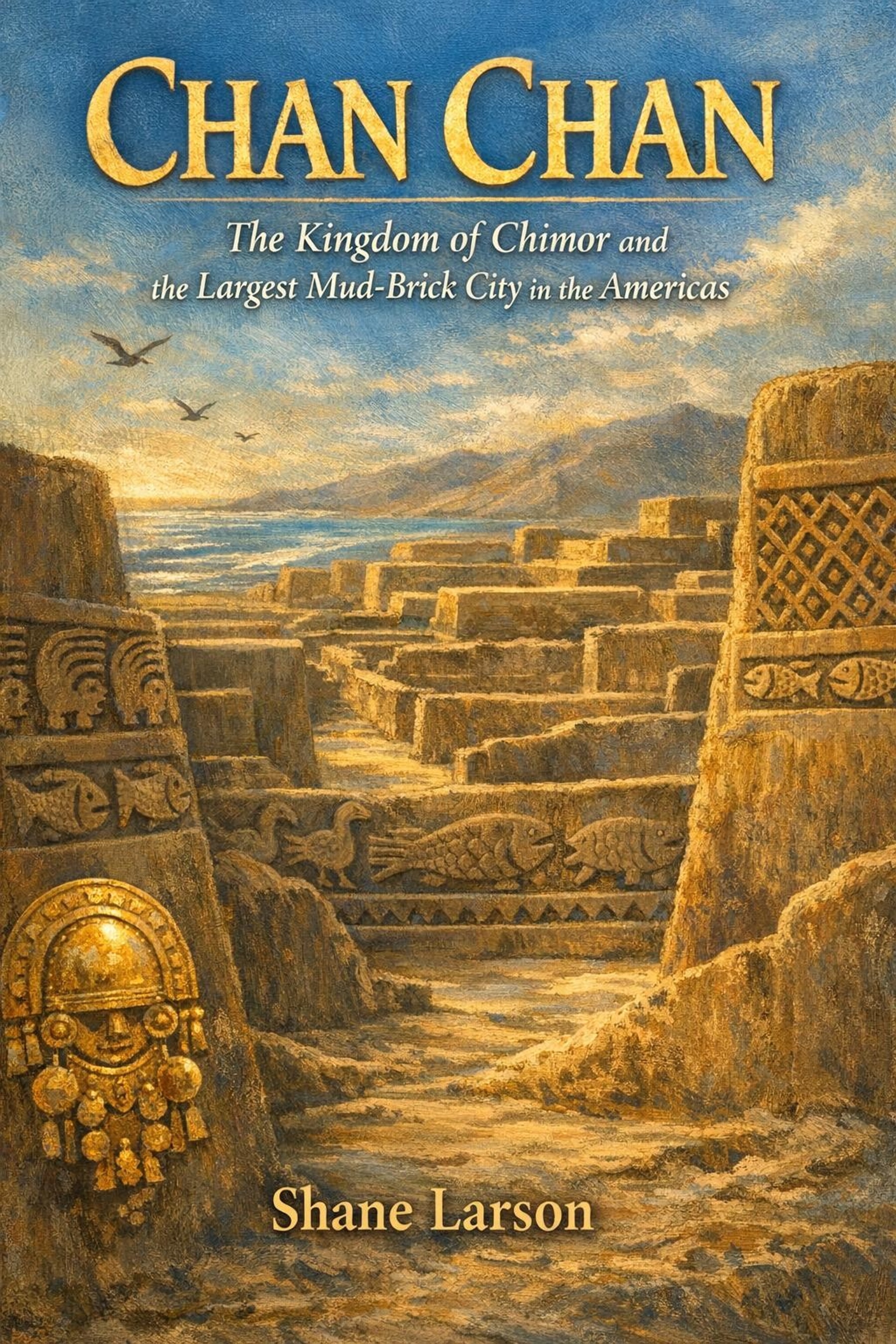
Chan Chan
The Kingdom of Chimor and the Largest Mud-Brick City in the Americas
By Shane Larson
About This Book
In the 1570s a Spanish colonist in Trujillo, on the north coast of Peru, registered a claim the way a prospector registers a silver vein. His deposit was a flat-topped mound of mud brick inside a ruined city four kilometres from town. He formed a company, put men to digging, and paid the Crown one-fifth of what came out. The gold was real. The mound was the burial platform of a king.
The ruined city was Chan Chan, and by then nobody in Trujillo could have said who had built it. The Inca governors the Spanish had overthrown forty years earlier had not built it either. They had conquered it, some sixty years before the first Spaniards landed in Peru, from a people called the Chimú, whose kingdom of Chimor once ran a thousand kilometres along the desert shore.
The Chimú left no writing. What they left is about twenty square kilometres of adobe, and the oddest city plan in the ancient Americas.
A capital that grew one dead king at a time
At the centre of Chan Chan are ten rectangular compounds, the largest covering more than twenty hectares. Each is shut in by walls up to nine metres high and entered through one door on the north side. Inside there are corridors that double back on themselves, courts lined with storerooms by the hundred, small three-sided offices placed where nobody could reach the stores without being seen, a well dug down to the water table, and, near the back, a platform full of burial cells.
Since a Harvard project mapped the city in the early 1970s, the leading explanation has been that each compound belonged to one king. He built it, ruled from it, and was buried in it, after which it stayed in the hands of his kin as the seat of his estate. His successor got the title and none of the property, and had to start again on the next plot. If that is right, the layout of the capital is a king-list in mud.
It may not be right. The compounds and the names in the one surviving list of rulers do not pair off neatly, the building order is still disputed, and some scholars read the plan as a record of paired rulers or of institutions instead. Chan Chan: The Kingdom of Chimor and the Largest Mud-Brick City in the Americas treats the idea as what it is, a strong hypothesis, and shows the evidence on both sides.
The story around the city is wider than the city. It begins in the wreckage of the Moche valley kingdoms around 800, takes in the gold-working lords of Lambayeque whom Chimor absorbed, follows the canals that made a desert farmable, and ends with the Inca conquest of about 1470, the colonial treasure companies, and a ruin that dissolves a little every time the rains come.
Why I Wrote This
I had written about the Inca roads and about what happened to the Andes after 1532, and both times Chimor turned up at the edge of the page as a place the Inca had beaten. That nagged at me. A state that held a thousand kilometres of coast and built a capital this size does not belong in a subordinate clause.
When I went looking for a book to read about it, I found monographs and conference volumes, most of them out of print, and nothing written for a general reader. So I wrote the one I wanted. The hard part was the silence. There is no Chimú voice anywhere in the record, and I decided early that I would not invent one. Everything here stands on a wall, a burial, a canal, a legend somebody else wrote down, or a tax receipt, and the text says which.
Frequently Asked Questions
Who built Chan Chan in Peru?
The Chimú, a north-coast people whose kingdom is usually called Chimor. They founded the city sometime between about 850 and 1000, a date still argued, and it was their capital until the Inca conquered them around 1470.
Is Chan Chan an Inca site?
No. It is older than the Inca empire and was built by the state the Inca defeated. The Inca ruled the coast for only about sixty years before the Spanish arrived, which is one reason the Chimú are so little known.
Is this a travel guide to Chan Chan and Trujillo?
It is a narrative history. An appendix walks through the one compound open to visitors and the main sites and museums of the north coast, with notes on what is original and what is restored, but it gives no prices, hours or transport details.
Does the book cover the child burials found at Huanchaquito?
Yes, in the final chapter, briefly and factually. It reports what the excavators found and published in 2019, what they think it meant, and what remains uncertain. There is no graphic description.
Do I need to know anything about the Andes or the Inca before reading it?
No. The book explains the geography, the earlier Moche kingdoms and the Inca as it goes.
How certain is the history in this book?
Less certain than a history of Rome, and the book says so throughout. Dates before about 1470 are archaeological estimates, the dynastic history rests on a few pages written in 1604, and the main theories about the city are still debated.
If You Liked This, You Might Like
- The Inca Highway — the empire that conquered Chimor and carried its goldsmiths off, seen through the road system that held it together.
- The Conquistadors' Smallpox War — what reached the Andes ahead of the Spanish, and why the coast Trujillo's colonists dug up was already half empty.
- The Khmer Empire — another state whose power was a water system, and whose capital was undone when the water stopped behaving.
- Chaco Canyon — a desert centre with no texts of its own, where the architecture is the only testimony and archaeologists still argue over what it was for.
A kingdom that never wrote a word about itself can still be read, slowly, from its walls, its water and its dead. This is that reading, with the doubts left in.
What You'll Learn
- Two founders on rafts. The north coast kept two dynastic legends, both written down by Spaniards long after the fact and both beginning with a lord who arrives by sea. The book sets Naymlap of Lambayeque beside Taycanamo of Chimor and asks what a legend like that can and cannot prove.
- Storerooms. A Chimú palace is mostly storage, guarded at every turning. The book works out what was probably kept there, including red thorny-oyster shell shipped down from the warm waters off Ecuador, and what kind of government that implies for a state with no script.
- The city outside the walls. Most residents lived in cramped, unplanned neighbourhoods and made things: metalwork, cloth, mould-pressed black pottery. Excavation suggests a capital of craftsmen with hardly a farmer in it.
- Seventy kilometres of canal that may never have worked. Engineers cut a channel from the next valley north to feed the fields above the capital. One camp says it was fine surveying defeated by a rising coastline; another says water never ran its full length. Both cases are laid out.
- El Niño as a standing threat. A flood around 1100 tore out the valley's irrigation, and the kingdom spent centuries building around the next one.
- The view from the losing side. The Inca conquest is told from Chimor's position: the mountain ally that fell first, the famous story about cut water supplies and why it should be handled with care, the king taken to Cusco.
- What the conquerors borrowed. Chimú smiths were resettled in the Inca capital, which is certain. Whether the Inca also learned statecraft from Chimor is an old argument, and the book gives it a fair hearing.
- Tombs worked as mines. Lawsuits and treasury accounts from colonial Trujillo show companies digging the royal platforms under licence, and a descendant of the Chimú kings arguing in a Spanish court that one of them was his ancestors' grave.
- A language with almost no words left. The speech of the Chimú heartland survives as place names, surnames and one possible list of numbers.
New Ancient History releases and free chapters — no spam, unsubscribe anytime.
More in This Genre
View all →