What the Cyrus Cylinder Actually Says
November 22, 2026 · 7 min read
In March 1879, workmen digging at Babylon for the British Museum turned up a broken barrel of baked clay about the length of a man's forearm. Its surface was covered in fine cuneiform. It had been made to be buried in the fabric of a building, where nobody but the gods and some future king repairing the same wall was expected to read it.
It is now one of the most famous objects in the world. A replica is displayed at the United Nations, and since 1971 the Cylinder has been widely described as the first charter of human rights. Quotations from it circulate online in which Cyrus the Great abolishes slavery and guarantees freedom of religion to all his peoples.
Those quotations are not in the text. What is in the text is more interesting than what has been added to it, and it takes about five minutes to go through.
An object made by Babylonians
The first thing to know is who wrote it. The Cylinder is in Akkadian, the old literary language of Babylonia, in the Babylonian script. Cyrus was a Persian king whose own titles, before 539 BC, called him king of Anshan. He did not compose this. The scribes of Babylon did, shortly after his army took their city, and they wrote it in the form their tradition had used for centuries whenever a king repaired a temple or a wall.
That form has a fixed shape. The king is named with his titles, the god's favour toward him is described, his pious works are listed, and a prayer asks for long life. Assyrian and Babylonian kings had been burying texts like this for more than a thousand years. The Cylinder is a late and very accomplished example.
Part one: the bad king
The surviving text has 45 lines, and the beginning is damaged. The first section is written in the third person and is about someone else entirely: Nabonidus, the last native king of Babylon.
Without a good word for him, the text says he was unfit to rule. He interfered with the proper worship of the gods, set up improper rites, neglected Marduk, the chief god of Babylon, and laid forced labour on the people of the city. The gods were angry and left their dwellings.
This is the case for the prosecution, and it was written by the winners. Nabonidus was a real king with real religious interests of his own, chiefly in the moon god, and he had spent about ten years of his reign away from Babylon in an Arabian oasis. The priesthood of Marduk had not enjoyed it.
Part two: the god chooses
Marduk, the text goes on, looked through all the lands for a righteous king. He took Cyrus, king of Anshan, by the hand and called him to rule everything. He made the Medes and other peoples bow at Cyrus's feet, and then ordered him to march on Babylon, keeping at his side as a comrade would.
The army is described as too large to count, like the waters of a river. And yet, the text insists, Cyrus entered Babylon without battle. Marduk delivered Nabonidus into his hands, and the people of the city, its nobles and governors, knelt and kissed his feet and rejoiced.
A separate Babylonian chronicle confirms the core of this. The city itself did fall without a fight, in October 539 BC. The same chronicle also records a hard battle at Opis on the Tigris a little earlier, with heavy killing afterward. The Cylinder does not mention Opis.
Part three: Cyrus speaks
About halfway through, the voice changes. The text shifts to the first person and Cyrus introduces himself: king of the world, great king, king of Babylon, king of Sumer and Akkad, king of the four quarters. These are old Mesopotamian titles. Then he gives his family line: son of Cambyses, grandson of Cyrus, descendant of Teispes, each one called great king and king of Anshan.
He says he entered Babylon in peace and took up residence in the palace amid celebration. His troops walked through the city without frightening anyone. He looked to the welfare of Babylon and its sanctuaries, and he relieved the citizens of the burden that had been wrongly laid on them. Marduk was pleased and blessed him, his son Cambyses, and his army. Kings from every region brought tribute and kissed his feet.
Cyrus the Great
The passage everything rests on
Then comes the part that made the Cylinder famous. Cyrus names a list of places: Ashur, Susa, Akkad, Eshnunna, Zamban, Meturnu, Der, as far as the land of the Gutians. These are cult centres across the Tigris whose sanctuaries, he says, had long been in ruins. He returned the images of their gods to them and gave the gods permanent homes. He gathered the people of those places and sent them back to their settlements. And the gods of Sumer and Akkad, whom Nabonidus had brought into Babylon to the anger of Marduk, he sent home to their own shrines.
That is the whole basis of the modern claim. It is a real policy, and it mattered to the people it touched. It is also specific. The places are named, and they lie in Mesopotamia and along its eastern edge. Judah is not among them. Neither Jerusalem nor its exiles appear anywhere in the text. The biblical book of Ezra describes a decree of Cyrus allowing the Judeans to go home and rebuild their temple, and such a permission would fit what the Cylinder describes elsewhere. But the Cylinder is not that decree. (The exiles' side of that story is told in The Babylonian Exile.)
Returning displaced gods was not new, either. Earlier kings, including Assyrian ones not remembered for their mercy, had claimed the same thing in the same language. Restoring a neglected shrine was what a legitimate king did.
Part four: a wall, and an older king
The text ends with a prayer and a building report. Cyrus asks the restored gods to speak for him daily before Marduk. Then he describes work on Babylon's defences, including the great wall called Imgur-Enlil, with baked brick and bitumen and new gates.
In the last readable lines, he mentions that during the work an inscription was found bearing the name of Ashurbanipal, a king who had gone before him. Ashurbanipal was an Assyrian, dead for nearly a century. The scribes were placing their new Persian master in a line of proper Mesopotamian kings, and telling future readers which tradition they were writing in.
What it says and what it does not
So here is the inventory. The Cylinder says the old king was impious, that Babylon's god chose Cyrus, that the city was taken peacefully, that burdens were lifted from its citizens, that certain gods and peoples were sent home, and that a wall was repaired.
It does not mention slavery. It contains no statement about freedom of belief, no statement about the rights of individuals, and no reference to anyone outside the region it names. It is a statement by a conquered city's establishment that the conqueror was legitimate and that the gods were satisfied.
None of this makes the modern reading foolish. Scholars who defend it point out that Cyrus's conduct at Babylon really was different in tone from the Assyrian habit of boasting about destruction, and that the text shows a ruler who found it worth his while to be seen restoring what others had disturbed. Scholars who reject it reply that a foundation deposit cannot be a charter, and that the word "rights" imports an idea nobody in 539 BC held. Both are describing the same 45 lines.
In 2009 and 2010, two fragments of a flat clay tablet carrying the same text were identified in the British Museum's own collection. That showed the wording was not confined to one barrel in one wall. It was copied and kept, which suggests it was meant to be known. That is the thing most worth thinking about. The surviving evidence does not show a philosophy of human rights. It shows that the scribes of a captured city were willing to put their best work at the service of the man who captured it, and that he wanted them to.
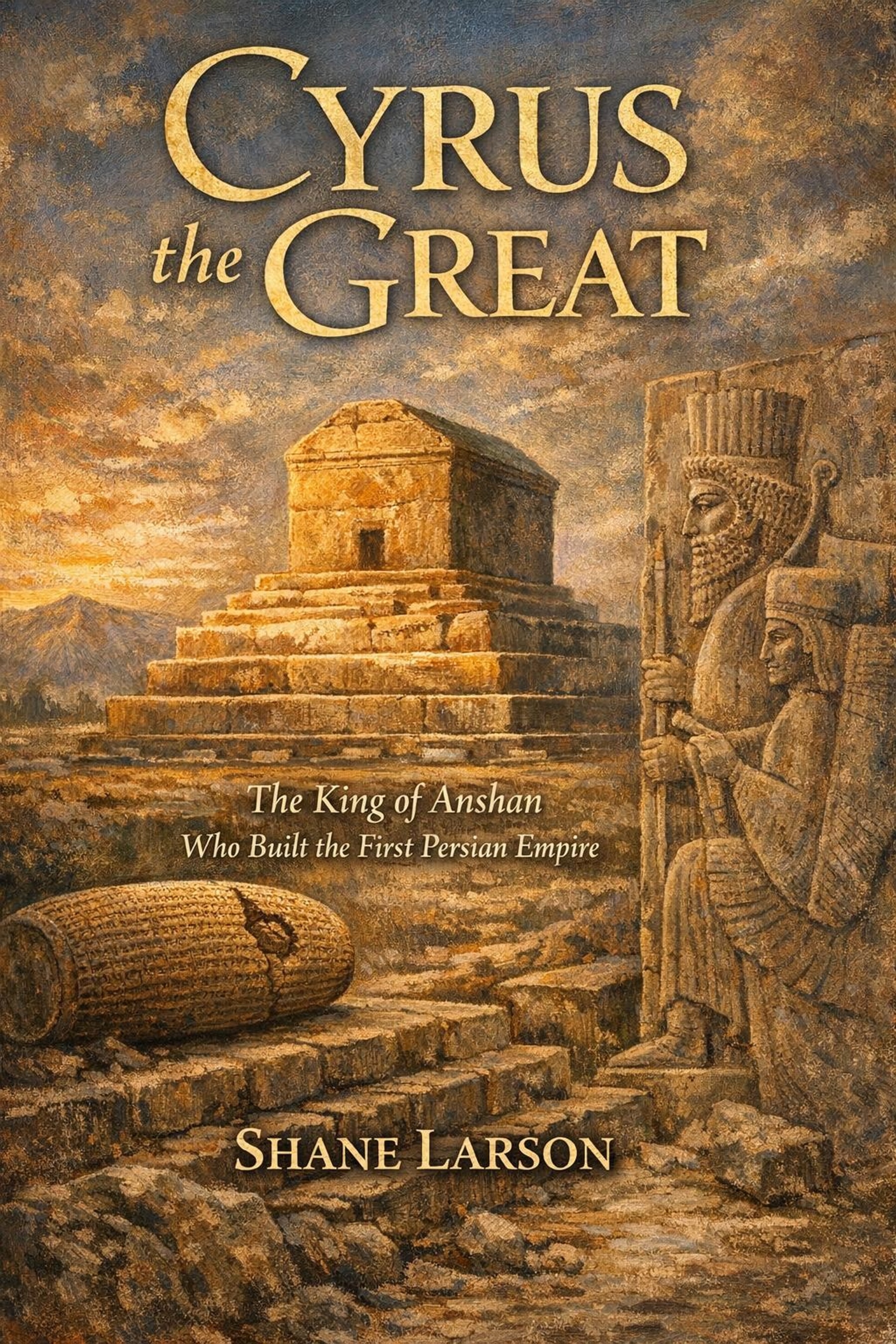
How he earned that, and what else was written about him by Greeks, Hebrews and his own successors, is the subject of *Cyrus the Great: The King of Anshan Who Built the First Persian Empire*.
Cyrus the Great
New posts and releases, straight to your inbox. No spam, unsubscribe anytime.