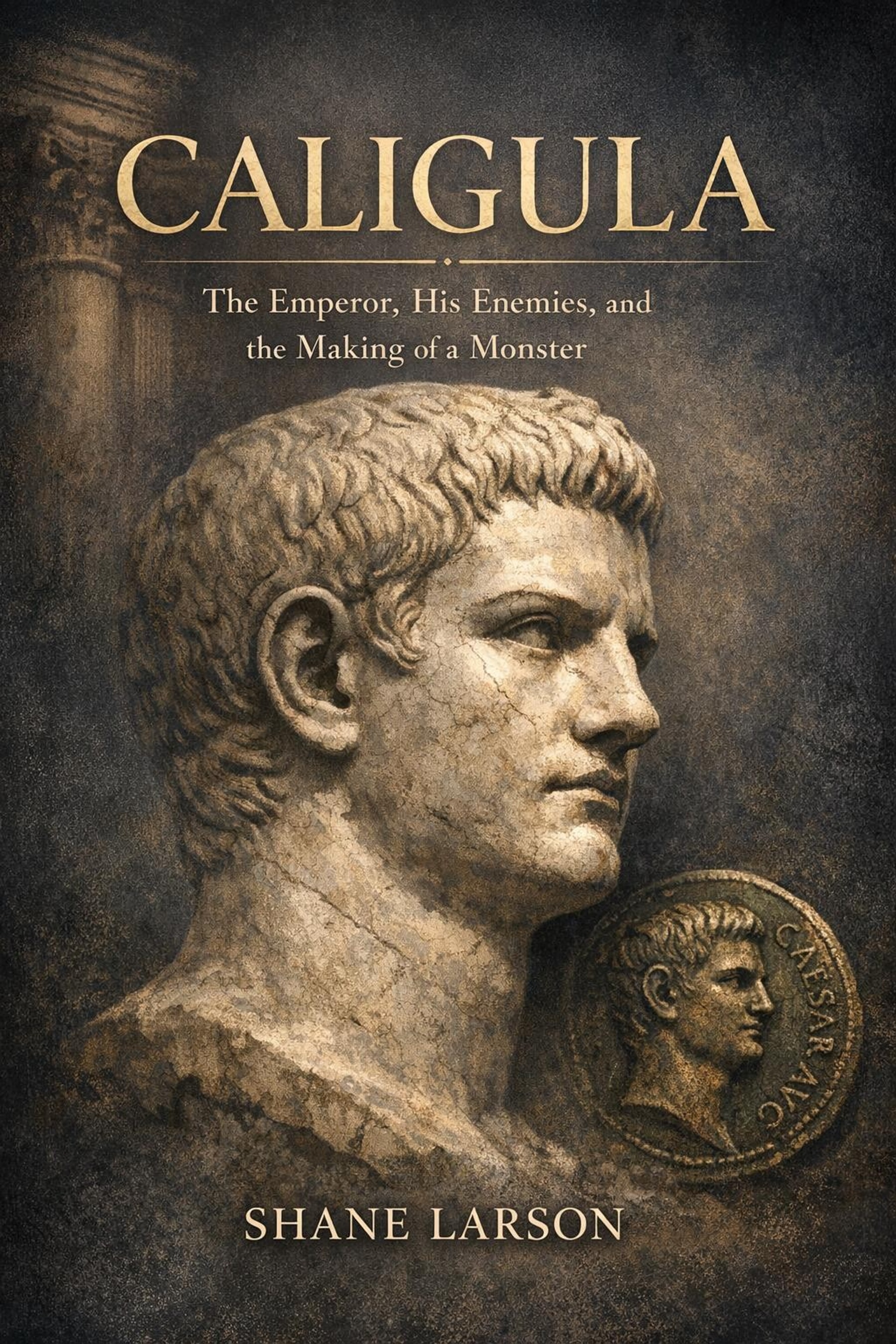
Caligula
The Emperor, His Enemies, and the Making of a Monster
By Shane Larson
About This Book
In AD 31 a young man of eighteen or nineteen was summoned to the island of Capri to live in the household of the emperor Tiberius. His name was Gaius. His mother was a prisoner on another island and would die there two years later. One of his brothers died in exile that same year. A second would starve in a cell on the Palatine in 33. The emperor under whose rule all of this had happened was now his host, his guardian, and his only way of staying alive.
He stayed six years and gave nothing away. An orator of the day, looking back, remarked that Rome had never had a better servant, nor afterward a worse master. In March of AD 37 Tiberius died, the Senate handed the survivor everything, and the city celebrated for months. Three years and ten months later officers of his own guard stabbed him to death in a covered passage on the Palatine. He was twenty-eight.
History remembers him by a nickname from the nursery, one he is said to have resented as an adult: Caligula.
The Man and the Men Who Wrote Him Down
Nearly everything else people believe about him rests on a short list of writers, and that is where the difficulty begins. Tacitus, the sharpest historian Rome produced, did cover the reign. Those books are lost. His Annals break off at the death of Tiberius and pick up again ten years later, so the best-known emperor of the dynasty is also the one with the thinnest record.
What remains is testimony from interested parties. Seneca was a senator the emperor sneered at. Philo led a delegation from Alexandria, stood in a room with him, and believed he meant to desecrate the Temple at Jerusalem. Suetonius was a palace secretary writing in the 120s who sorted his material by theme and seldom said where it came from. Cassius Dio was a proud senator writing almost two centuries on. Roman history was written by senators or for them, and this emperor spent his reign humiliating that class in public.
Caligula: The Emperor, His Enemies, and the Making of a Monster is a narrative biography built on one repeated test. Each famous story is told the way the ancient writer tells it. Then it is traced: who reports it, how long afterward, with what grievance, and whether anyone independent agrees. Some stories pass. The bridge of boats across the bay at Baiae is reported by four writers, one of whom lived through it. Others come back damaged. The seashells on the Channel shore rest on two writers, neither of them alive at the time. The charges about his sisters appear in the later accounts and in neither of the two hostile contemporaries.
This is not an acquittal. He had his young cousin and co-heir Gemellus killed within a year of taking power. He destroyed his father-in-law Silanus, and Macro, the prefect who had put him on the throne. Where the evidence for a cruelty is good, the book says so. The aim is to sort, so that a reader can tell which parts of the picture are evidence and which were added later by people with a motive.
Why I Wrote This
What hooked me was a single Latin verb. The one thing everybody knows about this emperor is that he made his horse a consul, and when I went back to the source I found that the writer does not claim it happened. He says it was said that the emperor intended it. The best-known fact about the man is a rumor about a plan, written down eighty years after his death.
Then I found out why nobody could check it. The historian who would have told us properly did write about these years, and the manuscript tradition dropped exactly those books. So the reign everyone has heard of is the worst documented of its dynasty.
I did not want to write a defense. He killed people who trusted him, and I think he enjoyed being feared. I wanted to know how much of the rest would survive being asked a plain question: who says so?
Frequently Asked Questions
Did Caligula really make his horse a consul?
No. Suetonius, writing in the 120s, reports only that he was said to have intended it. Cassius Dio, a century later, says he promised it. No writer who lived through the reign mentions the story at all.
Was Caligula actually insane?
Nobody can diagnose a man who died in AD 41. He fell seriously ill in the autumn of 37, and the killings of his cousin, his father-in-law and his prefect followed. The book lays out the proposed explanations, medical and political, and is clear that all of them are guesses. Contemporaries who had no connection to each other do describe someone who liked to frighten people.
How did Caligula die?
He was killed on 24 January AD 41 in a covered passage on the Palatine hill, during a festival. Two tribunes of the Praetorian Guard, Cassius Chaerea and Cornelius Sabinus, struck first. His wife Caesonia and their small daughter were killed the same day, and the Guard made his uncle Claudius emperor.
What happened to the Nemi ships?
Two enormous vessels built for him lay on the bottom of Lake Nemi, south of Rome, until the lake was drained between 1928 and 1932. Both hulls burned in their museum on the night of 31 May 1944, and the cause is still disputed. No ancient writer mentions the ships. Lead pipes stamped with his name are what date them.
Is this book suitable for readers new to Roman history?
Yes. It explains the family, the offices and the sources as it goes, and the appendices include a family guide and a timeline. It is a standalone biography and assumes no prior reading.
If You Liked This, You Might Like
- The Julio-Claudians — The full dynasty from Augustus to Nero, including the parents, grandmother and uncle who appear here only as the boy saw them.
- Nero — His nephew, the dynasty's other byword, whose reputation was shaped by many of the same writers.
- Masada — The Judaean revolt a generation later, for readers who want to follow what the Temple statue crisis of AD 40 foreshadowed.
- Augustus — His great-grandfather, who built the system of one-man rule that a twenty-four-year-old inherited in AD 37.
Four years of rule, seven witnesses, and one lost history. This is an account of what can be known about the man behind the nickname, and of how the rest was made.
What You'll Learn
- Seven witnesses, each with a date and a grudge. Seneca, Philo, Pliny the Elder, Josephus, Tacitus, Suetonius and Dio are introduced once, clearly, so that every later claim can be weighed against the man making it.
- Boots on the Rhine. The two-year-old in a miniature soldier's kit during the mutiny of AD 14, and how an army's pet name became the label for a tyrant.
- Three deaths for Tiberius. Natural causes, smothering, or poison, depending on which writer you ask. The versions are set side by side.
- Autumn 37. The illness that had the whole empire waiting, the deaths that followed it, and the medical explanations offered since, presented as the speculation they are.
- The speech of 39. The day he turned on the Senate and brought back the treason trials, an episode that rests on Dio alone.
- Philo's audience. The single surviving description of what it was like to talk to him, written by a frightened ambassador soon after the assassination.
- The statue for Jerusalem. The order that nearly started a war in Judaea, told from two main accounts that disagree on the sequence and on how it ended.
- 24 January AD 41. The tribunes Chaerea and Sabinus, the passage on the Palatine, and the same-day killing of his wife and daughter.
- How the reputation was built. Statues removed at night, coinage melted down, and the long afterlife of the story from Suetonius to the twentieth century.
- Three appendices. A table of thirty famous stories and who actually tells each one, a timeline from AD 12 to 41, and a guide to a family in which half the names repeat.
New Ancient History releases and free chapters — no spam, unsubscribe anytime.
More in This Genre
View all →