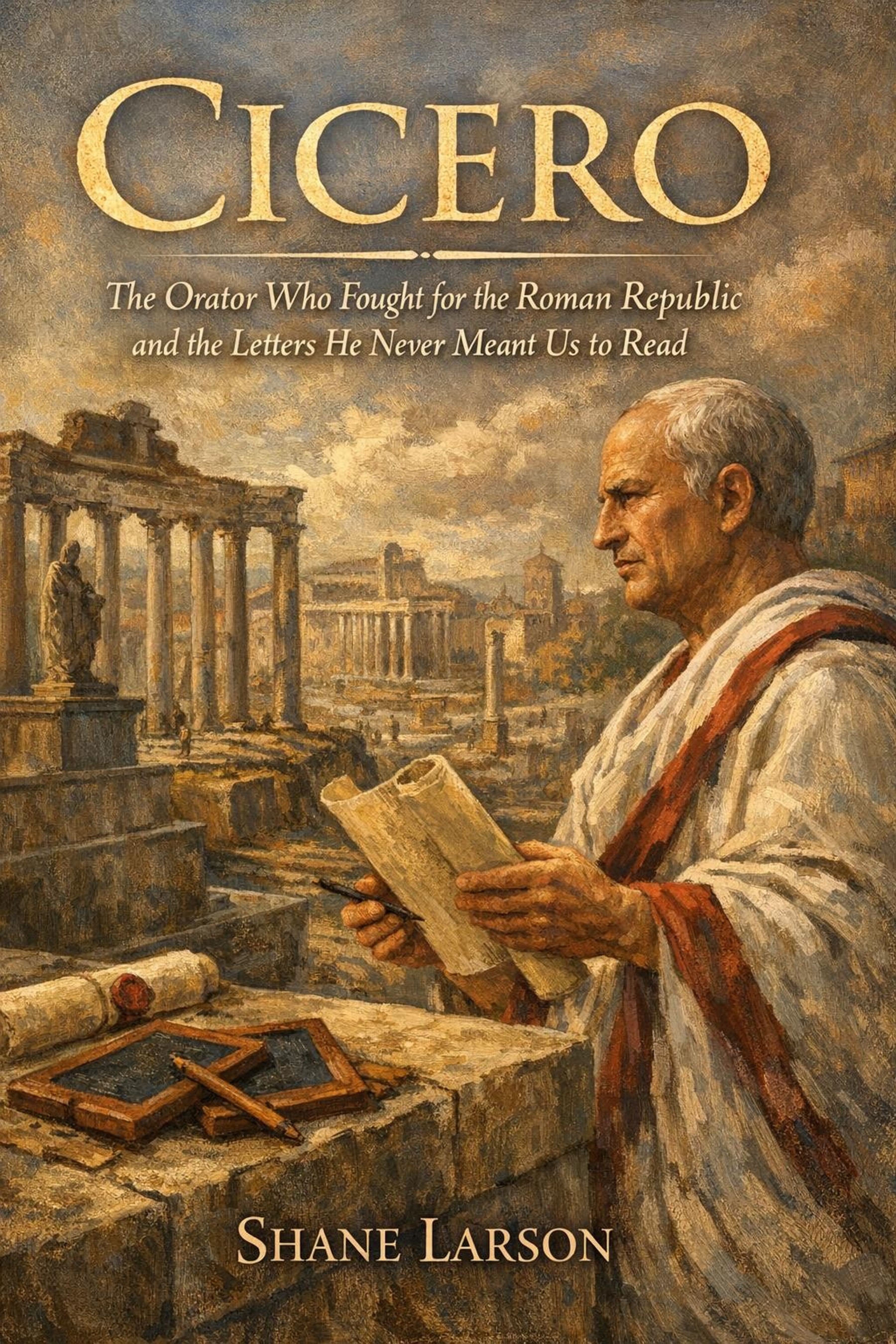
Cicero
The Orator Who Fought for the Roman Republic and the Letters He Never Meant Us to Read
By Shane Larson
About This Book
In the summer of 1345 the poet Petrarch was in Verona, going through the cathedral library, when he came on a manuscript nobody had read with attention for centuries. It held the letters of Marcus Tullius Cicero to his friend Atticus. Petrarch had loved Cicero since boyhood: the orator, the philosopher, the calm Roman voice on duty and old age. He copied the letters out with his own hand. Then he wrote one of his own, addressed to a man thirteen hundred years dead, and it was not a fan letter. He told Cicero he had finally seen what kind of man he was, and asked him why he could not have kept quiet and grown old with his books.
What Petrarch found is still there. The Cicero of the letters brags about his consulship to people who are tired of hearing about it. He writes from exile that he should have killed himself. He spends the first months of a civil war unable to decide which side to join and tells Atticus so, almost daily. He makes jokes at the worst moments. When his daughter dies he goes to a house on the coast and walks in the woods alone.
No other life from the ancient world can be told this way. For Caesar there are his own careful war reports. For Alexander there are books written centuries later. For Cicero there are more than nine hundred private letters, with some of the replies.
The Story
Cicero was born in 106 BC in Arpinum, a hill town seventy miles from Rome, into a family that had never held office in the capital. Romans had a name for a man like that who made it to the top: a novus homo, a new man. He got there by talking. At twenty-six he defended a man accused of murdering his own father, in a case that touched the dictator Sulla's inner circle and that no established advocate would take. At thirty-six he prosecuted Verres, a governor who had stripped Sicily, and finished him in a single hearing. At forty-three he was consul.
That year a bankrupt aristocrat named Catiline, twice beaten at the polls, raised an army in Etruria and left friends in Rome to open the city to it. Cicero exposed them, and on 5 December 63 BC, after a Senate debate in which Julius Caesar argued for mercy and Cato for death, he had five of them strangled in the prison below the Capitol. There had been no trial before the people, which Roman law required before a citizen could be put to death. He was hailed as Father of his Country. He had also handed his enemies a weapon.
They used it in 58, when the tribune Clodius carried a law outlawing anyone who had executed a citizen untried. Cicero fled to Greece, and his house on the Palatine was burned. He came back after eighteen months to cheering crowds and found that the Republic now belonged to three men with armies and money. The rest of his life is the record of a man with no army working out what words can still do: bending to Pompey and Caesar, failing to save a friend in a courtroom ringed by soldiers, governing a province honestly, choosing the losing side in the civil war, and turning in his sixties to philosophy because the Forum was closed to him.
Then Caesar was murdered, and for one year Cicero led the Senate against Mark Antony with the fourteen speeches he called his Philippics. He bet on a nineteen-year-old named Octavian to help him. The bet failed. In December 43 soldiers overtook his litter on the road to the sea.
Why I Wrote This
I had read about Cicero for years before I read him, and the Cicero in other people's books never quite added up. He was the noble defender of the Republic in one and a vain trimmer in the next. The letters explained why. Both men are in there, sometimes on the same page. The same person who faced down Antony when it was likely to kill him also spent weeks angling for a triumph over a mountain fort nobody had heard of.
What hooked me was the evening of 5 December. Here was the great believer in law and argument, and at the moment of real danger he took the short way, and it cost him everything he had built. I wanted to follow that one decision through the next twenty years of his life, using his own mail. I think he was right about the thing that mattered most. I also think he would hate this book.
Frequently Asked Questions
Why is Cicero important?
He was the leading orator and one of the leading politicians of the last generation of the Roman Republic, and his speeches, treatises and letters are the largest body of evidence we have for how that Republic worked and failed. His philosophical writing carried Greek thought into Latin and shaped European education for well over a thousand years.
Did Cicero really save Rome from Catiline?
There was a real plot and a real army, and Cicero's handling of it was skilful. It was also smaller and messier than his published speeches make it sound. The book lays out both the sceptical case and the evidence against it, and says where it comes down.
How did Cicero die?
He was killed on 7 December 43 BC near his villa at Formiae, on the orders of Mark Antony, after the alliance of Antony, Octavian and Lepidus put his name on a death list. His head was displayed on the speakers' platform in the Forum. The book tells it plainly and without lingering.
Do I need to know Roman history to read this?
No. Names, offices and laws are explained as they come up, and there is a timeline and a who's who at the back.
Does the book quote Cicero's letters?
It paraphrases them closely and tells you which letter each passage comes from, so you can find it in any translation. An appendix explains how the letters survived, how they are numbered, and which ten to read first.
If You Liked This, You Might Like
- Julius Caesar — the same decades from the side of the man who won, including his speech for mercy on the night Cicero chose otherwise.
- Augustus — picks up where this book ends, with the nineteen-year-old Cicero thought he could use and discard.
- Blood in the Forum — the Gracchi, Marius and Sulla: the generation of political killing that Cicero grew up in and never stopped arguing with.
A Republic, Cicero thought, was an agreement to settle things by talking. This is the life of the man who talked longest, and of what he wrote down when he thought nobody was listening.
What You'll Learn
- Two records, set side by side. Each chapter puts what Cicero said in public next to what he wrote in private the same week, and lets the reader see the gap.
- The trial of Verres, including the fifty-day dash around Sicily collecting evidence and the trick that stopped the defence from running out the clock.
- Catiline at full length. How much of a conspiracy there really was before Cicero named it, with the case that he exaggerated it and the evidence that he did not.
- The fifth of December, argued both ways. The Senate's emergency decree against a citizen's right to a trial: the question on which his whole later life turned.
- Exile from the inside. The letters to his wife Terentia and to Atticus from Thessalonica, among the most unguarded documents to survive from antiquity.
- A family. Terentia, who ran his finances and fought for him in Rome; his daughter Tullia; his difficult brother Quintus; and Tiro, the secretary who kept everything.
- A governor who would not look away. In Cilicia he discovered that the 48 percent loan squeezing a Cypriot town belonged to Brutus, the future assassin and model of Roman virtue.
- The philosophy, briefly and concretely. What he wrote in the two years after Tullia's death, and the words he gave Latin that English still uses.
- The last year, told from his desk, through the Philippics and the final letters.
New Ancient History releases and free chapters — no spam, unsubscribe anytime.
More in This Genre
View all →