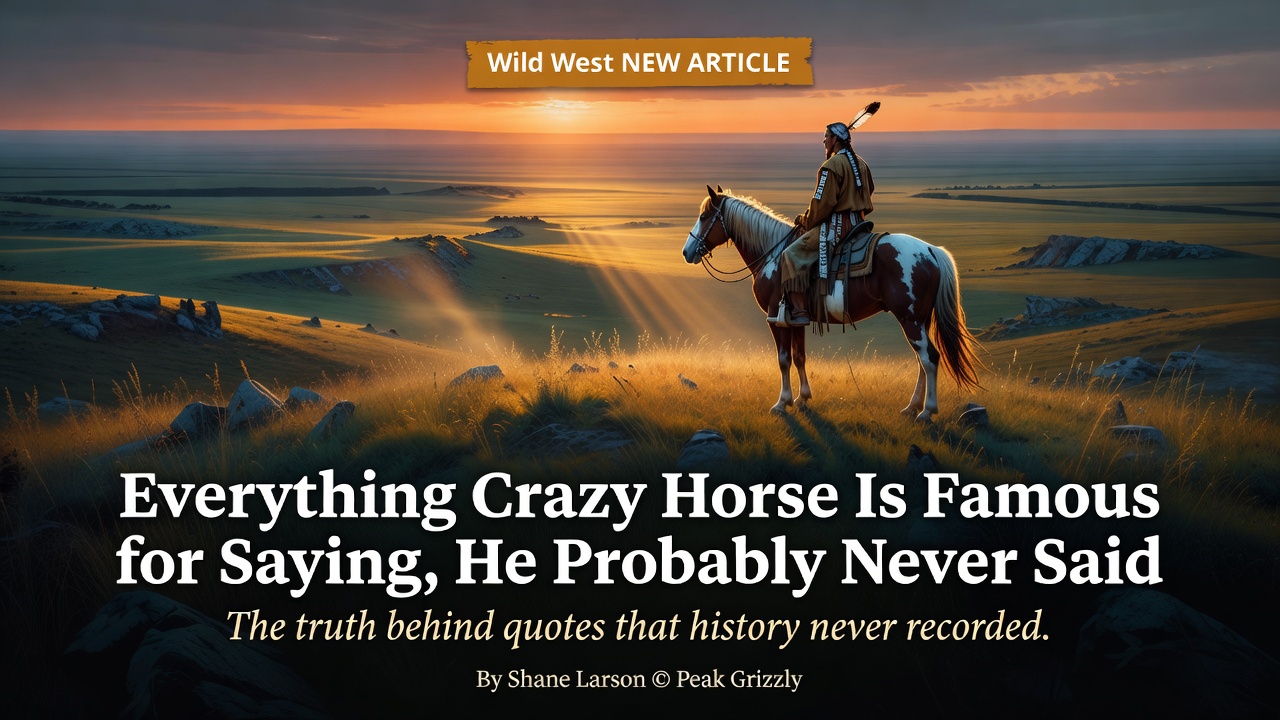
Everything Crazy Horse Is Famous for Saying, He Probably Never Said
August 27, 2026 · 6 min read
Crazy Horse is one of the most quoted figures of the American West. His words appear on posters, in commencement addresses, in album liner notes, on memorial granite, and in a steady stream of social media graphics. Which is remarkable, because he left no writing of any kind, spoke no English, gave no interviews, and died in 1877 having successfully avoided nearly every instrument of record his era possessed. Every word he ever spoke to a white listener passed through at least one interpreter — usually an interpreter with a history, an employer, or a grudge. And the lines he is most famous for cannot be traced to anyone who ever met him.
This is not a debunking exercise for its own sake. It is a demonstration of a method — one you can apply to any quotation attributed to any historical figure, and one that pays for itself the first time you almost put a fake quote in a toast, a term paper, or a tattoo.
The empty stage
Start with the underlying problem. A man who leaves no writing is an empty stage, and empty stages get filled. The fewer words a figure verifiably left, the more words end up in his mouth, because there is nothing on the record to contradict the additions. Shakespeare gets misquoted; Crazy Horse gets ghostwritten. That asymmetry is the whole story, and it is why the most silent man of the plains wars became one of its most quotable.
Now take the famous lines one at a time.
"My lands are where my dead lie buried"
This is probably the most widely reproduced Crazy Horse quotation, usually framed as his answer to a mocking question — "Where are your lands now?" — delivered as a perfect, devastating retort.
No account from his lifetime contains it. Nobody who knew him ever reported it. No source has ever been produced that puts the sentence closer to 1877 than the twentieth century, and its circulation is bound up with the promotional literature of the memorial era, decades after his death. The framing anecdote should itself raise suspicion: the taunt-and-perfect-comeback is a stock narrative shape, a retort story, and retort stories attach themselves to famous names the way barnacles attach to hulls.
Here is the uncomfortable part: the sentiment is not implausible. Lakota attachment to burial places is well documented, and the line expresses something a Lakota man of his generation might genuinely have felt. That is exactly what makes it durable. A fabricated quotation survives on plausibility, not on evidence — and plausibility is not provenance.
"Today is a good day to die"
The battle cry attributed to Crazy Horse at the Little Bighorn, and later to half the Lakota leadership, and eventually to fictional characters in novels and films.
No witness account of the battle puts the sentence in his mouth. Variants of the line were attributed to other Lakota fighters in print within years of the fight — which tells you the phrase was in circulation, not who said it, and not that anyone said it in those words. There is also a translation problem underneath the whole thing: the Lakota expression the English descends from is a statement of readiness — something closer to "I am prepared for whatever comes" — not the fatalistic death wish the English version implies. The line thrives in English because it is short, cinematic, and sounds like a movie trailer. That is a reason for its popularity. It is not evidence.
The seven-generations prophecy
There is a long visionary passage that circulates under Crazy Horse's name — the earth healing, the nations coming together, the young returning to the old ways after seven generations. It appears in anthologies, on posters, and across the internet, sometimes with a date and a deathbed setting attached.
Crazy Horse
No source has ever been produced for it, and it does not appear in print before the late twentieth century. It also exhibits, in concentrated form, the single most reliable tell of a fabricated quotation: it is written in perfect modern idiom, and it says exactly what the people circulating it want said. A nineteenth-century Lakota war leader speaking through a frontier interpreter did not produce sentences that scan like a 1970s benefit-concert program. When a quotation's vocabulary, rhythm, and message all belong to the quoter's era rather than the speaker's, you are almost always looking at ventriloquism.
The paraphrase promoted to quotation
There is a fourth category, and it is the trickiest: lines like "one does not sell the earth the people walk upon," which match positions Crazy Horse verifiably held. He did refuse to sell the Black Hills. He did refuse to sign. The underlying fact is true — but the specific English wording has no chain of custody, no named witness, no first appearance anyone can point to near his lifetime. Somewhere along the way, a historian's or novelist's summary of his position got promoted from paraphrase to direct speech, and the quotation marks were added like a coat of paint.
The honest handling is simple: attribute the position, not the sentence.
How a modern sentiment acquires a nineteenth-century attribution
The mechanism is worth understanding, because it is the same every time.
First, someone writes what the figure plausibly might have felt. Sometimes this is done openly — Mari Sandoz's influential 1942 biography of Crazy Horse was written with a novelist's technique, including interior thoughts composed on behalf of a man who left no words, and she never hid that this was her method. Second, a later writer lifts the reconstruction without the frame, quoting the imagined words as words. Third, an anthology or a poster picks the line up, citing the second writer. Fourth, every subsequent reprint cites the one before it. After two or three generations of this, the line has an impressive-looking trail of citations — all of them real, none of them a source. Call it citation laundering. The paper trail is genuine; the origin is not.
A field method: six questions
Here is the transferable part. For any quotation attributed to a historical figure — especially one who left no writing — ask:
- Who recorded it? A named witness, or "it is said"?
- When was it recorded, relative to when it was supposedly spoken? The same week, or fifty years later?
- In what language was it spoken, and if not English, who translated — and is the translator identified?
- After what interval of memory? A council transcribed that evening is one thing; an old man's recollection of a sentence heard in boyhood is another.
- With what motive? Interpreters, enemies, promoters, and heirs all had reasons to shape what a dead man said.
- Where does it first appear in print? Not in the book you happen to own — anywhere. If nobody can answer this one, the quotation is unsourced, no matter how many books carry it.
And keep the tell in your pocket: perfect modern idiom, saying exactly what the quoter wants said, should be treated as manufactured until proven otherwise. Genuine nineteenth-century testimony arrives with friction — awkward phrasing, translation seams, details nobody would invent. Fabrications arrive frictionless.
None of this diminishes the man. The documented record of Crazy Horse — the Fetterman fight, the Rosebud, the Little Bighorn, the surrender of nine hundred people, the killing at Camp Robinson — needs no invented speeches to be worth reading. If anything, the fabrications get in the way of a figure who is more interesting as he actually was: a man so committed to not being recorded that the world has spent a century and a half writing his lines for him.
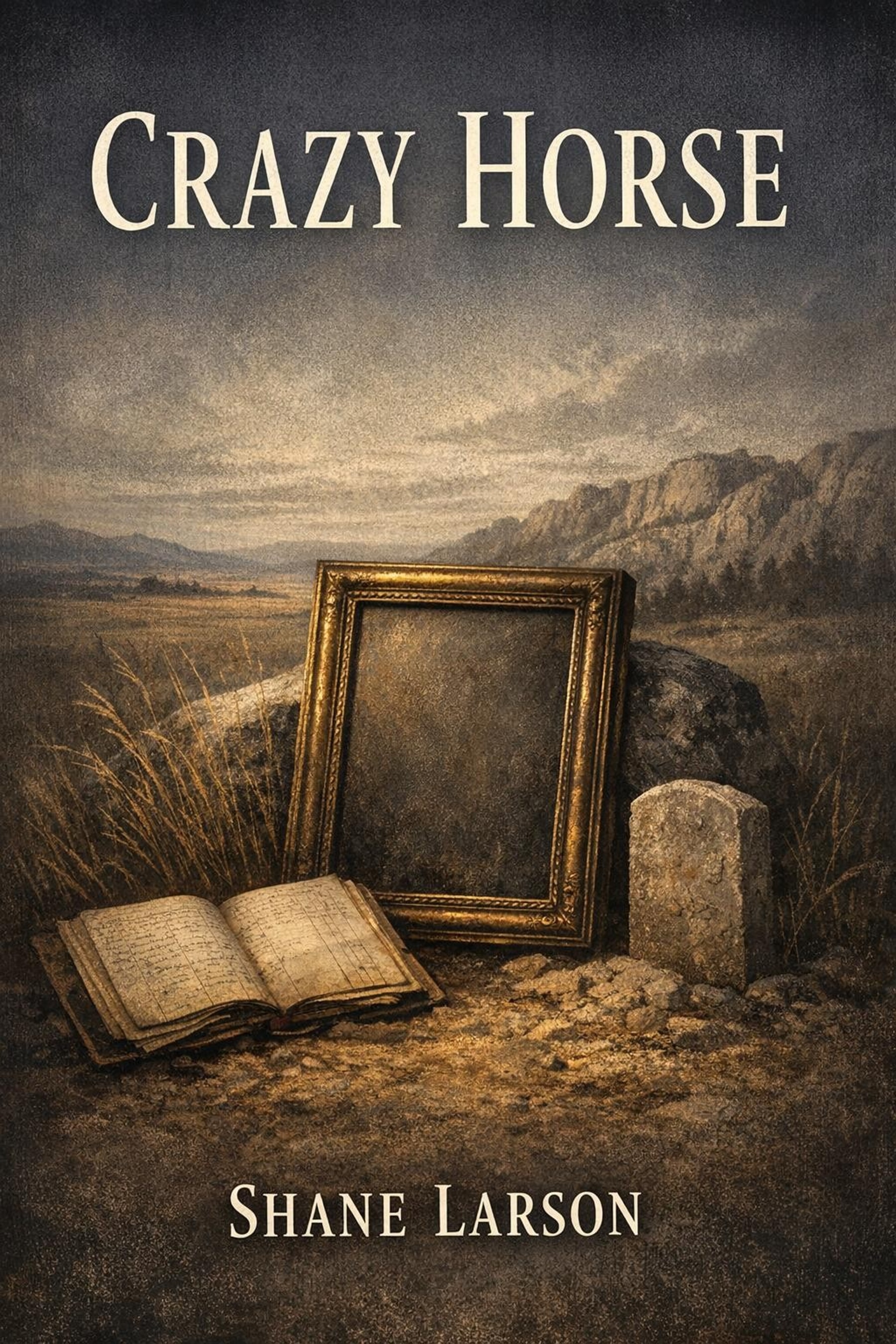
I spent a book working through this problem — Crazy Horse: The Man Who Left No Picture, which reconstructs the documented life and includes an appendix tracing each famous quotation to its earliest appearance in print. But you don't need the book to use the six questions. They travel free, and they work on every empty stage in history.
Crazy Horse
New posts and releases, straight to your inbox. No spam, unsubscribe anytime.