Thirteen Days That Ended on the Gallows: The Rufus Buck Gang and the Death of Indian Territory
September 30, 2026 · 6 min read
We tell the story of the Wild West as a contest between outlaws and lawmen, gunfights at high noon, and justice delivered from the barrel or the bench. It is a comforting shape for a story, because it has clear sides. The Rufus Buck case refuses that shape. It is one of the hardest stories the frontier produced, and pretending otherwise does a disservice to everyone caught inside it — most of all the victims.
In the summer of 1895, in the Creek Nation of Indian Territory, five young men embarked on a spree of robbery, murder, and rape that lasted roughly thirteen days. Their leader was Rufus Buck, a teenager of mixed Creek and Black ancestry. Around him gathered four companions — Lewis and Lucky Davis, Sam Sampson, and Maoma July — most of them barely out of boyhood. What they did in those two weeks was savage and, in much of it, senseless. They shot down a deputy United States marshal named John Garrett. They robbed stores, ranches, and travelers across the Creek and Cherokee country. And they committed assaults that horrified a frontier already accustomed to violence.
This article sketches the case and the world that produced it. The book goes further. But even a short telling has to begin where the book begins: with the land.
A Territory Being Dismantled
To understand the spree, you have to understand that Indian Territory in 1895 was a place under siege from within. The Five Tribes — the Creek (Muscogee), Cherokee, Choctaw, Chickasaw, and Seminole — had been removed there decades earlier under the promise that the land would be theirs. By the 1890s that promise was being unwound in plain sight. Railroads cut across the Territory. White settlers poured in, legally and otherwise. And the federal government had committed to allotment: the policy that would break up communal tribal landholding into individual parcels and, in the end, erase tribal sovereignty over the land entirely.
A society does not absorb that kind of dissolution without consequence. The old order — the tribal governments, the communal land, the social structures that had held since removal — was visibly coming apart. For a generation coming of age in that collapse, the future on offer was poverty, dispossession, and a legal status that grew more precarious by the year. None of this excuses what the Buck gang did. But it is the air they breathed, and a history that leaves it out is not history at all.
The Question of the Color Line
Rufus Buck's heritage placed him at one of the most fraught intersections in the Territory. The Five Tribes had themselves held enslaved people, and after emancipation the status of the freedmen — formerly enslaved people and their descendants, many with deep ties to the tribes — was bitterly contested. Were they citizens of the Creek Nation, entitled to land and standing? Or were they outsiders? The answer shifted with politics and treaty language, and it left many people, Buck among them, standing between worlds and belonging fully to none.
That liminal position is part of why the case has drawn so much later interpretation. Some accounts hold that Buck spoke during the spree of driving the white man out and restoring the old order — that the violence was, in his mind, a kind of rebellion. Whether that was genuine conviction, teenage bravado, or a meaning imposed on the case afterward is one of the genuine puzzles of the story. The honest answer is that the sources cannot settle it. A responsible account weighs the evidence and resists the temptation to choose the more marketable version.
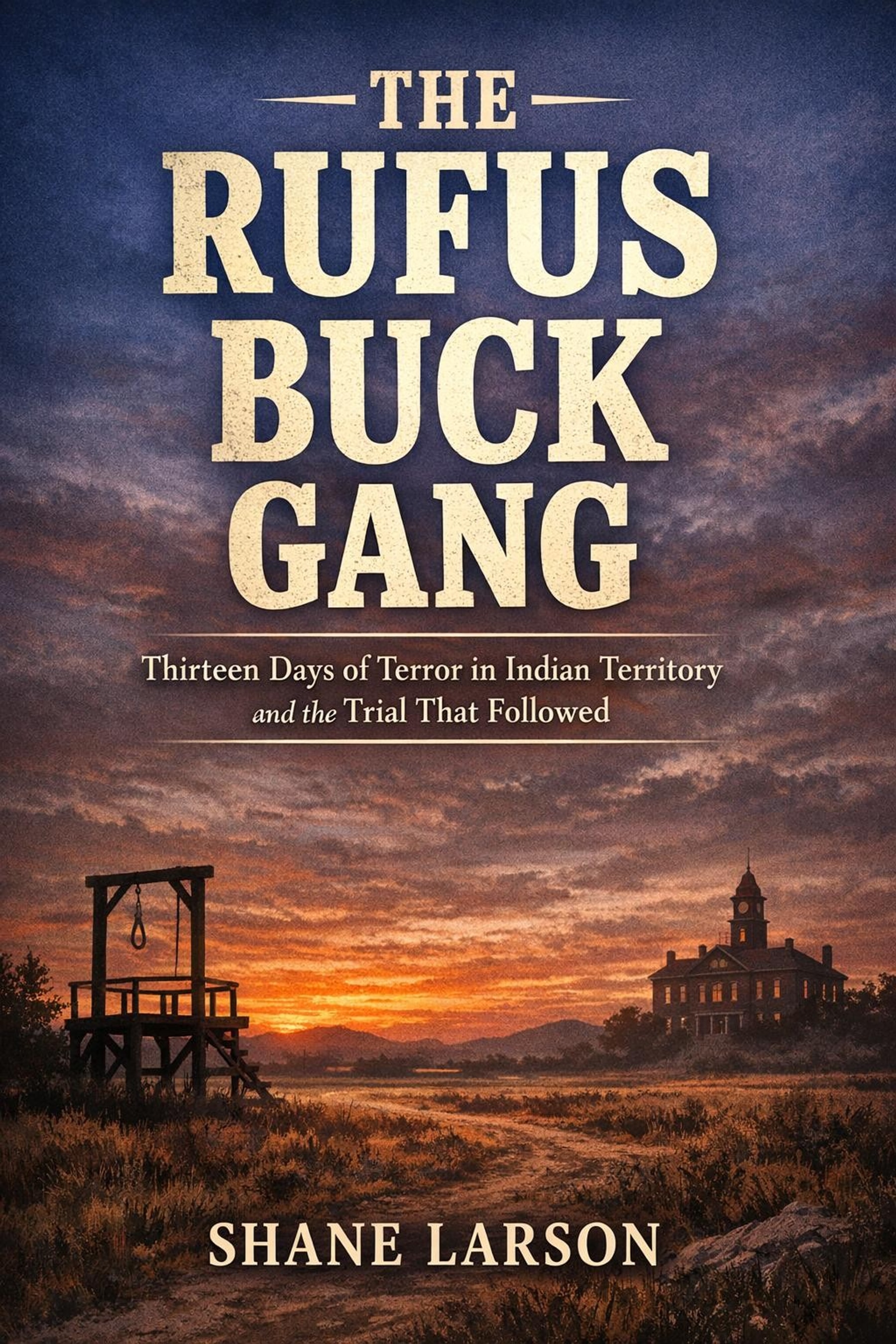
The Rufus Buck Gang
Honoring the Victims
There is a real danger, in writing about a figure like Rufus Buck, of letting the social context swallow the crimes. The spree included sexual violence. It left victims whose suffering was devastating and whose names and dignity deserve to be at the center of the story, not the margins. The discipline this case demands is to hold two things at once: to understand the world that produced the gang, and to refuse to romanticize the gang itself.
That is why the book handles the assaults with restraint and a documentary tone. The crimes are acknowledged honestly; the victims are centered; the prose never lingers on the horror for effect. Understanding is the goal. Exploitation is not.
The Manhunt and the Hanging Judge
The spree ended almost as fast as it began. Indian Territory was policed by an extraordinary patchwork — tribal Lighthorse companies and the deputy U.S. marshals who rode out of Fort Smith, Arkansas, among them the legendary Bass Reeves, the formerly enslaved lawman who became one of the most effective deputies in the West. Creek Lighthorse police and deputy marshals coordinated across tribal and federal lines, cornered the gang, and took them after a gun battle. The narrow thing they escaped was frontier summary justice; what they got instead was a trial.
Over that trial presided Judge Isaac Parker, the "Hanging Judge," whose Fort Smith court had held jurisdiction over the Territory for two decades. The timing matters enormously. The Buck case came at the very end of Parker's reign, as Congress was stripping his court of its Indian Territory jurisdiction. The trial was one of the last great dramas of a vanishing institution. All five were convicted — of murder, and in the rape cases as well — and sentenced to hang. Appeals to the U.S. Supreme Court failed.
July 1, 1896
On that day, the five young men were hanged together on the great gallows at Fort Smith, in one of the largest mass executions in the court's history. The story carries one final, haunting detail. In his cell, Rufus Buck wrote a poem — a strange, misspelled, devout verse about his mother, heaven, and redemption, found after his death scrawled on the back of a photograph. It is not a confession and it is not a defense. It is something stranger and more human than either, and it has helped make the Buck case a touchstone for the hardest questions about crime, race, dispossession, and justice on the closing frontier.
Why the Story Still Matters
The Rufus Buck Gang is remembered, when it is remembered, in fragments — a lurid spree, a mass hanging, an odd poem. The fuller story is an elegy for a Territory in its final years and a reckoning with how the deliberate destruction of a social order can curdle into violence that lands, in the end, on innocent people. It asks us to understand without excusing, to contextualize without romanticizing, and to keep the victims in view the whole way through. That is a hard balance. It is also the only honest one.
If you've followed my other Fort Smith books — Judge Isaac Parker and Bass Reeves — this one closes the circle on that world at the moment it began to vanish.
Read the full story in The Rufus Buck Gang: Thirteen Days of Terror in Indian Territory and the Trial That Followed — part of The Wild West series, available now in ebook and paperback.
The Rufus Buck Gang
New posts and releases, straight to your inbox. No spam, unsubscribe anytime.