The Metal Breasts: Why Sitting Bull Was Killed by Lakota Policemen, Not Soldiers
August 23, 2026 · 7 min read
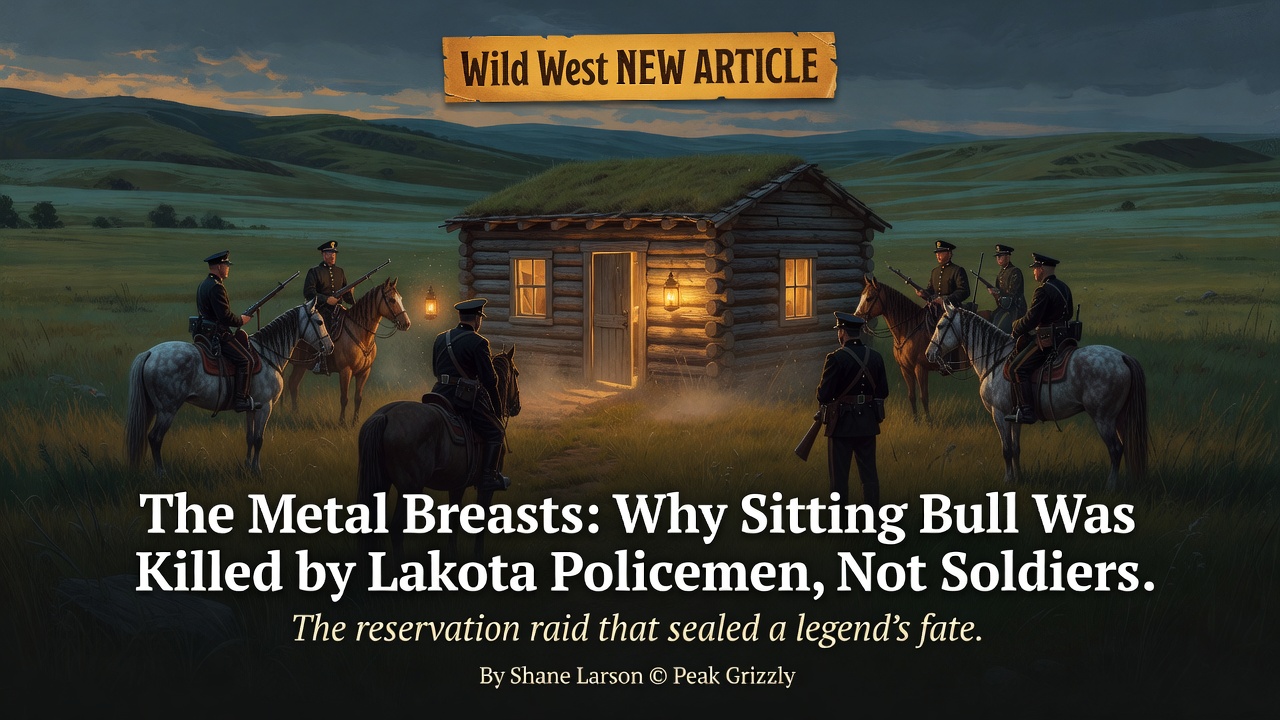
Before dawn on December 15, 1890, about forty-three policemen surrounded a log cabin on the Grand River in South Dakota and went in to arrest the man sleeping inside. Within minutes the arrest had become a gunfight, and within the hour Sitting Bull was dead — along with his seventeen-year-old son, six of the policemen, and seven other men from his camp. The most famous Native leader in America, a man who had outlasted the Custer fight, four years of exile in Canada, and a decade of reservation surveillance, was killed a few steps from his own door.
The detail that carries the whole story is the one most retellings hurry past. The men who shot him were not soldiers. They were Lakota — Hunkpapa and Blackfeet Sioux from his own reservation, several of them his neighbors along the Grand River, one of them a relative. They wore blue uniforms and metal badges, and the people they policed called them the ceska maza, the metal breasts. Understanding why the government sent them, and not the cavalry waiting a few miles off, is the closest thing there is to understanding how the reservation system actually worked — and why an arrest ordered to prevent bloodshed produced the killing of Sitting Bull and, fourteen days later, the massacre at Wounded Knee.
Authority That Ran Upward
Lakota camps had always policed themselves. The instrument was the akicita — men's societies whose members were appointed by the camp's leaders to keep order at exactly the moments when disorder could kill everyone: the communal buffalo hunt, the moving of the village, the negotiation of a truce. An akicita could destroy the lodge of a man who charged the herd early and spoiled the hunt for the whole camp. The office was real, the coercion was real, and none of it belonged to the men who exercised it. Akicita served at the pleasure of the camp, enforced norms the camp already held, and stood down when the hunt was over. Authority ran upward, from the people to the men carrying it.
The reservation Indian police, established across the agencies in the late 1870s, were built to look like that institution and to work in exactly the opposite direction. The policemen were recruited by the government agent, paid by the agent, uniformed and armed by the agent, and answerable to no one else. Their job was not to enforce the community's norms but Washington's: suppress the old ceremonies, break up plural marriages, keep children in the agency schools, report what the "non-progressive" camps were doing. It was a manufactured akicita with the loyalty inverted — familiar in form, foreign in function. That inversion was not a side effect. It was the design. An agent with a Native police force could do things inside a reservation that would have looked like an invasion if soldiers had done them, and could do them under the description of Indians managing their own affairs.
McLaughlin's Long Wait
James McLaughlin had run the Standing Rock agency since 1881, and he had wanted Sitting Bull removed from it for most of that time. His writings make the reason plain enough: Sitting Bull would not perform the conversion the agency system required. He took up farming, sent children to school, and stayed at peace, but he never conceded that McLaughlin — or the government behind him — held legitimate authority over the Hunkpapa, and his camp on the Grand River remained a gravitational center for people who felt the same. McLaughlin's reports describe him as an obstacle to civilization; what he was, more precisely, was an obstacle to the agent.
The Ghost Dance gave McLaughlin his opening. The movement that swept the western reservations in 1890 — a prophecy, out of Nevada, of a restored world and returned dead — reached Standing Rock that autumn, and dancing began in Sitting Bull's district. How committed Sitting Bull himself was to the doctrine is genuinely unclear; what is documented is that he permitted the dancing and wanted to evaluate the prophecy rather than take it on the government's word. In December he had a letter sent to McLaughlin saying he intended to travel to Pine Ridge, where the movement was strongest, to see it for himself. McLaughlin treated the notice as proof that the arrest he had recommended for weeks could no longer wait.
Sitting Bull
The Door That Was Closed On Purpose
There was, briefly, another way for this to end. In late November 1890, William F. Cody — Buffalo Bill — arrived at Standing Rock carrying an authorization from General Nelson Miles to bring Sitting Bull in peacefully. The idea was less strange than it sounds. Sitting Bull had toured with Cody's Wild West in 1885; the two men knew each other and got on, and Cody may have been the one white man in America who could ride into the Grand River camp and be received as a friend.
He never got there. Officers at Fort Yates steered Cody into a long night of hospitality at the officers' club while McLaughlin wired Washington urging that the authorization be rescinded. It was. Cody went home, and the one arrest scenario built on trust rather than force was off the table — not through mischance, but because the man running the agency worked to close it. McLaughlin wanted the arrest made by his police, under his authority, at a moment he chose.
He got all three. His written order to Lieutenant Bull Head, carried to the Grand River on December 14, told him to arrest Sitting Bull and added: "You must not let him escape under any circumstances." The timing — before dawn — followed from the same logic. Daylight meant a camp awake, and a crowd; the agency's fear was less that Sitting Bull would resist than that his people would. Two cavalry troops were positioned a few miles away, but deliberately kept out of the arrest itself. McLaughlin insisted it remain an agency matter: Lakota policing Lakota, with the army as a backstop rather than an actor.
Minutes
What happened at the cabin is contested at the level of seconds, and honesty requires saying why: the fullest surviving accounts come from McLaughlin, who had ordered the arrest and spent years justifying it, and from the surviving policemen, who had just killed their neighbors. The camp's dead did not leave reports. The broad shape, at least, is consistent across the versions. The police woke Sitting Bull and brought him outside; his followers gathered in the dark faster than the plan had assumed; there was shouting, and by several accounts his son Crow Foot taunted his father for submitting. A camp member named Catch-the-Bear fired first, hitting Bull Head, and the police responded — Bull Head and Sergeant Red Tomahawk both shooting Sitting Bull, who died where he stood. In the close fighting that followed, six policemen were killed or mortally wounded, and eight of the camp died with Sitting Bull, Crow Foot among them. Whether Crow Foot's death was combat or execution depends on which policeman's account is believed. There is no neutral version to prefer, and it misleads less to say so than to pick one.
Fourteen Days
The arrest had been ordered, in every official justification, to prevent violence. Its immediate product was a camp full of dead and a community in flight. Roughly one hundred and fifty of Sitting Bull's people fled south and took refuge with Big Foot's Minneconjou band on the Cheyenne River. Big Foot — ill, and now burdened with refugees from a killing that looked to every Lakota like the opening of something worse — moved toward Pine Ridge, was intercepted by the Seventh Cavalry, and surrendered. On December 29, 1890, during the disarmament of his camp at Wounded Knee Creek, the shooting started again. Around three hundred Lakota died there, fourteen days after the fight on the Grand River.
The line between the two events is short and direct, and it runs through the police. The ceska maza were not a neutral tool that happened to be picked up in a crisis. They were an institution designed years in advance to make exactly this kind of removal possible — internal, deniable, wearing a familiar face — without the appearance of an army operation. Using them is what put forty-three conflicted men in the dark outside a sleeping camp, which is what turned an arrest into a firefight, which is what set a frightened band moving toward Wounded Knee.
This article traces one thread; the book follows the whole life — from the Hunkpapa world Sitting Bull was born into, through the Little Bighorn and the Canadian exile, to the reservation politics that ended on the Grand River. Sitting Bull: The Last Free Lakota by Shane Larson tells that story in full.
Sitting Bull
New posts and releases, straight to your inbox. No spam, unsubscribe anytime.