Kit Carson Found a Dime Novel About Himself in the Camp of a Woman He Couldn't Save
September 1, 2026 · 7 min read
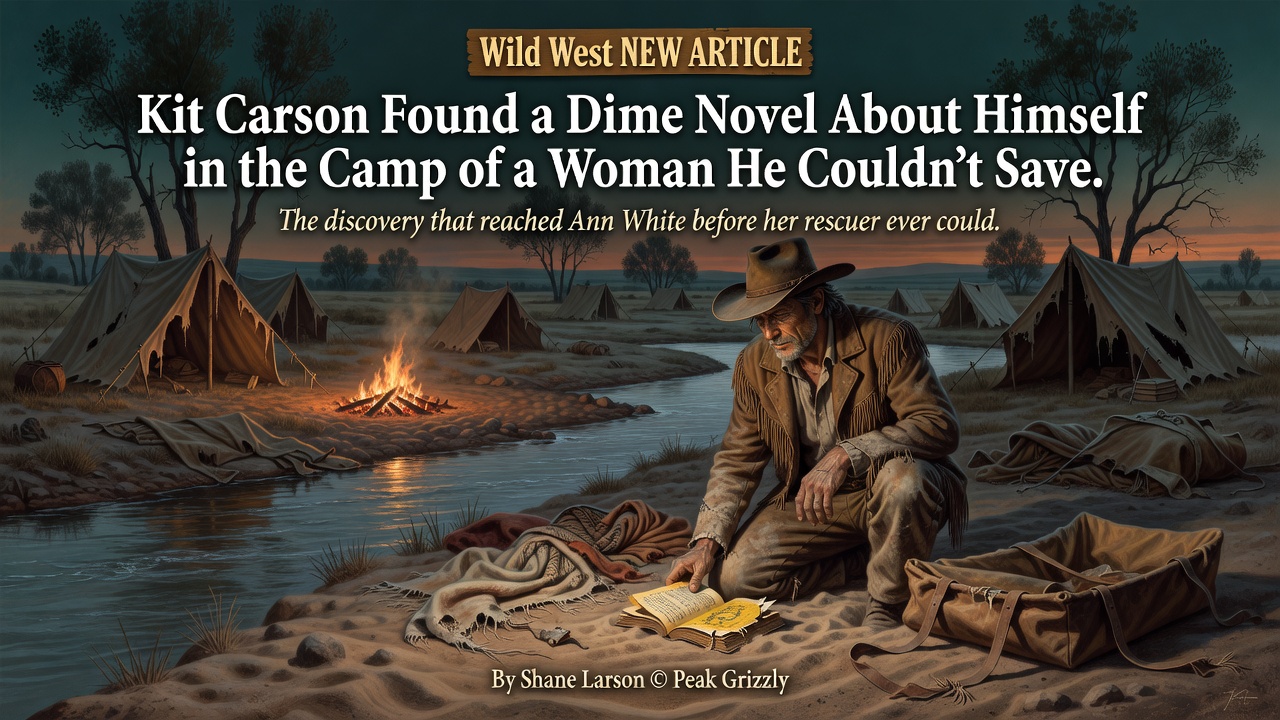
In the middle of November 1849, a column of United States dragoons rode down onto a camp on a tributary of the Canadian River, in eastern New Mexico, at the end of a pursuit that had lasted nearly two weeks. They were following a Jicarilla Apache band that had attacked a party of travelers on the Santa Fe Trail in late October, killed the men, and carried off a woman named Ann White, her infant daughter, and a servant. The principal guide for the last stretch of the chase was Kit Carson, then thirty-nine years old and already the most famous frontiersman in America.
The rescue failed by minutes. There was a dispute at the last moment — Carson wanted to charge the camp on sight; the senior guide advised the commanding officer to halt and try a parley — and in the pause the band scattered. Ann White's body was found about two hundred yards out, an arrow through her heart, still warm when the soldiers reached her.
Among the scattered belongings in the abandoned camp, someone found a book. It was a cheap, paper-covered adventure novel, and it was about Kit Carson. In its pages a fictional Carson killed Indians by the hundreds and rescued white women from captivity, single-handedly and without fail.
The real Carson, standing in the wreckage of the camp, could not read it. He was illiterate his entire life, in every one of the several languages he spoke. Someone had to tell him what the book was.
He said later that the find worked on him — that he could not stop thinking Ann White had probably read the novel, and that in her last days she had prayed for the man in it to appear. The man who actually came was too slow.
How we know this story — and how firm it is
It is worth being straight about the sourcing, because the sourcing is half the point.
We know the scene almost entirely from Carson himself. In 1856, in Taos, he dictated the story of his life to a clerk — dictated, because he could not write it — and that memoir is the source for the book in the camp and for what finding it felt like. The dictation came seven years after the event. No other member of the expedition is on record mentioning the novel, and the thin official record of the pursuit says nothing about it. Even the book's identity is an inference: scholars point to Charles Averill's Kit Carson, the Prince of the Gold Hunters, published in Boston that very year, as the likeliest candidate, but the memoir names no title — the man dictating it had no way to know one.
Still, the story holds up better than most self-reported frontier anecdotes, for one internal reason: it cuts against its teller. A man polishing his legend does not add the scene where the legend mocks him over a dead woman. It is probably true. It is not independently confirmed. Both of those things can be said in one breath.
A one-cent boy
The illiteracy was not a gap in an otherwise conventional education. There was no conventional education. Carson's father died when he was a boy in Missouri, and at fourteen or so he was apprenticed to a saddler in the town of Franklin. He ran away at sixteen and joined a caravan bound for Santa Fe, and the first documentary trace of his existence is the advertisement his master placed in a Missouri newspaper: a description of the runaway apprentice, a request for his return, and a reward of one cent.
One cent was the master's way of saying he wasn't paying to get the boy back. It is a strange first entry in the paper trail of a man who would end up with a county, a city, and a national forest carrying his name — and it is nearly the last thing in that paper trail he had any hand in. Everything Carson ever "wrote" afterward — reports as an Indian agent, military correspondence as a colonel, the memoir itself — passed through someone else's pen. What he had instead of letters was languages: fluent Spanish, working command of several Native languages, and the sign language of the plains. In the world he actually lived in, that was literacy. It just wasn't the kind that gets a say in print.
Kit Carson
The machine that built the other Kit Carson
The printed Carson was born in an official document. John C. Frémont's reports of his western expeditions — written up with the considerable literary help of his wife, Jessie Benton Frémont, and printed by Congress in the 1840s — turned the expedition's guide into a national character. Those reports were bestsellers by the standards of government publishing, and the Carson in them is already a figure in a story: cooler, grander, more quotable than a working scout has any need to be.
The fiction industry took it from there. Story-paper publishers like the Boston houses behind Averill got to Carson first, in the 1840s; the dime novel proper arrived in 1860, when the New York firm of Beadle and Adams began selling complete novels for ten cents — "a dollar book for a dime," as the house put it — in print runs that ran into the tens and hundreds of thousands. The frontier was the genre's home territory, and Carson was its readiest-made hero. Over the following decades, the fictional Kit Carson appeared in seventy-odd novels and serials, written mostly by men who had never been west of the Hudson, working to formula at speed for a flat fee.
What did the printed Carson do? He tracked flawlessly, shot improbably, killed Native people in numbers no arithmetic could survive, and rescued white women with perfect reliability — the exact service the book in Ann White's camp promised and the real man, on the one occasion we know the two Carsons met, could not deliver. The novels flattened the actual peoples of the West — Navajo, Ute, Arapaho, Cheyenne, Apache, nations with distinct languages, politics, and histories, several of which Carson had married into or worked for — into a single hostile mass that existed to be defeated. And they gave their hero a fluent, bookish way of speaking that the man himself did not have and could not have checked.
He knew the books existed. He was recognized in the street by strangers who knew the other man. Even the first proper biography, published in 1858 by an army surgeon named DeWitt Peters who knew Carson personally, was built from the dictated memoir and then upholstered with noble speeches its subject never gave. When portions were read aloud to him, Carson is reported to have said that Peters had laid it on a little too thick. That remark, fittingly, also comes to us secondhand.
Why the gap matters
Kit Carson may be the purest case in American history of a man and his reputation being manufactured in separate buildings. The reputation was assembled in New York and Boston, by writers working from other writers, for readers who never checked — and it outsold the man by any measure you like. For most Americans in the nineteenth century, the printed Carson was the only Carson there was.
That matters because the real record is so much harder than the novels — in both directions. The real Carson was a genuinely formidable trapper, guide, and negotiator who spent his adult life inside Native, Mexican, and American worlds at once, and who served for years as Indian agent to the Ute and Jicarilla Apache. He is also the colonel who, in 1863, under General James Carleton's orders, prosecuted the campaign against the Navajo (Diné) by burning cornfields and cutting down the peach orchards of Canyon de Chelly, a campaign that ended in the Long Walk to Bosque Redondo, where roughly a quarter of the people held there died. He asked more than once to resign the command, was refused, carried it out anyway, and later testified against the reservation's continuation. None of that fits in a dime novel — and when Americans in a later century began arguing about his name on their buildings, they were, in part, arguing about which Carson had been real all along.
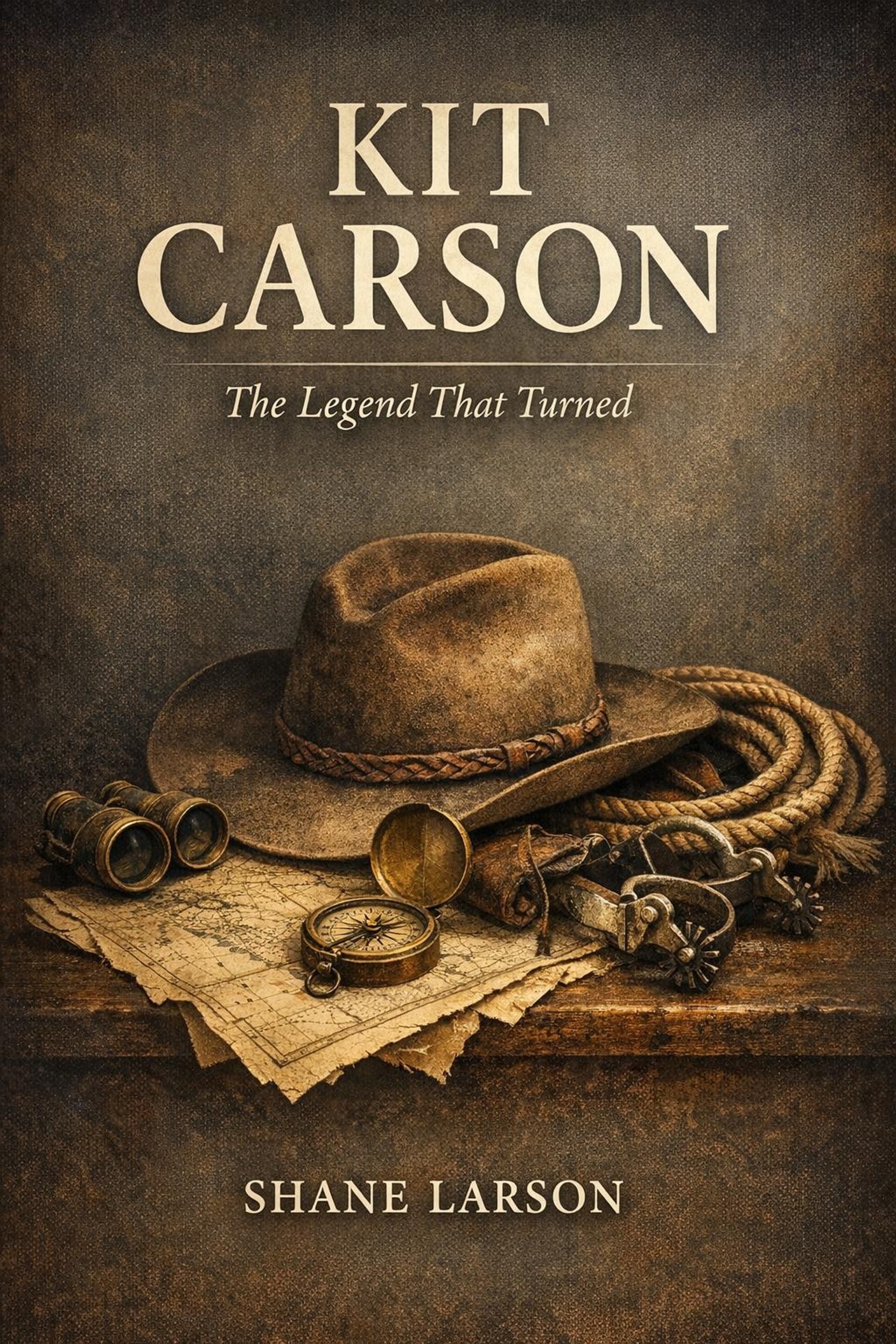
The whole story — the runaway, the trapping years, Frémont, the novels, the Navajo campaign, and the reputation that turned — is the subject of my book Kit Carson: The Legend That Turned. It tracks the printed Carson alongside the real one, event by event, and it does not deliver a verdict: not a defense, not a prosecution, the record — laid out precisely enough that the sorting is yours to do. If the gap between the man and the book in that camp stays with you the way it stayed with him, this is the biography that takes it seriously.
Kit Carson
New posts and releases, straight to your inbox. No spam, unsubscribe anytime.