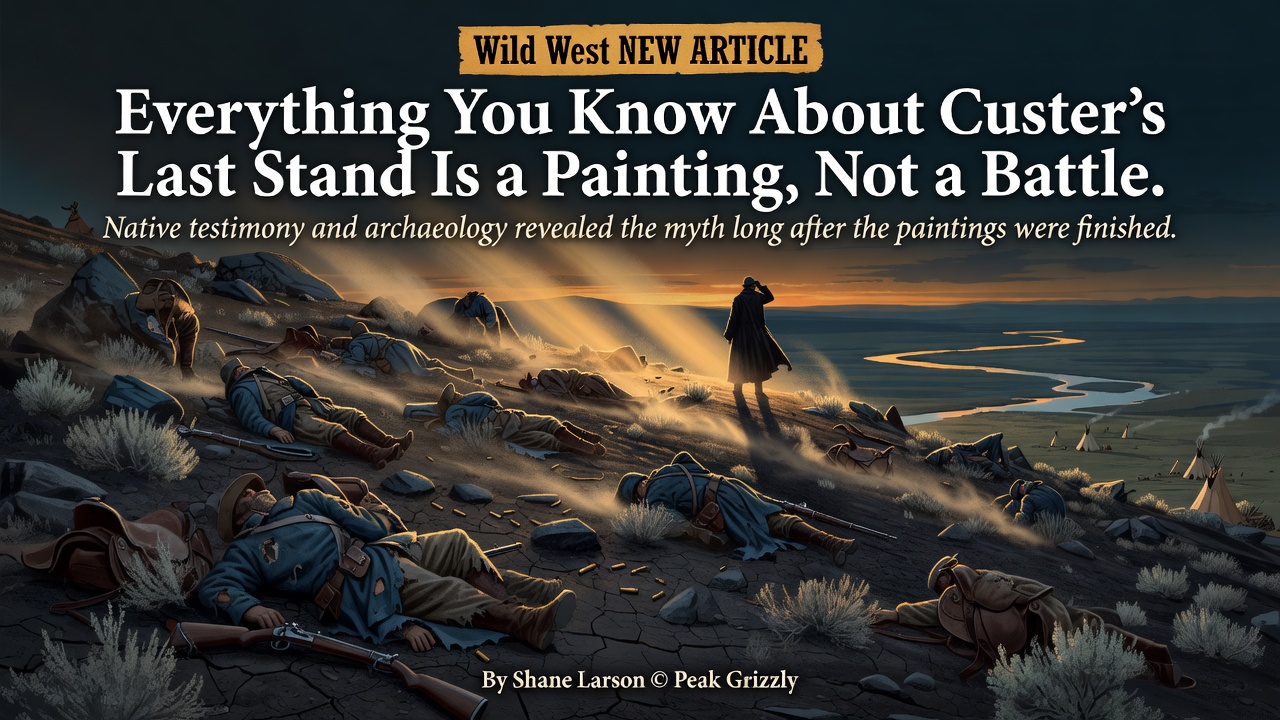
Everything You Know About Custer's Last Stand Is a Painting, Not a Battle
July 28, 2026 · 7 min read
Close your eyes and picture Custer's Last Stand. You already know the image, because it is one of the most reproduced scenes in American history: George Armstrong Custer at the crest of a hill, long golden hair catching the sun, saber or pistol in hand, standing tall inside a shrinking ring of loyal troopers, selling their lives dearly against a howling sea of attackers. Heroic. Doomed. Noble to the last.
Almost every detail of that picture is wrong, and a surprising amount of it was wrong on purpose.
Custer did not have long flowing hair at the Little Bighorn; he had cut it short before the campaign. He almost certainly did not carry a saber; the Seventh Cavalry had left its sabers behind in the field. And there was, according to the best evidence we now have, no organized heroic ring, no defiant last-man-standing tableau on the hill. The scene on the barroom wall is not a record of the battle. It is a painting — and behind the painting is one of the strangest and most revealing stories in the history of how Americans remember their own past.
The Silence That Made a Myth
Start with the fact that made everything else possible: nobody survived.
On June 25, 1876, Custer divided his regiment and led five companies — a little over two hundred men — north along the bluffs above the Little Bighorn River toward the largest Native village any of them had ever seen. Within an hour or two, every one of those men was dead. Not a single soldier who rode with Custer's immediate command lived to describe what happened to it. For the most famous part of the most famous battle of the Indian Wars, the U.S. Army had no witnesses at all.
Think about what that means. A void that complete is not neutral. It is an invitation, and in the grief and fury of the summer of 1876 — the news arrived during the nation's hundredth-birthday celebrations, a thunderclap in the middle of the party — plenty of people were eager to accept the invitation and fill the silence with the story they needed. The press needed a martyr and manufactured one within days: "Custer's Last Stand" was born in headlines before anyone had any idea what had actually occurred on that ridge. Frederick Whittaker rushed out a worshipful biography that canonized Custer as a fallen hero. A lithograph commissioned by the Anheuser-Busch brewery — the dramatic, entirely imagined "Custer's Last Fight" — was distributed to saloons across the country and became, for millions, the definitive picture of the battle. Buffalo Bill Cody staged the Last Stand in his Wild West show as mass entertainment while men who had been on the campaign were still alive.
And presiding over all of it, for fifty years, was the most formidable myth-maker of them all: Custer's widow. Elizabeth "Libbie" Custer was thirty-four when her husband died, and she lived to be ninety, spending the rest of her long life defending and burnishing his image. She wrote three bestselling memoirs that fixed the heroic Custer in the public mind. And through her considerable social influence, she made it costly for any officer to publish a less flattering account — the kind of thing that gets remembered by ambitious men with careers to protect. She outlived nearly all of them. By the time it was safe to tell a more complicated story, most of the people who could have told it were gone. It was, quite simply, one of the most successful public-relations campaigns in American history, run by a grieving widow on behalf of a dead man.
The Two Witnesses Nobody Wanted
Here is the thing, though. The silence at the center of the Little Bighorn was never really total. There were witnesses to Custer's battle — thousands of them. They were just the wrong witnesses, in the eyes of the people writing the history.
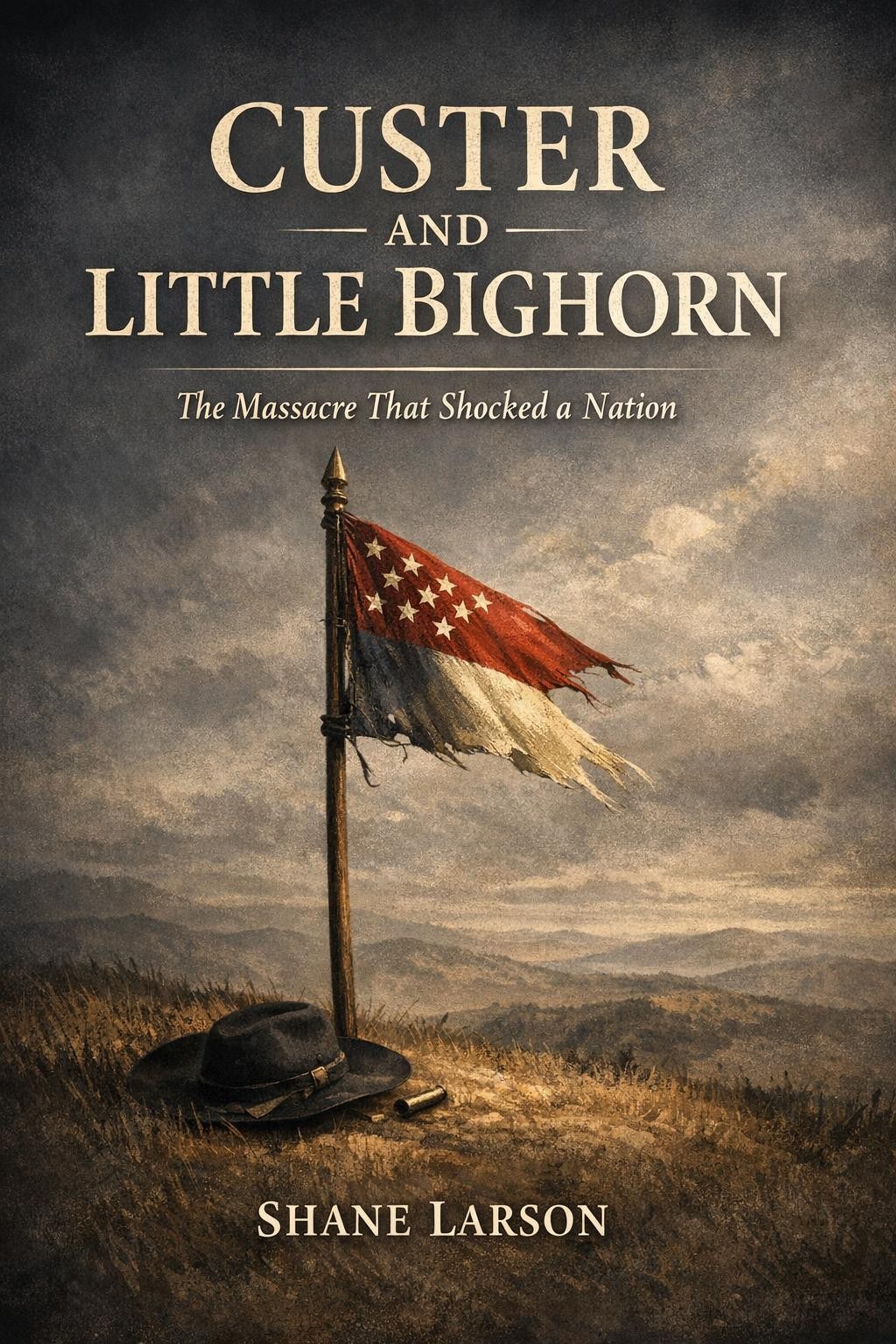
Custer and Little Bighorn
They were the Lakota and Cheyenne warriors who had won the fight. Across the decades that followed, many of them told their stories — to army officers, ethnographers, journalists, and interpreters — and their accounts were remarkably consistent with one another. They did not describe a gallant ring of heroes making a stand. They described a fight that came apart fast: soldiers losing their order and their nerve, a battlefield choked with dust and gunsmoke, a collapse rather than a defense, the whole thing over shockingly quickly. For a hundred years, white historians largely dismissed this testimony as unreliable, self-serving, or beneath serious attention. The people best positioned to say what happened to Custer were the very people the culture had decided not to believe.
There was a second witness, too, and this one could not be waved away, because it had no point of view to defend. It was the ground itself. In 1983, a grass fire swept the Little Bighorn battlefield and burned off the cover that had hidden it for a century. The archaeologists who arrived the next year did something that had never been possible before: they walked the entire field with metal detectors and recorded the precise location of every artifact they found — thousands of cartridge cases, bullets, buttons, and fragments of bone.
Then came the master stroke. Using a forensic technique borrowed from criminal ballistics, they examined the microscopic marks that a gun's firing pin and extractor stamp onto a cartridge case — marks unique to each individual weapon, like a fingerprint. By matching those marks, they could identify individual guns and then plot every case fired by each one across the battlefield. The result was something close to a play-by-play of the fight, written in brass and lead: this weapon fired here, then here, then thirty yards that way. And the pattern the cartridge cases revealed was unmistakable. It was not a static defensive ring. It was movement, and disintegration — skirmish lines forming and dissolving, positions shifting and collapsing, a battle coming apart across the slopes.
In other words, the ground told exactly the same story the Lakota and Cheyenne had been telling for a century. Two witnesses that the myth-makers had ignored — the Native testimony and the archaeology — arrived, from completely different directions, at the identical battle. And it was not the battle on the lithograph.
A Better Story Than the Myth
I understand the appeal of the Last Stand. A ring of doomed heroes is a clean, tragic, flattering image, and clean tragic flattering images are what nations tend to want from their history. But the real Little Bighorn, the one the evidence gives us, is a better story — harder, sadder, and far more human.
It is the story of a fading celebrity soldier, brave and gifted and reckless, so hungry to recover the fame of his Civil War youth that he threw a divided, exhausted regiment at the largest gathering of Plains peoples in living memory rather than risk letting it slip away. It is the story of a campaign that was, in plain documentary fact, the enforcement arm of a broken promise — the United States had guaranteed the sacred Black Hills to the Lakota by treaty, then found gold there and manufactured a war to take the land back, a theft the Supreme Court itself would rule illegal a century later. It is the story of Sitting Bull and Crazy Horse and thousands of people fighting, and for one stunning afternoon winning, in defense of their families and their way of life — a victory that would bring down on them everything the United States could muster, and end, fourteen years later and with the same regiment present, in the massacre at Wounded Knee.
None of that fits on a beer-company lithograph. All of it is true, and knowable, and better than the myth. When you strip away the golden hair and the heroic ring, what remains is not a smaller story. It is a truer one — about hubris and a broken treaty, about a people's desperate victory and its terrible price, and about how a nation, handed a defeat it couldn't bear during its own birthday party, chose to paint a hero over the hole in its history rather than look into it. The book goes into all of it: the man, the war, the battle rebuilt from its best evidence, and the long, revealing story of the myth and its unmaking. If the painting has ever bothered you — if you've ever suspected there was more to that ridge than the ring of heroes — this is the battle underneath it.
Custer and Little Bighorn
New posts and releases, straight to your inbox. No spam, unsubscribe anytime.