Who Wrote the Monteagle Letter? The Four Suspects in the Gunpowder Plot's Oldest Mystery
November 3, 2026 · 8 min read
On the evening of Saturday 26 October 1605, William Parker, Lord Monteagle, sat down to supper at his house at Hoxton, then a village north of the City. It was a house he had not, by most accounts, been using much. Some time after seven a footman came in with a letter. A man he did not know, fairly tall, his face unreadable in the dark, had stopped him in the street and told him to put it into his master's hands. It had no signature and no date. Monteagle glanced at it and then did the thing that has puzzled everyone who has looked at the evening since: he passed it to Thomas Ward, a gentleman of his household, and asked him to read it aloud to the table.
What Ward read was about a hundred and fifty words long, in an unremarkable hand and barely punctuated. It survives in the National Archives at Kew, in the bundle known as the Gunpowder Plot Book. Its writer professed a care for Monteagle's safety out of love for some of his friends, advised him to find an excuse to stay away from the coming Parliament, said that God and man had agreed to punish the wickedness of the time, and warned that Parliament would receive, in modernised spelling, "a terrible blow" and not see who struck it. Burn the letter, it ended, and the danger would be past.
What it does not say matters more. It names no place, no day beyond the Parliament, no method and no person. There is no powder in it, no cellar, and no Catholics. It is precise about exactly one thing: Monteagle must not be in the chamber. Whether the writer also wanted the government to read it is the question that divides the suspects.
Nine days with a warning in hand
Monteagle did not burn it. He rode that night to Whitehall and found Robert Cecil, Earl of Salisbury, the king's principal secretary, about to sup with several privy councillors. The King's Book, the official narrative printed within weeks, has the councillors baffled: perhaps a fool's letter or a malicious joke, too vague to act on, best left for the king. Salisbury's own letters to the English ambassadors abroad say the lords guessed at once that the Parliament house was the target and powder the likely means, and chose to wait and let the business ripen. The two versions agree on the one thing that matters. The delay was deliberate.
James was hunting at Royston. He came back on 31 October and was shown the letter on Friday 1 November. In the official telling he read it twice, joined the phrase about the blow to the line about burning the paper, and deduced gunpowder where his council had seen nothing. A search was ordered for the afternoon of Monday 4 November, and a second, thorough one for that night, which is when Sir Thomas Knyvet went down into the vault beneath the House of Lords with a lantern.
The plotters, meanwhile, knew. Ward was a friend of Thomas Wintour, Catesby's closest associate, and by Wintour's later confession someone came to his chamber on the Sunday night and told him what the letter said. Francis Tresham, the newest of the thirteen, was summoned and accused, and denied it so convincingly that two men who had meant to kill him let him go. On Sunday 3 November Catesby, Wintour and Thomas Percy met and decided to go on.
Nobody was ever charged with writing the letter. The official story needed the discovery to be providential and the king to be its instrument; a named informer would have made it a tip-off. Monteagle was rewarded as the saviour of the realm, and the question went into the files with the letter.
Suspect one: Francis Tresham
The case is obvious. Tresham had been sworn into the plot on 14 October, twelve days before the letter, and by his own account had argued against the enterprise and in particular for warning the Catholic peers. Two of his sisters were married to peers who would be in the chamber, Lord Stourton and Monteagle himself. If anyone inside the circle was going to break it, he was the likeliest.
The weaknesses are as plain. The letter is not in Tresham's hand, or in any hand convincingly matched to him, which leaves the case resting on motive alone. As Monteagle's brother-in-law he could have warned him in person, and the letter's vagueness is a strange choice for a man who wanted nothing more than his sister's husband at home. And he died in the Tower on 23 December 1605, under examination and in great pain, without ever claiming to have written it, at a time when having saved the king's life was the one thing that might have saved his own.
Suspect two: Anne Vaux
Anne Vaux had sheltered the Jesuit superior Henry Garnet for the better part of twenty years, and by her own 1606 examinations she had noticed the horses and the talk that autumn, feared some dangerous enterprise, and begged Garnet to stop it. She belonged to the same web of Vaux, Tresham and Catesby kinship as Monteagle's wife. A warning to one carefully chosen Catholic peer, worded so that it identified nobody, fits a woman who guessed that something terrible was coming, did not know the details, and could not denounce her own kin. Comparisons of the hand with hers have produced resemblance rather than identity.
The Powder Treason
Against her: no document connects her to the letter at all. She was questioned at length in 1606 by men hunting for any thread that led to the Jesuits, and nothing in her examinations suggests anyone suspected her of writing it. Her candidacy is a modern hypothesis with no evidence beyond the fit.
Suspect three: Monteagle himself
The third theory is that Monteagle had already learned of the plot from someone in his circle and arranged the letter as a way of bringing it to the government without naming his source or admitting he had been told. The circumstances fit oddly well. He was at a house he rarely used, on the one evening a letter was delivered there. He had it read aloud in front of witnesses, by a gentleman on friendly terms with Wintour, which both attested the delivery and guaranteed that the plotters would hear of it and have a chance to flee. He took it straight to Salisbury and was rewarded, by most accounts, with lands worth two hundred pounds a year and a pension of five hundred. When the confessions were edited for print, his name was left out of a passage about the earlier approaches to Spain in which he had taken part.
The trouble is that every piece of this has an innocent explanation. Reading the letter aloud is what a man might do if he wanted it on record that he had hidden nothing, and the government had every reason to protect the man who brought it. The theory also requires him to have been at once a man of deep cunning and a man willing to hand the plotters a week's warning they might have used to kill him.
Suspect four: Salisbury's office
The most radical case, argued by Catholic writers in the seventeenth century and at full length in 1897 by the Jesuit historian John Gerard, no relation to the priest of the same name in the plot, is that the letter was written by or for Salisbury. On this view the government already knew of the conspiracy from an informer and needed a way to bring it into the open that would protect the source, make the discovery look providential, and give the king a part.
The weaknesses are serious. There is no document. The theory supposes a command of events that the government's conduct after 5 November does not show: the first proclamation named only Percy, and the plotters rode out of London unwatched. It requires Salisbury to have deliberately warned the conspirators that they were compromised, which very nearly caused their flight. And it does not explain why a government that already had the plotters' names did not simply arrest them.
The others
A Worcestershire tradition names Monteagle's sister Mary Habington, whose husband owned Hindlip Hall, where Garnet would be found in January. A few writers have looked at Percy, at Christopher Wright, and at others inside the circle. None has more evidence behind them than the four above.
What can actually be said
The letter has kept its secret for four hundred years. The evidence does settle something, though, and it is not about the author. The letter was real; its delivery was witnessed at a supper table the night it arrived. It was in Salisbury's hands on 26 October, and the government then held a warning of an attack on Parliament for nine days and let the plot come to the point of a lit match before it moved. S. R. Gardiner, answering Gerard in 1897, made the case that has held since: a real plot, Catesby's plot, confessed to separately and consistently by men facing death who never blamed the government for it. Mark Nicholls and Antonia Fraser land broadly in the same place, with one addition most historians now accept: Salisbury probably knew what he was dealing with from the evening the letter arrived, and may have had word of something earlier, though nothing now proves it.
So the better question may not be who wrote the Monteagle letter. It may be what Robert Cecil did with the nine days after he read it, and that question, unlike the first, has an answer. He waited.
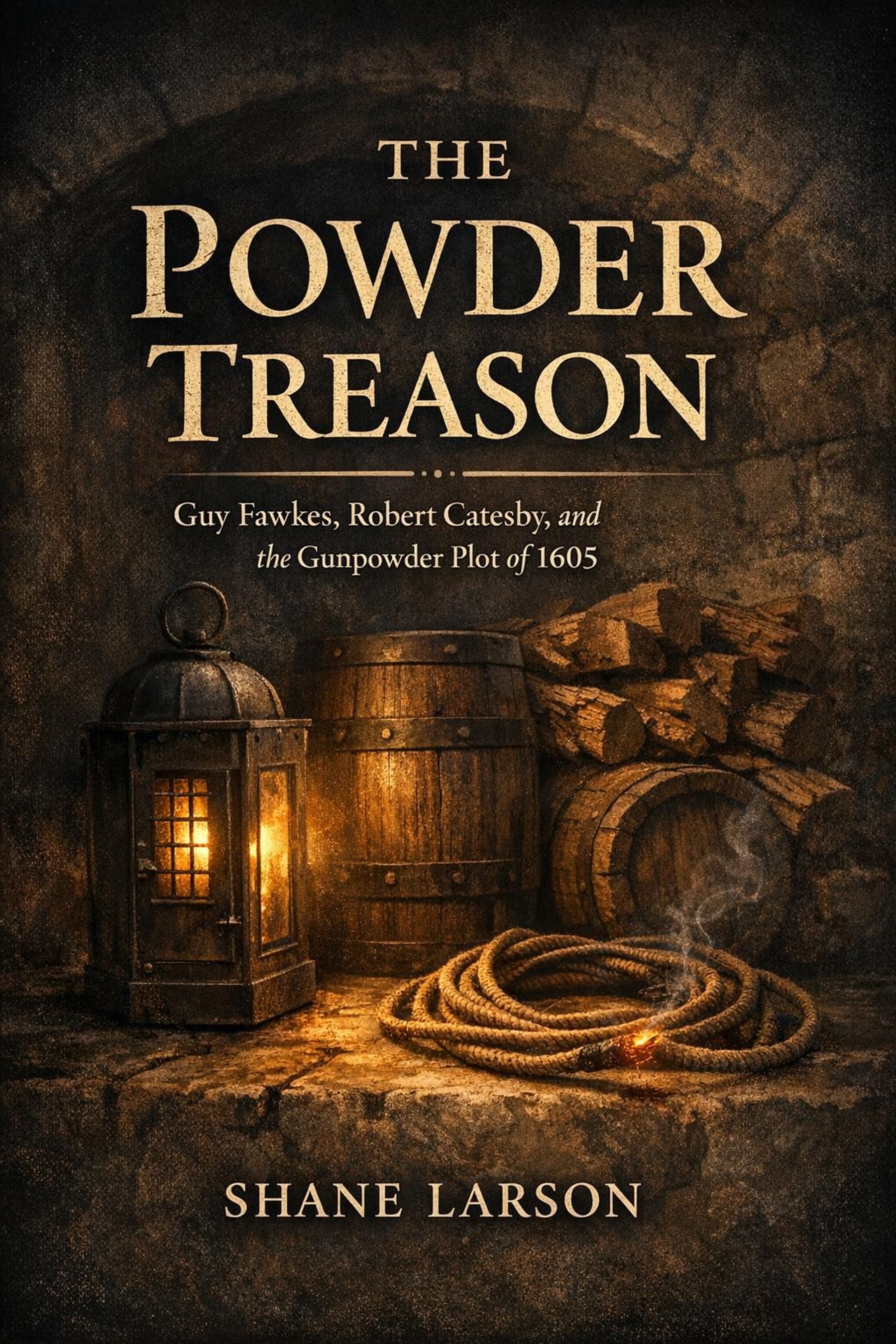
*The Powder Treason: Guy Fawkes, Robert Catesby, and the Gunpowder Plot of 1605* is a standalone history on the English-history shelf, beside *Elizabeth I* and *Mary, Queen of Scots*. It gives the Monteagle letter a chapter of its own, sets the persecution of Catholic England beside the plot it produced without letting either excuse the other, and prints the letter in full, in modernised spelling, in the appendix on the documents.
The Powder Treason
New posts and releases, straight to your inbox. No spam, unsubscribe anytime.