Catherine Parr Published Three Books. The Third Had to Wait for Henry VIII to Die.
October 30, 2026 · 8 min read
Ask what Catherine Parr is known for and the answer is a verb from a nursery rhyme. Ask what her own century knew her for and the answer is on a title page. In the summer of 1545 Thomas Berthelet, the king's printer, put out a small book of prayers from his shop in Fleet Street. What was new was the line under the title. The title page described the book as collected out of holy works by the most virtuous and gracious Princess Katherine, queen of England, France and Ireland.
It is sometimes said that she was the first woman to publish a book in English under her own name. The safer claim is the narrower one, and it is still large enough: no queen of England had ever done it. Margaret Beaufort, Henry VII's mother, had put her name to printed translations from the French forty years earlier, but she was never a queen. Catherine of Aragon had paid the humanist Vives to write a treatise on the instruction of Christian women. Anne Boleyn had kept French evangelical books in her chamber and lent them out. None of them had made a book in English and sent it to the press as her own. Catherine Parr did it three times in four years, and the three books, read in order, tell a story the rhyme leaves out.
1544: the book with no name on it
The first came out in the spring of 1544, also from Berthelet, and carried no author at all. Psalms or Prayers is a free English rendering of some fifteen psalm-prayers from a Latin book by John Fisher, the bishop of Rochester whom Henry had executed in 1535. The psalms are turned into prayers in the first person, and the volume closes with two more: a prayer for the king, and a prayer for men going into battle, asking for victory with as little bloodshed and as little harm to the innocent as might be.
The timing is the point. It appeared a month or so before Cranmer's English Litany, the first service of the English church set wholly in the vernacular, and a few weeks before Henry sailed for France and left his wife regent and governor of the realm. A book of war prayers from the king's own printer, in the king's own language, in the season the king went to war, was a political object whether or not it meant to be. That Catherine was behind it is an inference rather than a fact: the printer, the format, the family likeness to the signed book of the next year, and the habit the two had of being bound together afterwards. She had not yet put her name to anything.
1545: the book that signed
Prayers or Meditations is the one she signed. Its spine is the third book of Thomas à Kempis's Imitation of Christ, which Catherine knew through the English translation Richard Whitford had made around 1530 for the nuns of Syon. The original is a dialogue between Christ and the disciple. She kept the disciple's part, dropped Christ's, and cut the passages that belonged to the cloister, so that what remained was a single human voice addressing God without interruption. It opens with a petition to the most gracious Lord Jesus to grant her his grace.
The word on the title page is collected, not composed. The claim was modest and accurate; the name was the novelty. Berthelet reprinted it in November, and it went on being reprinted into Elizabeth's reign and beyond. Elizabeth herself, aged twelve, translated it into Latin, French and Italian as a New Year's gift for her father at the start of 1546.
What the book does not do is argue. A Carthusian of the 1520s and a Protestant of the 1560s could both have prayed from it without flinching, and that doctrinal quietness is why historians trying to pin down the queen's religion get so little purchase on it. The quietness was not accidental. In 1545 a queen who was known to favour the reformers could sign a book of prayers drawn from a fifteenth-century monk. She could not sign anything else.
Why a queen's name on a prayer book was a risk
The law had moved against readers two years earlier. The Act for the Advancement of True Religion of 1543 had restricted who might read scripture in English, and the King's Book of the same year had fixed doctrine where Henry wanted it, which was a long way short of where Catherine's circle stood. In 1546 the pressure became a campaign. A proclamation of 8 July ordered the English New Testaments of Tyndale and Coverdale, and the works of a list of named reformers, surrendered by the end of August for burning. Anne Askew, a Lincolnshire gentlewoman already condemned for heresy, was taken to the Tower and racked, by her own account with the Lord Chancellor and Sir Richard Rich working the machine themselves, and the questions put to her were about money and messages from women at court: the Duchess of Suffolk, Lady Denny, Lady Hertford and others in the queen's orbit. She gave them nothing, and was burned at Smithfield on 16 July.
Catherine Parr
Whether the queen herself was next is a question with one witness. John Foxe, in the enlarged 1570 edition of his Acts and Monuments, says that articles were drawn against her, a warrant for her arrest was signed, and she talked the king round in a single evening of submission. No warrant, no articles, no council entry and no ambassador's dispatch confirms it, and the book gives that problem a chapter rather than a sentence. What needs no Foxe to establish is the gap in her bibliography: after the signed book of 1545, the next new work under Catherine Parr's name waited until the autumn of 1547.
1547: the book that waited
Henry died on 28 January 1547. On 5 November that year Edward Whitchurch, one of the publishers of the Great Bible and a committed evangelical, issued The Lamentation of a Sinner, with the queen named on the title page and a note that it was published at the desire of the Duchess of Suffolk and the request of her brother, William Parr, by then Marquess of Northampton. The preface was by William Cecil, twenty-seven years old, a Gray's Inn lawyer in the service of the Lord Protector, and his name tied the dowager queen's book, in print, to the new regime.
It is not collected from anyone; it is hers, and it is the only one of the three in which she speaks about herself. In it the queen confesses that she had lived blind to the truth, trusting in her own works and in ceremonies and in the traditions of men, until she came to understand that salvation comes through faith in Christ crucified and through nothing a sinner can earn. She praises the king as a Moses who led his people out from under the Pharaoh of Rome, and she rebukes the gospellers who talk scripture in the tavern and live as they always did, a complaint Henry himself had made to Parliament at Christmas 1545.
That doctrine of justification is the reason the book could not have appeared while Henry lived. It cuts against the King's Book, and the Act of Six Articles that policed such things was still law until the Parliament that sat that winter repealed it. When she wrote it is less certain. Some passages read as though composed while the king was alive, and it has been argued that she finished the book in 1546 or earlier and kept it in manuscript because she could not safely publish it. The book treats that as plausible and unprovable. What is certain is the sequence: anonymous in 1544, signed but safe in 1545, and silent until the man who made it unsafe was in his vault at Windsor. A second edition followed in 1548, and her prayers were still being gathered into collections of women's devotion in the 1580s.
Why nobody remembers the writer
If a generation of English readers knew Catherine Parr first as an author, how did she end up as a one-word rhyme and a Victorian nurse? Partly because her books fell between the stools of later centuries, too Protestant for the Catholic revival and too full of à Kempis and Fisher for the evangelicals, so that nobody had a reason to keep them in print after Elizabeth. Partly because her letters sat in state papers that were not calendared until the twentieth century. Partly because Foxe, the one vivid source, made her the heroine of a story about giving way, and Agnes Strickland liked that story best. And partly because she died not as a queen but as Lady Seymour of Sudeley, in a private chapel in Gloucestershire, with no royal tomb and a grave that was lost for two hundred years.
Her motto as queen was To be useful in all I do. The books were the most durable use she made of her position, and they are the one place she can still be heard without an interrogator or a martyrologist in the room.
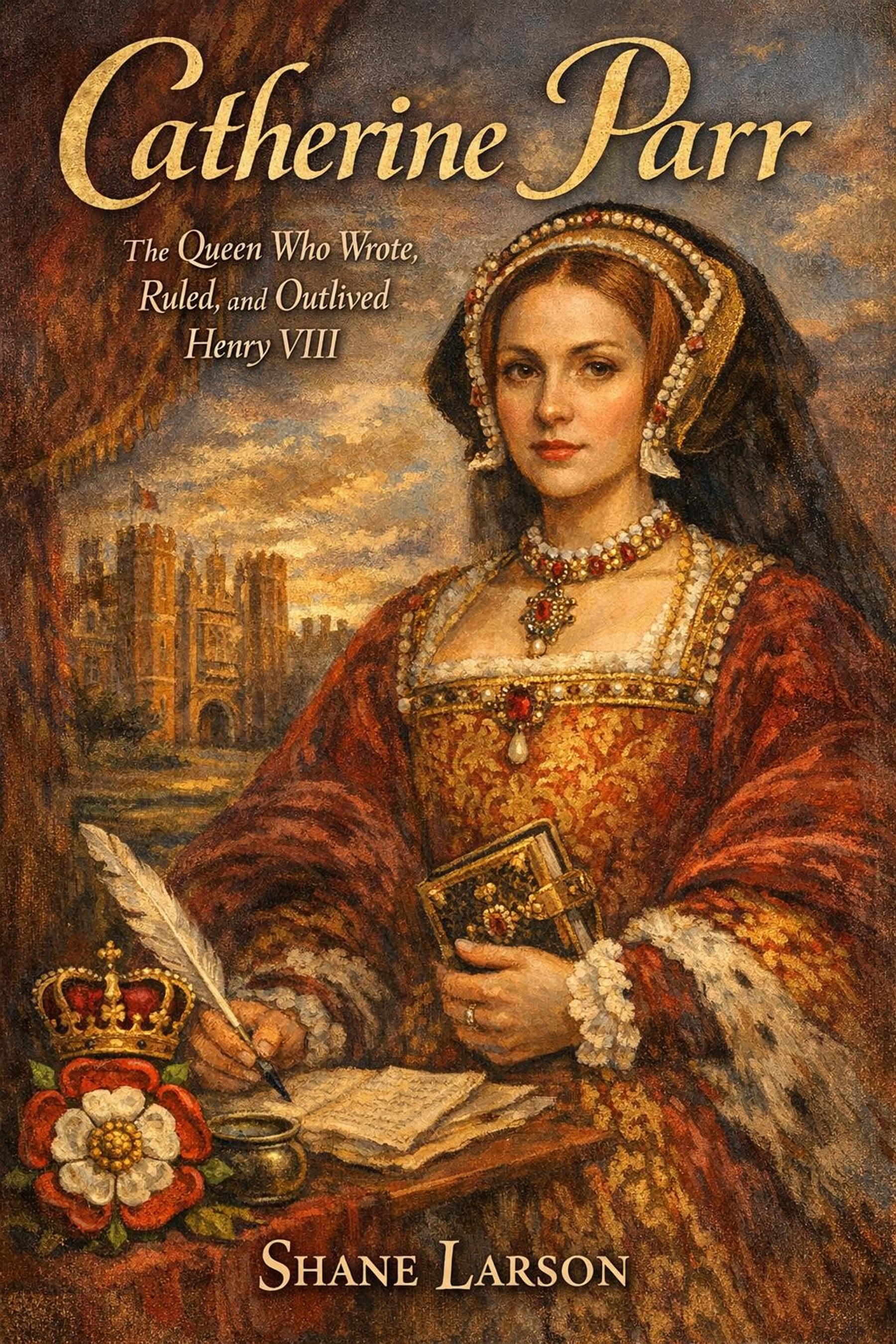
*Catherine Parr: The Queen Who Wrote, Ruled, and Outlived Henry VIII* is the sixth and closing volume of a series on the six queens of Henry VIII. It gives each of the three books its place in the story, works from the sixteenth-century printings rather than modern editions, and sets Foxe's account of 1546 out as Foxe's, with the evidence for and against it in the open. The marriage she made after Henry, and the man she made it with, belong partly to *Jane Seymour*, which tells Thomas Seymour's rise and fall from his own family's side; this volume tells the nineteen months from hers.
Catherine Parr
New posts and releases, straight to your inbox. No spam, unsubscribe anytime.