The Dead Man Walking: Why Doc Holliday Wasn't Afraid of Anything
June 29, 2026 · 5 min read
On a November day in 1887, a thirty-six-year-old man lay dying in a hotel-turned-sanatorium in Glenwood Springs, Colorado. His lungs were finally giving out after fifteen years of tuberculosis. By the most repeated account, he asked for a glass of whiskey, drank it, looked down at his bare feet, and said, "This is funny."
He had always expected to die with his boots on — shot down in some saloon over a card game. Instead John Henry Holliday died in bed, sober enough to laugh at the irony. He was the most feared gambler-gunman of the southwestern frontier, the man who stood at Wyatt Earp's shoulder near the O.K. Corral. And almost nobody who feared him understood that for the whole of his violent decade, he had been a dead man walking.
That single fact — that Doc Holliday was already dying through every gunfight, every card game, every threat he ever made — is the key that unlocks his entire life. Strip it out, and he's just another frontier shootist. Put it back in, and you understand why he behaved the way no one else did.
A respectable beginning
Holliday was not born to violence. He came into the world in 1851 in Griffin, Georgia, to a respectable Southern family, and grew up bright and well-schooled in the wreckage of the Reconstruction South. His mother died of tuberculosis when he was young — a loss that shadowed everything, because the disease that took her was almost certainly the one she passed to him.
He did everything a promising young man was supposed to do. He went north to the Pennsylvania College of Dental Surgery in Philadelphia and earned a genuine doctorate — Doc Holliday was a real doctor, just not the kind the nickname implies. He came home and opened a dental practice in Atlanta. He had manners, education, and a conventional future laid out in front of him.
Then, in his early twenties, came the cough. The diagnosis was pulmonary tuberculosis. The prognosis was a few months. There was no cure in the 1870s — only the standard, desperate prescription doctors handed to consumptives by the thousands: go someplace warm and dry, and hope.
So Doc Holliday went West to die.
The disease that chose his profession
Here is the mechanical reality that reshaped his life, and it's more interesting than any legend. A man dying of tuberculosis cannot reliably practice dentistry. He coughs. He coughs over the open mouths of his patients, in an age that already feared consumption as a death sentence, and the patients stop coming. The career he had trained for was physically incompatible with the disease that was killing him.
But a sick man can sit at a card table all night. Gambling asks nothing of the lungs. So Holliday drifted into the one profession his body would still allow — faro, poker, the long smoke-filled nights of the frontier gambling circuit. Dallas, Denver, Cheyenne, Dodge City, Las Vegas in New Mexico, Leadville, and finally Tombstone.
And tuberculosis didn't just choose his profession. It remade his temperament. Consider what it does to a man's calculations to know, with certainty, that he is already dying — slowly, painfully, on a schedule no doctor can stop. The ordinary fears that keep most people cautious simply evaporate. Why back down from a fight when the worst thing that can happen is a faster, cleaner death than the one already coming?
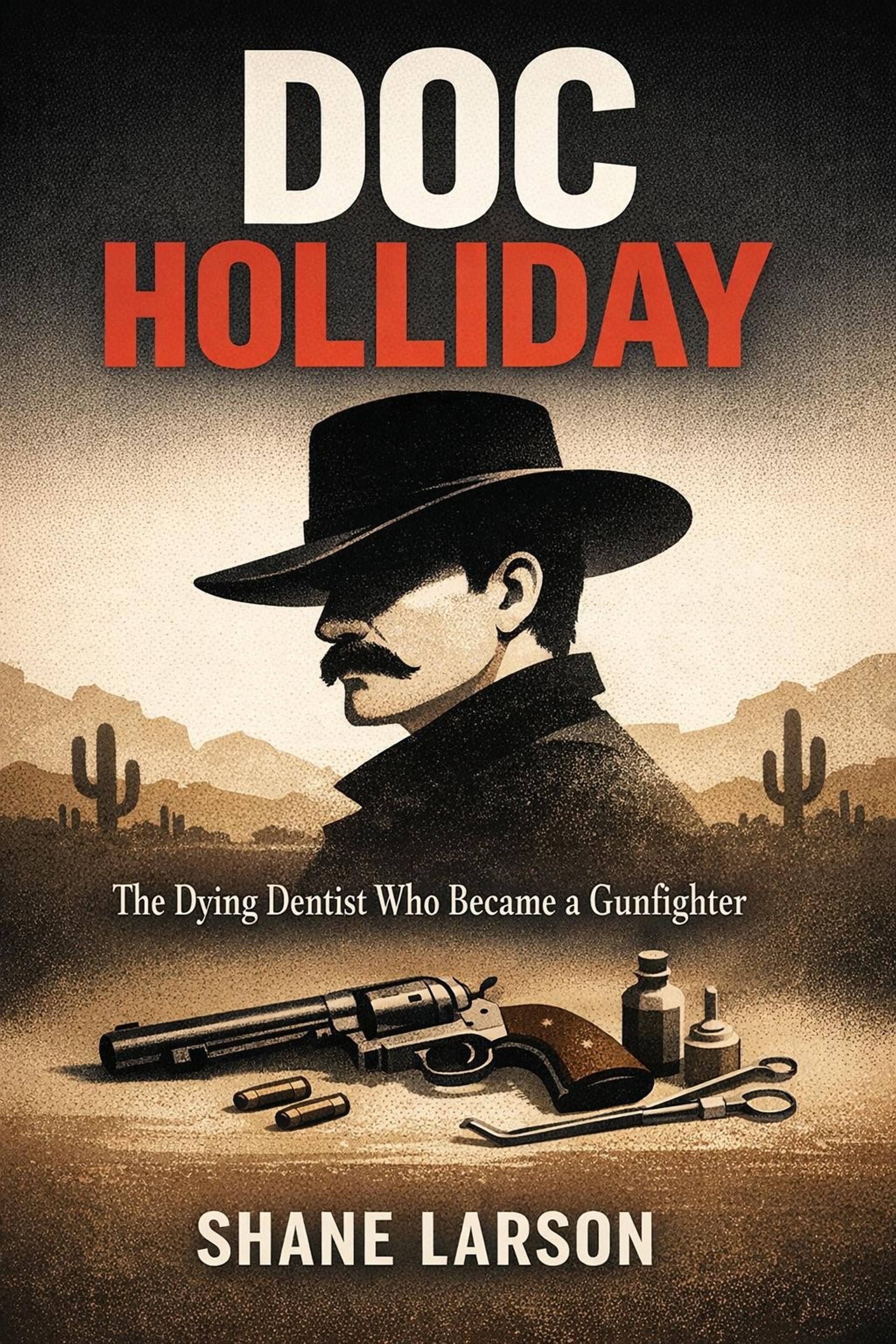
Doc Holliday
That fearlessness was real, and the frontier read it instantly. Holliday gambled hard, drank harder, and developed a reputation for a quick temper and a quicker hand with a knife or a pistol. A man who doesn't care whether he lives is the most dangerous man at any table.
The loyalty at the center
The strangest chapter of Holliday's life isn't a gunfight. It's a friendship.
In Dodge City, by the most credible accounts, Holliday intervened to save Wyatt Earp during a saloon confrontation — stepping in when Earp was outnumbered and might have been killed. From that moment, the two men were bound together, and it is one of the oddest pairings in American history. Earp was disciplined, ambitious, and barely drank. Holliday was a dissolute Southern gambler who drank constantly and lived as if tomorrow were optional. On paper they had nothing in common.
But Holliday was loyal in a way the frontier rarely produced. He had little to live for, and he poured what he had into that one bond. When the Earps went to war with the Cowboy faction in Tombstone, Doc Holliday stood with them in the vacant lot near the O.K. Corral on October 26, 1881. When Morgan Earp was murdered months later, Holliday rode on the Earp Vendetta Ride as one of Wyatt's most committed gunmen — his name landing on the same murder warrants. A man with nothing else to live for gave everything he had to a friend.
Where the legend outran the man
It would be easy to take the dime-novel version at face value, and plenty of writers have. The truth is more honest and, I'd argue, more compelling. Much of what is "known" about Holliday comes from later, embroidered memoirs and pulp fiction. The number of men he actually killed is far smaller and murkier than the legend claims. The details of the Dodge City rescue are debated. Even his famous deathbed line is uncertain.
Writing his story means saying so plainly — separating the documented shootings from the inflation, and letting the real man stand where the record actually supports him. He doesn't need the embellishment. The educated dentist rerouted by disease into violence and loyalty, dying by inches while building a legend, is dramatic enough on the strength of the facts alone.
The boots come off
The final act is the one the movies skip. After the vendetta years, Holliday's health collapsed for good. He drifted to Leadville, Colorado — broke, consumptive, scraping by at the tables, surviving one last shooting scrape. By 1887 he had wasted to barely more than a hundred pounds. He went to Glenwood Springs hoping the sulfur vapors might ease his lungs. They didn't.
He died there in November 1887, in bed, his boots off, at thirty-six. The gunfighter who spent his whole violent decade expecting to die in a saloon went out quietly, laughing at the irony. The disease that had built the legend finished the job it started fifteen years earlier.
That's the man behind the myth: not just the thirty seconds near the O.K. Corral, but the whole arc — Georgia boyhood, dental degree, death sentence, gambling circuit, the great friendship, the gunfight, the vendetta, and the lonely end. A life shaped from start to finish by a disease, and a loyalty he gave to one friend because he had nothing else to give.
Doc Holliday
New posts and releases, straight to your inbox. No spam, unsubscribe anytime.