The Gunfight That Didn't Happen at the O.K. Corral
July 31, 2026 · 6 min read
Say "gunfight at the O.K. Corral" and a whole movie unspools in your head: a wide, dusty corral, four grim lawmen walking abreast in long coats, a clean showdown between good men and bad men that the good men win. It's one of the most vivid images in American memory.
Almost none of it is right.
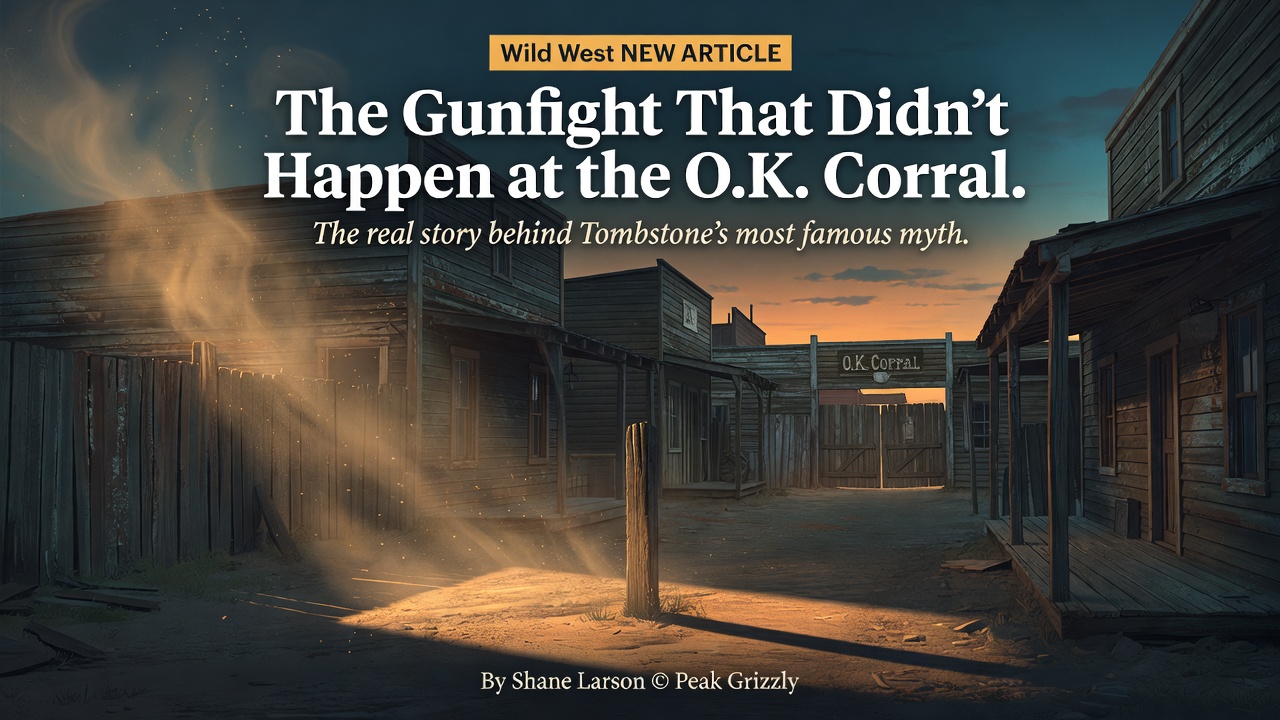
The most famous thirty seconds in the history of the American West did not happen inside the O.K. Corral. It happened in a narrow vacant lot off Fremont Street, near the corral's back entrance but not in it. The combatants didn't stride across an open yard; they bunched up in a gap between buildings barely wide enough to fit them all. And the fight was not a tidy clash of heroes and villains. It was the violent climax of a long, grinding feud that had been compounding for two years — over cattle, money, politics, and pride.
If you only know the screen version, the real story is better. It's just messier. And the mess is the point.
A silver town with a split personality
Tombstone existed because a prospector named Ed Schieffelin found silver in the hills of southeastern Arizona Territory in 1877. Soldiers had told him the only thing he'd find out there was his tombstone. He named his claim out of spite, and the boomtown that grew up around it took the name.
By 1881 Tombstone was a genuine city dropped into the desert — thousands of people, brick storefronts, an opera house, gas lighting, fine restaurants, a stock exchange, and saloons that never closed. But it sat in the middle of open ranch country, and that geography created two worlds that didn't trust each other. Inside town were the merchants, mine owners, and federal appointees — many of them Northern, Republican, and invested in order, because order is what protects property and profit. Out in the surrounding county were the ranchers: many Texas-born, Southern, Democratic, and resentful of the town's money and its airs.
Among those rural men was a loose, shifting network the newspapers lumped together as "the Cowboys." Some were honest stockmen. Some rustled cattle across the nearby Mexican border and robbed the occasional stagecoach. The categories blurred, which is exactly why the conflict got so poisonous: nobody could draw a clean line between rancher and rustler, and everyone had a reason to accuse everyone else.
The Earps were a business, not a posse
Into this walked the Earps. Virgil, Wyatt, and Morgan arrived in late 1879 with their wives, looking to make money the way ambitious men did in a boomtown — through gambling interests, real estate, stagecoach and mining ventures, and law enforcement, which paid in salary, fees, and reputation.
It matters that they came as a family. The Earps operated as a clan, watching each other's backs and pooling their fortunes. It also matters which Earp was actually the lawman. The movies fixate on Wyatt, but in October 1881 Virgil was the one wearing the badges that counted: Tombstone's city marshal and a deputy U.S. marshal. Wyatt was a gambler and sometime lawman with ambitions to win the county sheriff's office — a plum job, because the sheriff collected the county's taxes and kept a percentage. That office, and the political contest over it, sits underneath the whole feud.
Their rival for it was Johnny Behan, the county sheriff, a smooth Democratic politician aligned with the rural faction. Behan and Wyatt disliked each other over politics, over the sheriff's job, and — not trivially — over a woman, the actress Josephine Marcus, who would eventually leave Behan and spend the rest of her life with Wyatt.
Two years of friction, then thirty seconds
Stage robberies, missing livestock, and accusations traded in both directions kept the temperature climbing through 1880 and 1881. A bungled deal between Wyatt and Ike Clanton over reward money for some stage robbers left Ike terrified that Wyatt would expose him as an informer. By the night of October 25, 1881, Ike was drunk, frightened, and loudly threatening to kill the Earps and Doc Holliday to anyone who would listen.
Wyatt Earp & the O.K. Corral
The next morning he was still at it, now hungover and armed. Virgil pistol-whipped him and hauled him before a judge for carrying weapons in town. Tensions ratcheted as the McLaury brothers and young Billy Clanton rode in. Word spread that the Cowboys were arming and waiting near the O.K. Corral. Under a town ordinance that banned carrying firearms within the city limits, Virgil decided to go disarm them — and deputized Wyatt, Morgan, and Doc to back him.
Sheriff Behan tried to stop it and failed. The four men walked to the lot off Fremont Street. Behan said he'd disarmed the Cowboys; he hadn't. Someone said, "I have come to disarm you." Then the shooting started.
Nobody knows for certain who fired first. The testimony is genuinely contradictory, and any honest account has to say so. What we do know: about thirty shots in roughly thirty seconds at point-blank range. Billy Clanton and both McLaury brothers were killed. Virgil and Morgan were wounded, Doc was grazed, Wyatt was untouched. Ike Clanton — who had spent a day and a night promising to kill the Earps — ran from the fight unarmed and survived it.
The part the legend skips
Here's where the movie usually ends and the real story keeps going.
The Earps and Holliday were charged with murder. A month-long hearing before Judge Wells Spicer produced a mountain of sworn testimony — which is, ironically, why we know as much as we do. Spicer ruled the killings were not criminal, and the town split bitterly over whether justice had been done.
Then the Cowboys answered in the dark. In December 1881, Virgil was ambushed with shotguns from an unfinished building; his left arm was shattered and crippled for life. In March 1882, Morgan was shot dead through the glass door of a billiard parlor. The law indicted no one.
That failure is what broke Wyatt loose from the law. Carrying a deputy U.S. marshal's commission, he led what became known as the Earp Vendetta Ride — a three-week extrajudicial manhunt that killed Frank Stilwell in a Tucson rail yard, Florentino Cruz in the hills, and, reportedly, the Cowboy leader Curly Bill Brocius at a place called Iron Springs. Then, with Arizona murder warrants out for him, Wyatt rode out of the territory for good.
This is the moral heart of the story, and it refuses to resolve into a tidy lesson. The men Wyatt hunted had almost certainly maimed his brother and murdered another. The courts had done nothing. And what he did in response was, by any plain reading, a string of killings outside the law. Hero and vigilante stop being opposites.
How a local killing became a national myth
Wyatt Earp did not die in a blaze of frontier glory. He drifted for decades — Colorado, Idaho, San Diego, the Alaska gold rush, the Nevada mining camps — and finally landed in Los Angeles, where he hung around the young film studios and told actors how cowboys really moved and talked. He died in bed in 1929 at seventy-nine, a half-forgotten old man.
Two years later, a writer named Stuart Lake published Wyatt Earp: Frontier Marshal, a heavily embellished "as-told-to" biography that invented the clean, heroic lawman who would dominate film and television for the rest of the century. The Wyatt Earp most people picture is substantially a creation of 1931, not a record of 1881.
That gap — between the messy thing that happened and the clean thing we remember — is what Wyatt Earp & the O.K. Corral is really about. The Earps were neither saints nor monsters. The Cowboys were real men, not movie extras. And the legend itself is a historical subject worth studying, because how a country chooses to remember its violence tells you as much as the violence did.
Wyatt Earp & the O.K. Corral
New posts and releases, straight to your inbox. No spam, unsubscribe anytime.