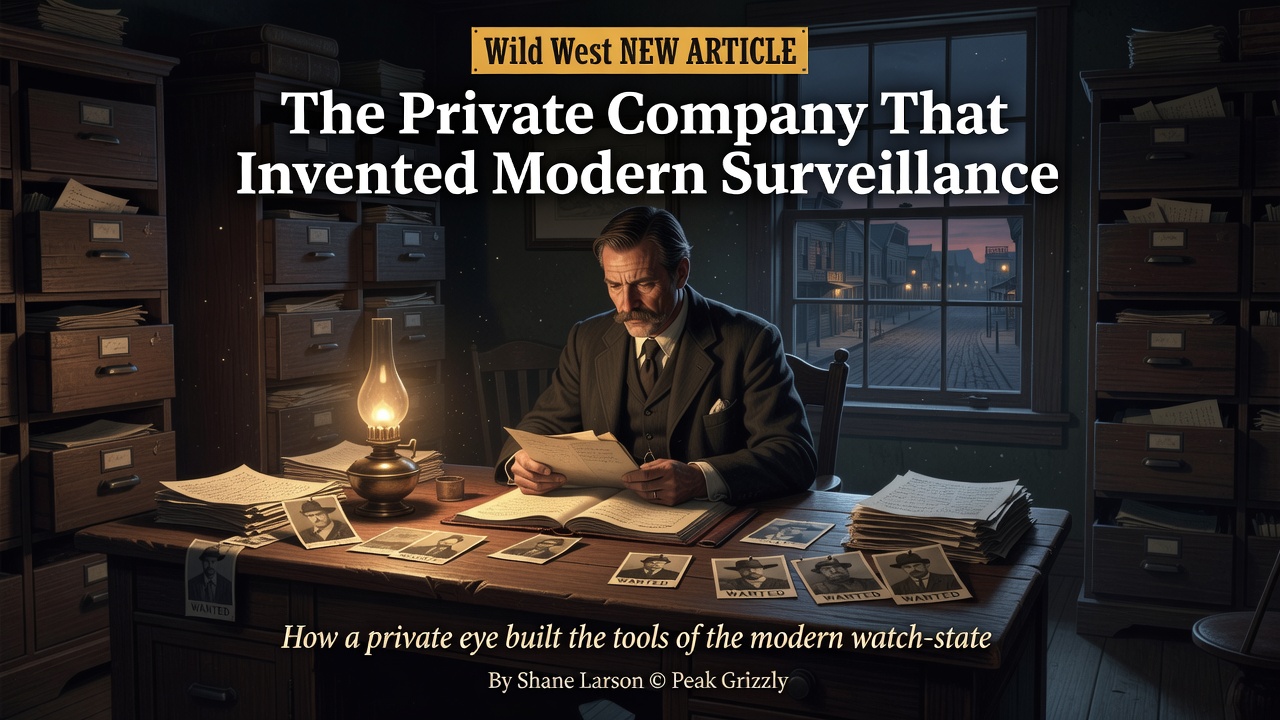
The Private Company That Invented Modern Surveillance
July 29, 2026 · 5 min read
We tend to think of mass surveillance as a modern invention — a product of the internet, the smartphone, the security camera on the corner. It is older than that. The tools that define how America watches its own people were largely built in the second half of the nineteenth century, not by a government, but by a private, for-profit company answerable to its paying clients. It was called the Pinkerton National Detective Agency, and its logo was a single open eye over the slogan "We Never Sleep." That logo gave the English language a phrase you still use: private eye.
This is the story of how a Chicago detective's shop became the ancestor of the FBI, the corporate-security industry, and the data brokers quietly assembling files on you right now.
A vacuum where the law should have been
To understand the Pinkertons, you have to understand how little law there was to go around. In the 1850s, the United States had almost no professional police. Big cities were just beginning to form uniformed departments. There was no federal detective bureau of any kind. Railroads and express companies were moving enormous sums of money across state lines through territory no single sheriff could cover, and when that money was stolen, there was often no one whose job it was to get it back.
Allan Pinkerton stepped into that vacuum. He was an unlikely founder: a radical Scottish cooper — a barrel-maker — and a Chartist agitator who fled Glasgow ahead of an arrest warrant and settled near Chicago. He stumbled into detective work almost by accident after helping break up a local counterfeiting ring, discovered he had a talent for it, and founded his agency around 1850. Within a decade he had built something genuinely new: a private, interstate investigative force that could operate anywhere a client could pay it to go.
That business model — privatized law, sold to whoever could afford it — is the key to everything the agency became, for better and for worse.
Inventing the tools of the watch-state
The Pinkertons did not just hunt criminals. They built the infrastructure for hunting criminals, and that infrastructure is what makes them matter.
They assembled a "rogues' gallery" — a systematic archive of criminal photographs — years before the word mug shot existed. They didn't stop at pictures. Each photograph was attached to a record: physical description, known aliases, criminal methods, known associates. Those records were cross-indexed and shared between the agency's branch offices, so that a suspect identified in one city could be recognized in another. In other words, they built one of the first systematic criminal databases in the world, and they networked it across a continent. This was federal-scale identification work, done by a private firm, decades before the federal government attempted anything like it.
They pioneered undercover infiltration as a deliberate, long-term method. They ran surveillance operations and kept what we would now call surveillance files. In 1856 they hired Kate Warne, widely recognized as the first female detective in the United States, on the logic that a woman could go places and win confidences a male operative never could. When Allan Pinkerton claimed in 1861 to have uncovered a plot to assassinate president-elect Abraham Lincoln in Baltimore and secretly moved him through the city, the agency briefly became the closest thing the Union had to a national intelligence service.
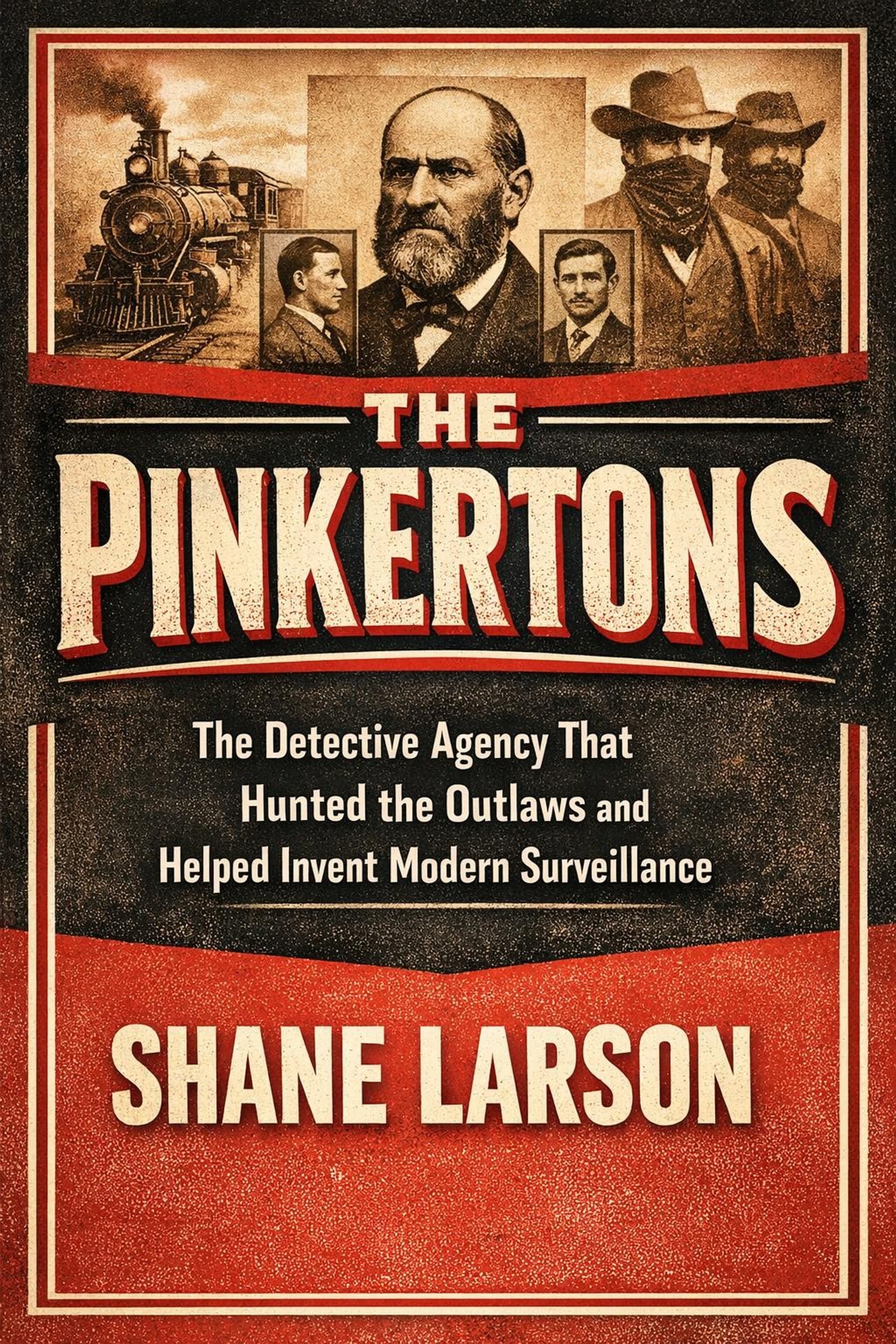
The Pinkertons
Every one of those innovations — the photographic identification archive, the cross-indexed criminal file, the undercover operation, the stakeout, the coordinated national manhunt — is now standard police practice. The Pinkertons got there first, and they did it as a business.
The manhunts that made the legend
The agency's fame, then and now, rests on its manhunts. Railroads and express companies hired it to run down the James-Younger gang, and the pursuit turned personal and bloody. It reached its low point on a January night in 1875, when operatives surrounded a Missouri farmhouse where they believed Frank and Jesse James were hiding and threw an incendiary device through the window. The brothers were not there. The blast killed their nine-year-old half-brother and maimed their mother. The raid was a public-relations catastrophe that turned much of Missouri against the agency and helped recast Jesse James as a Robin Hood figure — a folk hero made partly by the very people hunting him.
Decades later the agency pursued Butch Cassidy, the Sundance Kid, and the rest of the Wild Bunch across the West, with cowboy-detective Charlie Siringo on the trail, pressure that helped drive the gang all the way to South America. The agency even produced its own legend on the other side of the line: Tom Horn, who worked as a Pinkerton operative before drifting into the murky range-detective business in Wyoming, where the distance between "detective" and "hired killer" all but disappeared.
The other face: the private army of capital
There is a second Pinkerton story, and any honest account has to hold it alongside the first. After the Civil War, the agency became the private army of American industry. In the Pennsylvania coal fields, the operative James McParland spent years undercover among Irish miners, and his testimony helped send members of the so-called Molly Maguires to the gallows in 1877 — a case historians still argue about, precisely because so much of it rested on a single paid informant.
The agency's reputation reached its breaking point at Homestead, Pennsylvania, on July 6, 1892. Three hundred armed Pinkerton agents floated up the Monongahela River on barges to retake Andrew Carnegie's steel works from striking workers. The result was an all-day battle that left men dead on both sides and made the word "Pinkerton" a synonym for hired violence in the American labor movement. A congressional investigation followed, and within a year new laws were restricting the use of private armed agents. The same organization that defined the modern manhunt had become the most hated symbol of the strikebreaking era.
The long shadow
So what became of the eye that never sleeps? It never really closed. When the Bureau of Investigation — the future FBI — was founded in 1908, it studied and absorbed Pinkerton methods, from identification systems to case files. The agency's deeper legacy is structural: the model of privatized, client-driven intelligence-gathering survives today in the corporate-security industry and, most of all, in the data brokers who assemble, cross-index, and sell files on ordinary people — the exact business the Pinkertons pioneered, now running at digital scale.
That is the through-line worth sitting with. The American watch-state did not begin with a government program. It began with a private company, hunting outlaws for paying clients, building the file as it went.
The Pinkertons
New posts and releases, straight to your inbox. No spam, unsubscribe anytime.