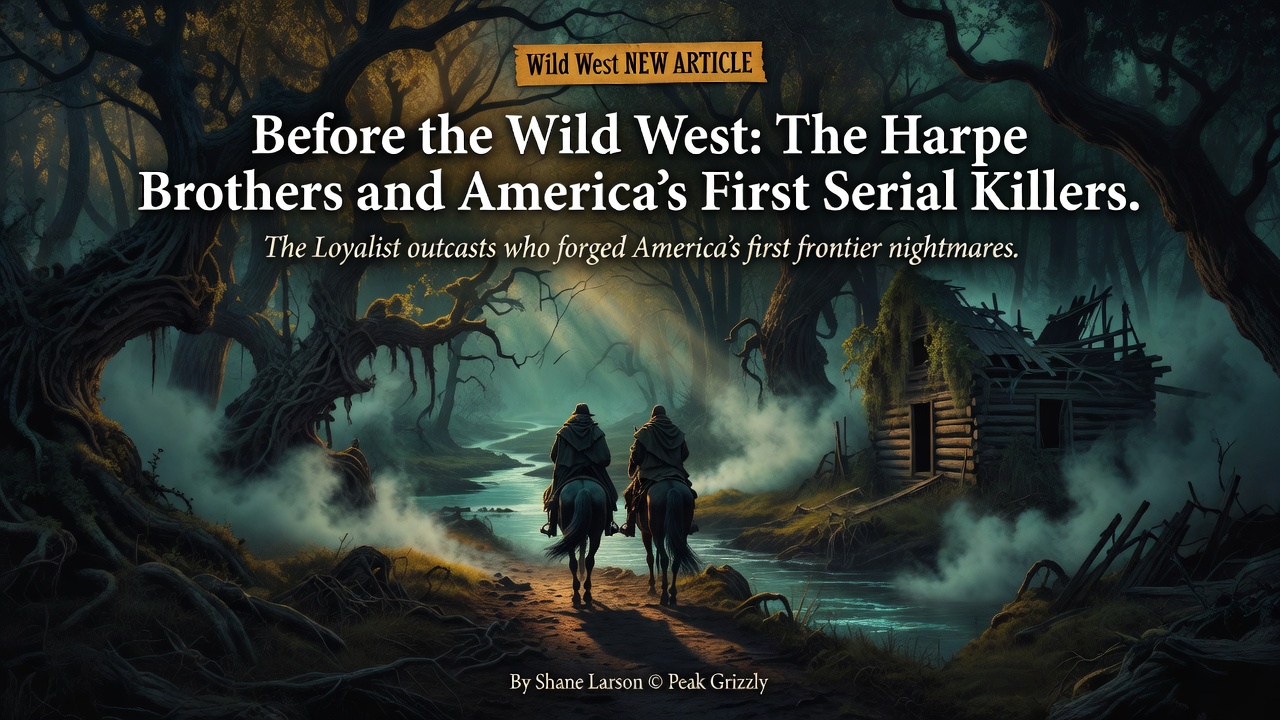
Before the Wild West: The Harpe Brothers and America's First Serial Killers
July 29, 2026 · 8 min read
Title: "Before the Wild West: The Harpe Brothers and America's First Serial Killers"
When we picture the violence of the American West, we reach for a familiar set of images: a dusty main street, two men squared off at high noon, a sheriff's badge, a hanging judge. That West is real enough. But it arrives late in the story. Decades before any of it, on a frontier that had barely been mapped, two men carved out a reputation so dark that the country had no language for it. Most historians now call them what the 1790s could not: America's first documented serial killers.
Their names were Micajah and Wiley Harpe — "Big" Harpe and "Little" Harpe — and their story is where the long, uneasy history of frontier justice actually begins. The brothers did not invent murder on the early American borderlands, but they gave it a sustained, almost impersonal character that stood apart from the usual disputes over land, livestock, or honor. Their crimes forced scattered settlements to confront a pattern rather than isolated acts.
Out of a war that never quite ended
The Harpes came out of the Revolution, but not the version we celebrate. They were born to Scots Loyalist families in the North Carolina backcountry, and by most accounts they rode with Tory raiders against the Patriot frontier during the brutal partisan war in the southern interior. That war was not the orderly affair of textbooks. In the backcountry it was neighbor against neighbor, ambush and reprisal, farms burned and men shot from cover. Bands like the one led by David Fanning operated with little central control, striking Patriot outposts and then melting back into the woods; the cycle of retaliation left entire counties depopulated for months at a time.
When it ended, the Harpes were on the losing side — Loyalists in a republic that had no place for them. They became what the era produced in disturbing numbers: men without a country, shaped by years of guerrilla violence, drifting toward the margins of a raw new nation. Plenty of such men reentered ordinary life. The Harpes did not. They drifted west instead, into the country opening up beyond the mountains, and somewhere along that road the violence stopped being a means and became, it seems, an end. Contemporary court records from North Carolina note the brothers' early brushes with local authorities over stolen horses and threats, small signs that the habits of the partisan years traveled with them.
A frontier without law
To understand how two men could kill for two years across several states, you have to understand what the late-1790s frontier actually was. The Wilderness Road and, further south, the Natchez Trace were the great arteries of westward movement — and they ran through country with almost no functioning government. There were few courts, fewer sheriffs, no coordinated pursuit, no telegraph to carry a warning ahead, no organized way for one settlement to alert the next. Kentucky had only achieved statehood in 1792; Tennessee followed in 1796. Between the scattered forts and the river landings, authority often amounted to whatever armed group happened to be present.
A traveler on those roads was, in a real sense, alone. Companions met on the trail were strangers trusted out of necessity. That is the vacuum the Harpes moved through. They did not need to be criminal masterminds; they needed only opportunity and the knowledge that, for a long stretch, no one was coming. The frontier's lawlessness was not a backdrop to their crimes. It was the precondition for them. Flatboat crews descending the Ohio or families pushing wagons over the Cumberland Gap carried their own weapons and their own suspicions, but they could not post guards every night for weeks on end.
The rampage
Between roughly 1797 and 1799, the Harpes cut a trail of murder across Tennessee and Kentucky. They traveled with three women — two claimed as wives — who would later be captured and put on trial. They killed with knife, tomahawk, and gun, and their methods became notorious: victims were sometimes disemboweled and weighted with stones to sink them in the rivers, a grim practical detail that also kept the bodies from surfacing to raise an alarm. One well-documented case involved a man named William Ballard, whose remains were recovered from the Tennessee River near the site where the Harpes had camped the night before.
What set the Harpes apart from ordinary frontier robbers was that plunder did not seem to be the point. They killed travelers who carried little. They killed, by every account, with a coldness and a frequency that horrified even a hardened backcountry accustomed to violence. The total number of victims is unknowable. Contemporary and later estimates range from the high twenties to forty or more — a span wide enough to tell you how thin the record really is. Survivors' accounts describe the brothers appearing suddenly on the trail, sometimes posing as fellow migrants, then turning without warning once trust had been established.
For a brief, ugly interval they intersected with the larger outlaw world of the frontier, sheltering among the river pirates who used Cave-in-Rock, a great limestone cavern on the Ohio, as a base to ambush flatboats. Even there, the story goes, the Harpes' gratuitous cruelty was too much, and they were driven out. Whether or not every detail of that episode is true, it captures something the sources agree on: the Harpes unsettled even the men who lived by violence. The pirates' own operations relied on quick, profitable attacks; the brothers' habit of killing without clear gain threatened to draw unwanted attention from downstream settlements.
The most infamous claim — and the limits of the record
No account of the Harpes can avoid the single most monstrous allegation attached to them: that Big Harpe killed his own infant child, by one telling because its crying annoyed him. It is a detail so terrible that it has defined the legend for two centuries.
It is also exactly the kind of claim a careful history has to slow down and examine. The Harpe story hardened into folklore almost immediately, passed through early-nineteenth-century chroniclers who were not above embellishment and who wrote decades after the fact. The worst, most cinematic details tend to be the ones that come down through the thinnest sources. A responsible account neither repeats them as established fact nor pretends they were never alleged. It lays out what the evidence supports, marks clearly where the record gives out, and lets the reader weigh it. That tension — between what happened and what was said to have happened — is one of the most honest and interesting parts of the whole story. Court testimony from the women who rode with the brothers confirms the presence of at least one infant during the final months, but the circumstances of its death remain confined to later retellings.
The reckoning
The end came in two acts. In the summer of 1799, after the Harpes murdered a settler's wife and her child, a posse finally ran Big Harpe down in the Kentucky barrens. He was shot from his saddle, and as he lay dying the husband of one of his victims took his head with a knife and carried it to a crossroads, where it was wedged into the fork of a tree and left as a warning. The place is called Harpe's Head to this day. The posse had been raised after the discovery of fresh graves along the road; the pursuit lasted several days through difficult terrain.
Little Harpe escaped south and went to ground along the Natchez Trace, falling back in with the river-pirate world. When a reward was posted for the bandit leader Samuel Mason, Little Harpe and a confederate murdered Mason for the bounty and tried to collect it — only to be recognized, arrested, tried, and hanged around 1804, his own head set on a pole beside the Trace. The identification came from a former captive who had seen the brothers years earlier; the hanging itself drew crowds that traveled for days to witness it.
There were no trials worthy of the name for what Big Harpe did, no due process, no institution capable of meeting the crime. There was a grieving husband, a borrowed horse, a knife, and a tree at a crossroads. That is not justice as we would recognize it. It is vengeance. But on that frontier it was the only answer available — and it is the rough, unsettling seed from which the posses, vigilance committees, and hanging judges of the later West would grow.
Why the Harpes still matter
It would be easy to file the Harpes under freak monstrosity and move on. The more useful way to read them is as a case study in what happens when human violence outruns every institution meant to contain it. They were a product of a specific moment — a war's bitter aftermath, a frontier without law, a road full of strangers — and they mark the dark starting line of the American West's long argument with its own violence. The same conditions that allowed the brothers to operate for two years also produced the first organized responses: neighborhood watches along the Trace, agreements between river landings to share descriptions of suspicious travelers, and, eventually, the territorial laws that followed statehood.
That is why their story is the prequel to everything else. Before the gunslingers, before the marshals and the hanging judges, the frontier showed exactly what it could produce, and how little stood in the way. Understanding the Harpes is understanding where the rest of the story comes from.
New posts and releases, straight to your inbox. No spam, unsubscribe anytime.