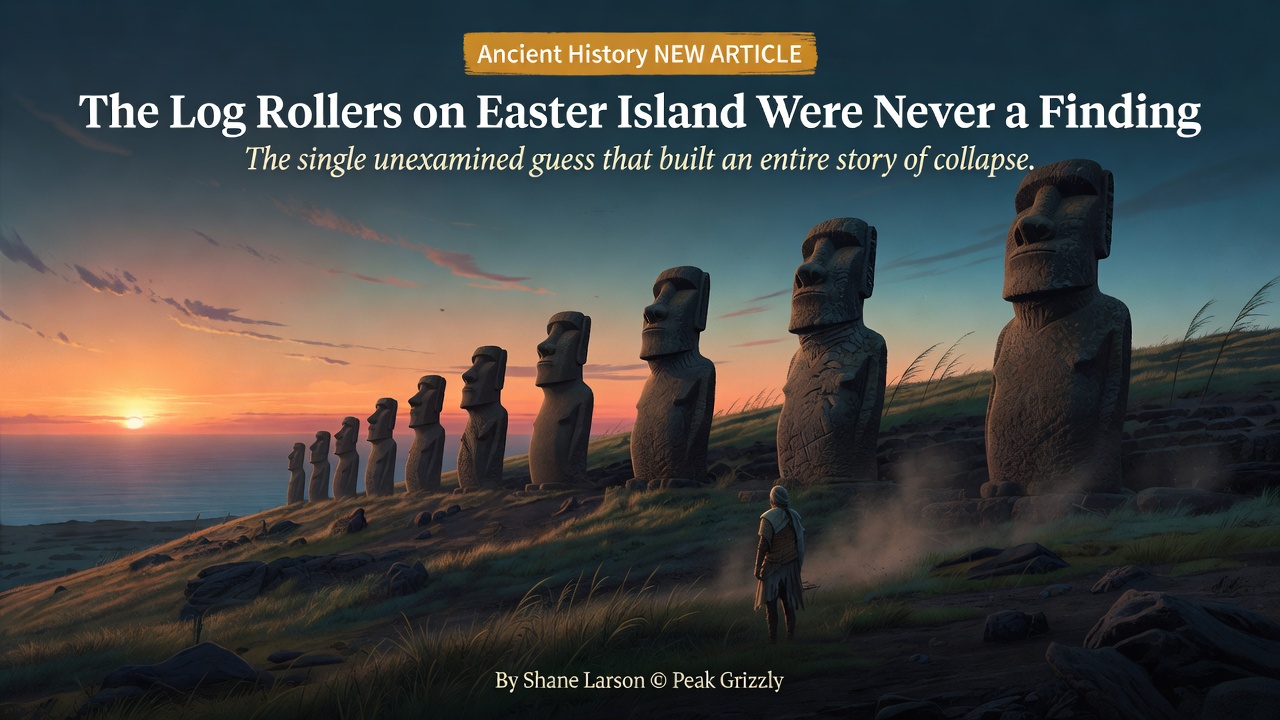
The Log Rollers on Easter Island Were Never a Finding
August 3, 2026 · 8 min read
Ask anyone how the statues of Easter Island were moved and you get the same answer, delivered with the confidence of common knowledge: they were rolled on logs. Sledges, rails, greased timber, gangs of men hauling — the details float, the material never does. Wood.
Now ask where that comes from.
No excavation produced it. There is no eyewitness account of a statue moved on timber, because by the time Europeans reached Rapa Nui in 1722 nobody alive had seen a moai travel, and within a few decades the practice had stopped entirely. No islander ever described rollers. There is no rope, no sledge, no worn timber track in the archaeological record. The log-roller answer is not a finding. It is an inference, made by visitors, from the contents of their own toolbox.
That would be a curiosity if the inference had stayed small. It did not. It became the load-bearing beam of the most widely told environmental parable of the last fifty years.
The answer arrived before anyone had asked the question
Europeans moved heavy stone with timber, cordage, and massed labour. Every engineer among them knew the rollers-and-sledge method, and every educated one had seen the ancient images of colossi dragged on sledges by lines of hauling men. Set that mind in front of a multi-tonne statue on a treeless island and the conclusion is instant — and it does not feel like a conclusion at all. It feels like seeing.
Watch what happened next, because this is the hinge. The island had almost no trees. That fact did not put pressure on the timber assumption — it was absorbed by it. There must once have been trees, and the statues must have eaten them. The absence became evidence for the assumption rather than a test of it.
Then, in the twentieth century, pollen cores showed that Rapa Nui genuinely had been forested, dominated by a large palm now extinct. That was a real discovery, carefully done, and it stands. But it landed on top of a premise nobody had audited, and the two locked together into a chain that looked like proof: forest, statues, deforestation, ruin. Thor Heyerdahl's expedition of 1955–56 hardened it further with a demonstration — islanders dragging a small moai lashed prone to a wooden sledge — which worked well enough, photographed beautifully, and settled the matter in the public mind for a generation. Later work refined the engineering without touching the premise. The competing reconstructions disagreed about everything except the wood.
And on that shared premise an enormous conclusion came to rest. If moving statues consumes timber, then the statue cult was a machine for eating the forest. The religion was the mechanism. Each moai was a down payment on catastrophe, and the islanders became the authors of their own destruction — which is precisely the feature that made the story so useful. A closed island, a finite resource, a people who could have stopped and did not. It reached its widest audience through Jared Diamond's Collapse in 2005, and it was told in good faith with the evidence then available. The point is not that anyone lied. The point is that the first link in the chain had never been examined by anyone, on any side.
The islanders said the statues walked, and for a century that counted as folklore
There was an alternative account available the entire time, and it was not vague.
Asked how the moai travelled from the quarry at Rano Raraku to the platforms, Rapanui said — consistently, across generations, to every ethnographer who bothered to ask — that the statues walked. Not that they were carried or dragged. Walked. Upright, along the roads, under their own motion, driven by the mana of a chief or a priest. Statues left lying beside the roads were statues that had stopped walking. Katherine Routledge recorded this during her 1914–15 survey, the first systematic archaeology done on the island, from elderly islanders whose grandparents' generation reached back toward the last era of statue activity. Later researchers heard the same thing. It was not a fringe tradition. It was the tradition, stable in its essentials in every recording of it.
For a century it was filed under folklore. The reasoning was rarely spelled out because it did not seem to need spelling out: stone statues do not walk, so a story that says they walked is a myth, so it contains no engineering information.
Nobody asked the question an engineer or a historian should ask of any persistent, specific, unanimous tradition — what would it look like, physically, if this were a description rather than a metaphor? What would a real method have to look like for the people watching it to reach for the word "walking"?
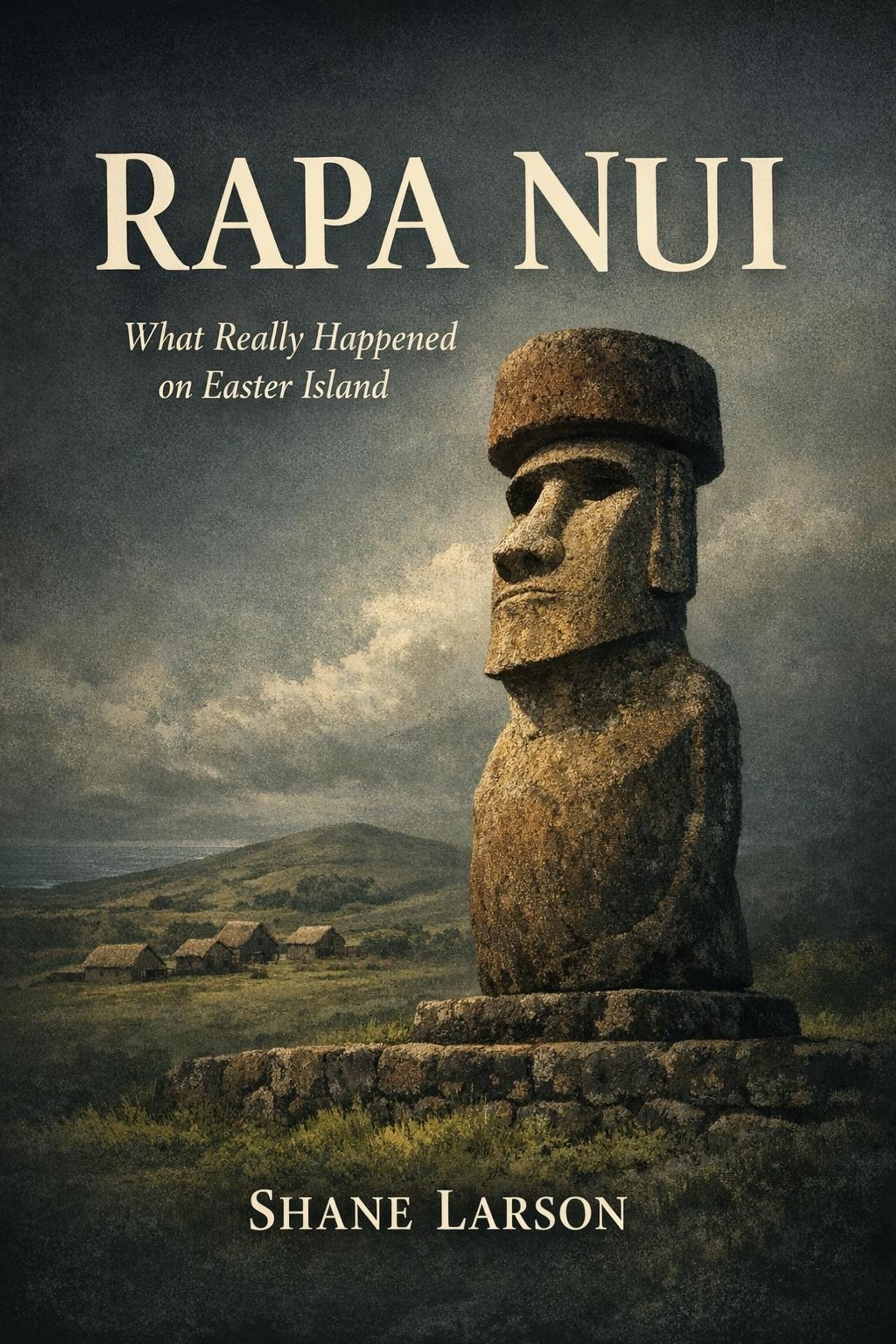
Rapa Nui
The dismissal was not even consistent with what was known about Polynesian oral tradition, which carried navigational star paths and sailing directions with a precision Europeans doubted repeatedly and had to concede repeatedly. Here is the part worth sitting with. The testimony was not tested and found wrong. It was discarded for not fitting a model that had itself never been tested. Between an untested European assumption and an untested Rapanui tradition, the assumption won for two hundred years, on the identity of who was speaking.
The evidence was lying beside the roads the whole time
Dozens of moai are strewn along the transport routes, and the old story read them as wreckage — statues dropped when the timber ran out or the society came apart mid-haul. Then Terry Hunt and Carl Lipo measured the road statues as a population and compared them to the statues that reached their platforms.
They are not the same shape. Road statues carry a pronounced forward lean, mass pitched ahead of vertical. And instead of the flat, stable foot you would give a statue meant to stand for centuries, they have a curved base, convex front to back — a D-shaped foot, wide at the leading edge.
For an object meant to stand still, both features are defects. For an object meant to move upright, they are what an engineer would specify. A tall mass with a rounded base and a forward bias does not need to be lifted or dragged. It can be rocked: tip it onto one edge, let its own weight swing it forward onto the other, repeat. Ropes high on the head, a team on each side, a third rope behind to check the lean, and the thing waddles — pivot, step, pivot, step.
The platform statues finish the argument. Moai that arrived and were erected show the transport features carved away: bases dressed flat, the lean corrected toward vertical, eye sockets cut only then. The corpus preserves two design stages, a travelling configuration and a standing one. And in 2012 Hunt and Lipo cast a 4.35-tonne replica with road-statue geometry and had eighteen people walk it a hundred metres in under an hour, chanting to keep time, with no wood touching the statue at all.
Be careful what that proves, because a counter-myth is as easy to build as a myth. It proves the method is physically real and that the odd shape of the road statues is functional. It does not prove any particular statue travelled that way in the fourteenth century. Experiments cannot prove the past. They establish what it could have contained.
The critics deserve better than a wave. Jo Anne Van Tilburg, whose statue survey is the most complete ever compiled, ran her own full-scale test moving a replica horizontally on a wooden frame, and it worked. Her objections are substantial: the walked replica was modest, while Paro — the largest moai ever erected — ran to something like eighty tonnes, and nobody has shown the gait scales. The replica's geometry was chosen for walkability, on a prepared surface, with no obligation to survive kilometres of broken volcanic ground where one dropped statue is unrecoverable. Real roads cross grades that sit awkwardly with rocking. The dispute is live and unresolved.
But notice that it no longer matters to the parable. Even the horizontal method, as costed by its own experimenters, uses a reusable frame and rails — a capital tool, not a bonfire of palms per statue. Whichever side eventually wins, the arithmetic that made statue-building the engine of deforestation is gone. The forest still vanished. The statues no longer explain it.
The failure here is not that somebody guessed. Guessing is how inquiry starts. The failure is that the guess was never labelled as one, so nothing downstream ever inherited its uncertainty. A moral verdict about a real population came to rest, four inferential steps later, on a claim about rollers that nobody had checked and nobody could source. The load kept increasing and the foundation was never inspected, because by then it had stopped looking like a foundation and started looking like background.
There is a second cost, harder to book. The people who knew were saying so the entire time, in plain language, to anyone who asked. Their answer was rejected for the wrong reason — not tested, just misfiled — and a century later it was rediscovered by outsiders and greeted as ingenuity. Testimony that does not fit a model tends to get read as decoration.
The practical version, for anything you are working on: find the claim in your own reasoning that everyone treats as background, and ask who established it. Sometimes the answer is a study. Sometimes the answer is that someone assumed it in 1770 and nobody has looked since.
Rapa Nui: What Really Happened on Easter Island is available now on Amazon Kindle.
Rapa Nui
New posts and releases, straight to your inbox. No spam, unsubscribe anytime.