The 1,427-Page FBI File on Albert Einstein
May 1, 2026 · 9 min read
In 1953, the State Department quietly looked into whether Albert Einstein could be deported.
The investigation was triggered by a letter Einstein had sent to a Brooklyn schoolteacher named William Frauenglass. Frauenglass had been subpoenaed by a Senate subcommittee investigating "subversive influence" in American education. He had written to Einstein for advice. Einstein wrote back, told him to refuse to testify, cited Gandhi-style civil disobedience, and said in plain language that what was happening in America in 1953 was the same kind of intellectual coercion he had fled from in Germany twenty years earlier.
The New York Times printed the letter. Senator McCarthy denounced Einstein on the Senate floor. The State Department took the matter seriously enough to ask the Justice Department whether the seventy-four-year-old Nobel laureate's citizenship could be revoked.
The answer was no — not without an act of Congress, and Congress was not going to do that to Albert Einstein. So the matter was dropped.
But the file was not dropped.
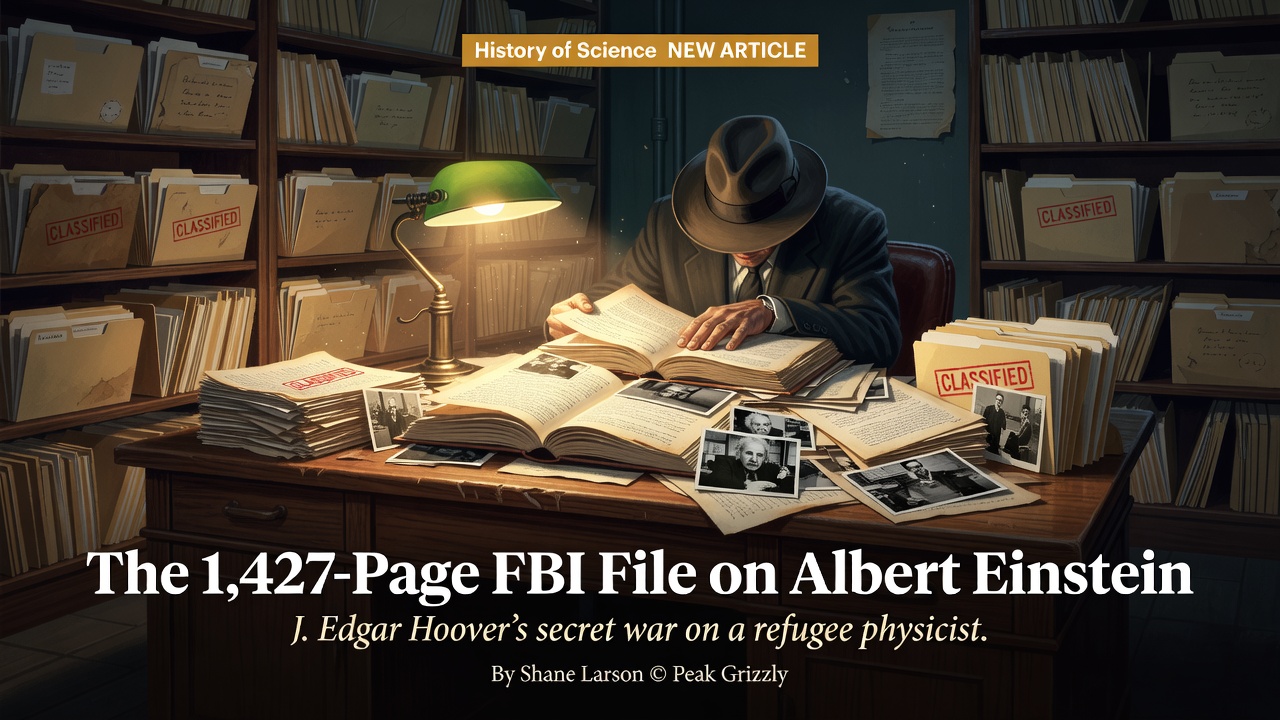
The FBI's file on Albert Einstein, opened in 1932 and closed only by his death in 1955, eventually grew to 1,427 pages. J. Edgar Hoover personally directed the investigation. It included wiretaps on his Princeton phone, mail intercepts, informants among the Princeton household staff, and surveillance reports submitted by FBI offices in cities Einstein had visited as long ago as the 1920s. When the file was released under the Freedom of Information Act in 1983, twenty-eight years after his death, portions of it were still redacted under national security exemptions. Some of those redactions remain today.
This is not the Einstein on the dorm-room poster. This is the actual man.
What Hoover Believed
The FBI's working theory of Albert Einstein, as it emerges from the surveillance file, was roughly this:
Einstein had been a Soviet sympathizer since the 1920s. He was personally connected to the leadership of the Communist Party of the United States. His secretary, Helen Dukas, was probably a Soviet courier. His Princeton home at 112 Mercer Street was a meeting place for Soviet operatives. He was, in one internal memo's phrasing, "almost certainly" running or supporting a Soviet espionage network out of the Institute for Advanced Study.
None of this was true. Einstein had never been a member of the Communist Party. He had no Soviet contacts beyond ordinary correspondence with Soviet scientists, the same correspondence American physicists routinely conducted in the pre-Cold War years. Helen Dukas was a German-Jewish refugee who had served as Einstein's secretary since 1928 and who, after Elsa Einstein's death in 1936, became the keeper of his household. She was not a Soviet courier. The Mercer Street house was a place where an old man drank tea and worked on equations. It was not an espionage hub.
What was true was that Einstein, throughout his American years, supported a broad range of left-wing political causes that the Hoover-era FBI considered functionally indistinguishable from Soviet sympathy. He supported world government. He supported nuclear disarmament. He supported civil rights — not in the polite donate-to-the-NAACP sense, but in the visible, public, friendship-with-Paul-Robeson sense. He corresponded with W.E.B. Du Bois. He gave a 1946 commencement address at Lincoln University, a historically Black college, in which he called segregation "the worst disease" of American society. He signed petitions for Ethel and Julius Rosenberg's clemency. He told a Brooklyn schoolteacher to refuse to testify before McCarthy's subcommittee.
To the FBI under Hoover, every one of those positions was prima facie evidence of Soviet alignment. The file's extensive section on Einstein's "Communist front" affiliations is, on close inspection, a list of every civil rights, anti-fascist, and disarmament organization an American intellectual could have supported in the 1940s. The Emergency Committee of Atomic Scientists. The Committee for the First Amendment. The American Friends of Spanish Democracy. The National Committee to Repeal the McCarran-Walter Act. None of these were Soviet front organizations. The FBI listed them as such anyway.
The pattern is not subtle. The file does not document Einstein's espionage. It documents the extent of his political dissent.
What Was Actually Substantive
It would be inaccurate to say Hoover had nothing on Einstein. He had something — but the something was not espionage.
The file accurately catalogues Einstein's deep involvement in left-wing internationalism. He was, in the late 1940s, the most prominent American advocate for world government — the position that nuclear weapons made the nation-state obsolete and that humanity needed a binding supranational authority to control them. He repeatedly signed open letters to that effect, including the 1946 Atomic Scientist's Letter to the People and the 1947 New York Times Magazine essay calling for international control of atomic energy.
He supported Soviet-friendly American organizations, in the sense that he signed petitions and lent his name to fundraising drives organized by people who were sympathetic to the Soviet Union. He did this knowingly. He did not consider sympathy with the Soviet Union — in 1946, before the full extent of Stalin's purges was public knowledge in the West — disqualifying. He thought a postwar world had to include peaceful coexistence with the Soviets, and he was willing to be associated with people who held that position even when they held it for reasons he himself did not share.
He also corresponded directly with Soviet scientists, particularly Dmitri Skobeltsyn and Sergei Vavilov. The correspondence was scientific, not political, but it was correspondence the FBI considered worth tracking.
Einstein Against the World
And he never disavowed any of it. When friends warned him that his public political stances were giving Hoover ammunition, his standard response was that he had been right about Hitler in 1932 when he refused to disavow his anti-Nazi positions, and that he was not going to learn the wrong lesson from that experience now.
That is not espionage. It is dissent. The file's failure was that it could not tell the two apart.
The Difference Celebrity Made
Here is the part of the story that should make any reader uncomfortable.
Einstein was the FBI's most prominent target who never paid a serious price for it. His passport was not revoked. His home was not raided. He was not deported. He was not blacklisted from publishing. He was not jailed. He continued, throughout the McCarthy years, to live in his Princeton house, to work at the Institute for Advanced Study, to give public addresses, and to receive the respect of his peers.
Other people the FBI surveilled in the same years were not so lucky.
Paul Robeson — the singer, actor, and Black political activist who was Einstein's friend — had his passport revoked from 1950 to 1958. His State Department-blocked international career collapsed; he could not perform abroad; his American performance bookings dried up under FBI pressure on venues. By 1958, when his passport was finally restored, he was a broken man. He died in 1976 having never recovered his career.
W.E.B. Du Bois — the Black intellectual whose correspondence with Einstein appears in the FBI file — was indicted in 1951 as an "unregistered foreign agent" for chairing a peace petition. He was acquitted, but the State Department revoked his passport. His career collapsed. He died in 1963 having moved to Ghana because he could not work in his own country.
Other targets fared worse. Hollywood writers were imprisoned. Academics were fired. Schoolteachers like William Frauenglass — the man whose case prompted Einstein's famous letter — lost their jobs.
Einstein was insulated by celebrity. The FBI knew that prosecuting Albert Einstein in 1953 would have been a disaster for the United States internationally. Moving against the world's most famous Jewish refugee from Nazi Germany, in the middle of the Cold War, on charges that the public would correctly perceive as politically motivated, was a fight Hoover could not win. So the file was kept open, the surveillance continued, and the public Einstein was permitted to keep speaking — while less famous targets paid the actual cost of their dissent.
This is one of the lessons of the 1,427-page file. A surveillance state produces its own reality. It also picks its battles. Einstein was protected because he was visible. People around him were not.
Why It Matters Now
The Frauenglass letter is worth reading in full. Einstein wrote it in May 1953, after a year of watching the McCarthy subcommittee tear through American universities and high schools. He wrote it as someone who had personally watched what happened in Germany in 1932 and 1933, when the same intellectual coercion — the loyalty oath, the political litmus test, the demand that intellectuals declare which side they were on — became the precondition for staying employed.
The letter said:
The reactionary politicians have managed to instill suspicion of all intellectual efforts into the public by dangling before their eyes a danger from without. Having succeeded so far, they are now proceeding to suppress the freedom of teaching and to deprive of their positions all those who do not prove submissive, i.e., to starve them out.
What ought the minority of intellectuals to do against this evil? Frankly, I can only see the revolutionary way of non-cooperation in the sense of Gandhi's. Every intellectual who is called before one of the committees ought to refuse to testify, i.e., he must be prepared for jail and economic ruin, in short, for the sacrifice of his personal welfare in the interest of the cultural welfare of his country.
What Einstein was telling Americans in 1953 is the same thing his life had been telling Germans in 1933. When the political authority of your country is asking you to stop thinking, your only remaining duty as a thinker is to refuse.
The 1,427-page FBI file is the cost the system imposed on him for refusing.
The fact that he refused anyway is what made him Einstein.
It is easy, in 2026, to sentimentalize the Cold War-era American dissident. We watch Trumbo and we admire Dalton Trumbo. We watch Good Night, and Good Luck and we admire Edward R. Murrow. We watch Oppenheimer and we feel something complicated about Robert Oppenheimer's collapse under the security state. The Einsteins of those decades are figures in a finished drama. The state that surveilled them is gone. Hoover is dead. McCarthy is dead. The names are history.
But the structure of the surveillance state — the pattern by which a security apparatus conflates dissent with espionage, marshals state power against intellectuals who refuse to cooperate, and selectively protects the famous while crushing the merely visible — is not gone. It has new forms. It will have new forms again. The intellectuals being asked, right now, to keep their politics out of their work — about AI, about climate, about the boundary between corporate research and corporate policy — are operating in a recognizable lineage.
Einstein refused that compromise. He paid for the refusal in surveillance, in friendship with people the state was systematically destroying, in the constant low-grade harassment of a watched man. He kept refusing. He never stopped. He died with another open letter on his desk.
That is the part of the story that has been left off the dorm-room poster.
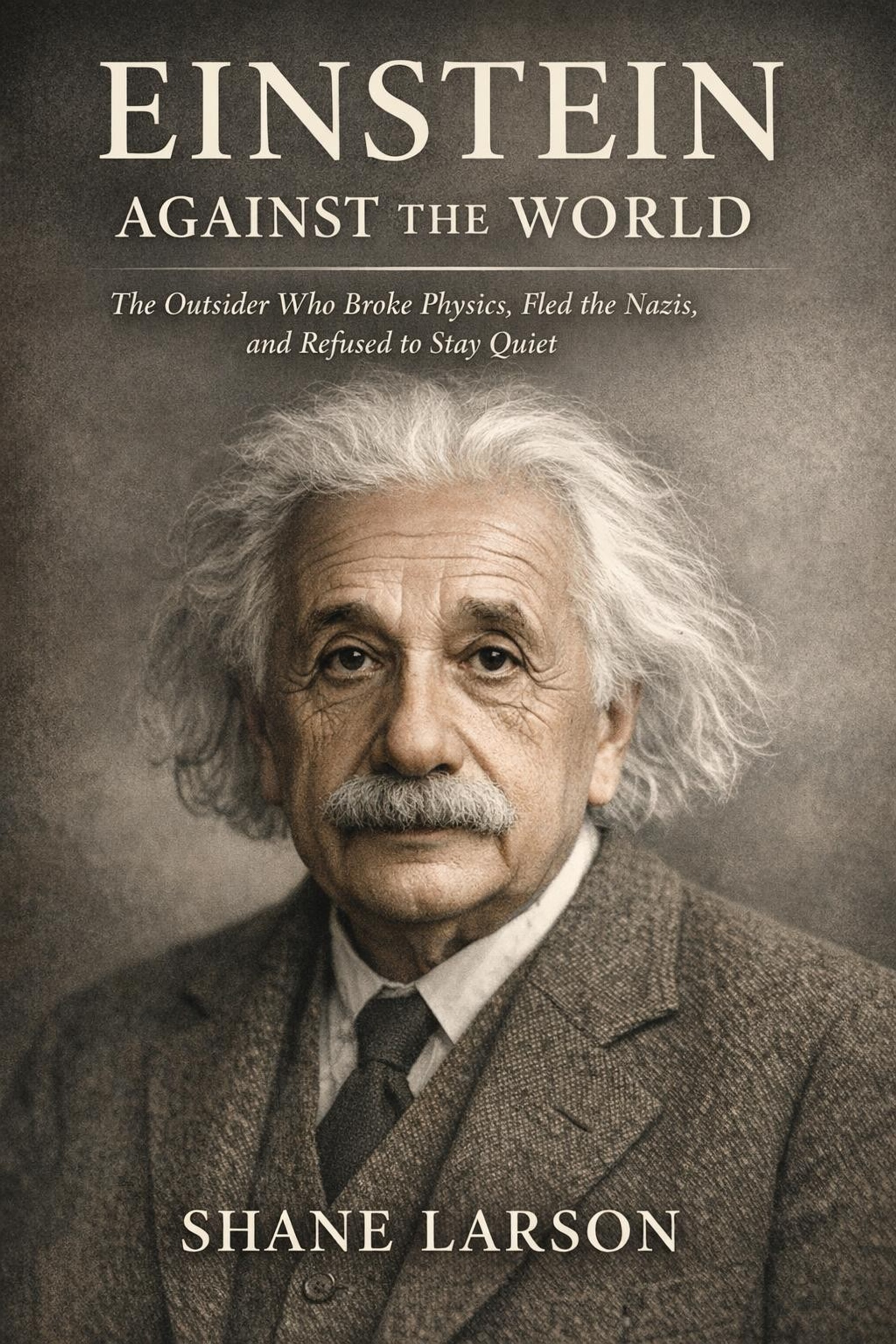
That is the story I tell in Einstein Against the World. Not the saint. Not the kindly grandfather. The actual man — refugee, dissident, FBI target, courageous and difficult and inconvenient — and the cost he paid for being all of those things at once.
Einstein Against the World
New posts and releases, straight to your inbox. No spam, unsubscribe anytime.