Elizabeth Báthory's Blood Bath First Appears in Print 115 Years After She Died
November 26, 2026 · 7 min read
Ask anyone what Elizabeth Báthory did and you will get the same answer. She was a Hungarian countess who bathed in the blood of young women to keep her skin young. It is the one detail everybody knows, and it is the reason she is called the Blood Countess.
It is also missing from every document written by anyone who was there. The story has a first appearance in print, and that appearance has a date: 1729. She died in 1614.
What the 1611 record says
The case left a file. In March 1610 György Thurzó, the Palatine of Hungary, ordered an inquiry into complaints about the countess's household, and two notaries took sworn statements. At the end of December 1610 his men seized her at Csejte, now Čachtice in Slovakia. In January 1611 four of her servants were questioned and sentenced at Bytča, the Palatine's seat. With later inquiries, the witness statements come to about three hundred, most of them reporting what the witness had heard from others.
Those documents accuse the countess and her servants of serious and lethal violence against the girls who worked for her. They do not accuse her of bathing in blood, drinking it, or using it for her looks. The motive the legend supplies, vanity, is not there either. The servants were questioned under torture and had every reason to say whatever their questioners wanted. They did not say that.
The countess herself was never tried. The Palatine, in council with her relatives, ordered her confined at Csejte, and she died there in August 1614.
Turóczi, 1729
The bath arrives 115 years later. In 1729 the Jesuit academic press at Nagyszombat, now Trnava in Slovakia, printed a Latin history of Hungary arranged reign by reign. Its author was a Jesuit priest, László Turóczi. Under the reign of Matthias II he included a short section headed Tragica Historia, a tragic history, about a noblewoman who struck a maid, noticed that her skin seemed fresher where the girl's blood had fallen, and from then on bathed in the blood of young women.
It is told as a moral tale and it names no source. That was normal for a compendium of the period. But Turóczi cannot have been working from the court record, because the record was not yet in print and his story does not match it.
What he could have drawn on was local tradition. Csejte lay about a day's journey from Nagyszombat. The castle had been taken in a war in 1708 and had been decaying ever since. A century of talk in the villages under a ruin, about a great lady shut up for crimes against girls, is the most likely origin anyone has found. No earlier written source has been identified.
It is worth knowing what kind of Hungary the book came from. The kingdom had been split in three since the Ottoman victory at Mohács in 1526, the battle that made the name of Suleiman the Magnificent, and the countess's husband had made his name in the Turkish wars. She belonged to the great Protestant nobility of that age. By 1729 most of those families had returned to Catholicism or been ruined, and the Jesuit press at Nagyszombat was printing schoolbooks for a Catholic kingdom. Nobody with the power to object to a story about her was left.
Bél, 1742
It would be easy to stop there and call the bath Catholic propaganda against a Protestant family. The next writer makes that harder. Mátyás Bél was a Lutheran pastor and schoolmaster at Pozsony, now Bratislava, and the leading Hungarian scholar of his generation. His county-by-county description of the kingdom was the standard reference for generations. In its fourth volume, printed in 1742, he repeated the story in much the form Turóczi had given it.
Bél had no confessional reason to blacken her name. He repeated the story because it was in print and because a description of the region seemed to need it. The effect was large. After 1742 the bath was no longer one Jesuit's anecdote. It was part of the entry on Csejte in the most respected geographical work on Hungary.
Wagener, 1796
Michael Wagener took it out of Latin and out of Hungary. His book, published in Vienna in 1796, was a work of what the period called philosophical anthropology: a collection of cases meant to illustrate human nature at its extremes. His piece on the countess is about vanity as a source of cruelty.
The Countess of Csejte
Two things happened in Wagener. The story gained a fuller narrative, with accomplices and a discovery. And, as a later English writer rendered him, it already carried a number: 650 victims. That figure does have a root in the 1611 file, though a thin one. A single witness at Bytča said that a household official had seen a list of 650 names signed in the countess's hand. The official did not confirm it and no list was ever produced. By 1796 the number and the bath were travelling together.
The record in print, 1817
In June 1817 a German-language periodical in Prague called Hesperus printed a translation of the Bytča record: the four servants' confessions, thirteen witness statements and the sentence. The same periodical had carried a retelling of the legend in 1812, by Baron Alajos Mednyánszky. Now, for the first time, a general reader could set the legend beside the testimony.
The check was decisive on paper. There was no bath. The 650 rested on a register reported third-hand that nobody had ever seen.
Nobody subtracted anything. The legend carried on through the nineteenth century as though the publication had not happened. If anything, the printed record made the story more confident, because the number it already carried now had a document to point to.
Paget, 1839, and Baring-Gould, 1865
The story reached English twice, by separate routes. John Paget, an Englishman who travelled in Hungary in the 1830s, told it in Hungary and Transylvania in 1839. His version has the struck maid, the bath and the motive of beauty, and puts the dead at three hundred. He credits Mednyánszky and says legal documents attest it.
The version that lasted came from Sabine Baring-Gould, an Anglican clergyman and folklorist, in The Book of Were-Wolves in 1865. He followed Wagener, gave the 650, and left her surname blank. What mattered as much as the telling was the company. He set her in a book about werewolves, beside the French marshal Gilles de Rais, and she entered English reading as a specimen among monsters.
Why printing the record did not kill the story
There are four plain reasons.
The first is that the record is hard reading. It is a legal document, full of names and procedure. A story about blood and beauty is one sentence long and nobody forgets it.
The second is that most writers copied each other. A periodical in German reached a small public, and the retellers of the following decades drew on earlier retellings, not on the testimony.
The third is that the record does not clear her. It accuses her of killing girls. A reader who already believed in the bath could take the testimony as proof of the main charge and treat the bath as a detail the witnesses happened to leave out.
The fourth goes deepest. The legend explains and the file does not. The bath gave the eighteenth century a sermon on vanity in an age of cosmetics. It gave the Romantic period a ruined castle, a cruel aristocrat and a sealed room. It appeared in the same decade that reports from the Habsburg frontier put the word vampire into German, French and English, and later writers did not keep the two apart. The file offered a set of accusations and a decision not to try the accused. It gave no motive. The legend supplied one.
There is also the missing verdict. A judgment fixes a story: it says what was charged and what was proved, and anyone who wants to enlarge the story has to do it against a document. Because the countess was never tried, no such document exists. The pattern is not confined to Hungary. In the Kansas case of the Bloody Benders, too, the legend outran the file.
What that leaves
None of this makes her innocent. Most historians who work on the case think real and lethal violence against servants is more likely than not. They also treat the bath and the 650 as legend. Both things can be true, and the publication history above is a matter of printed fact.
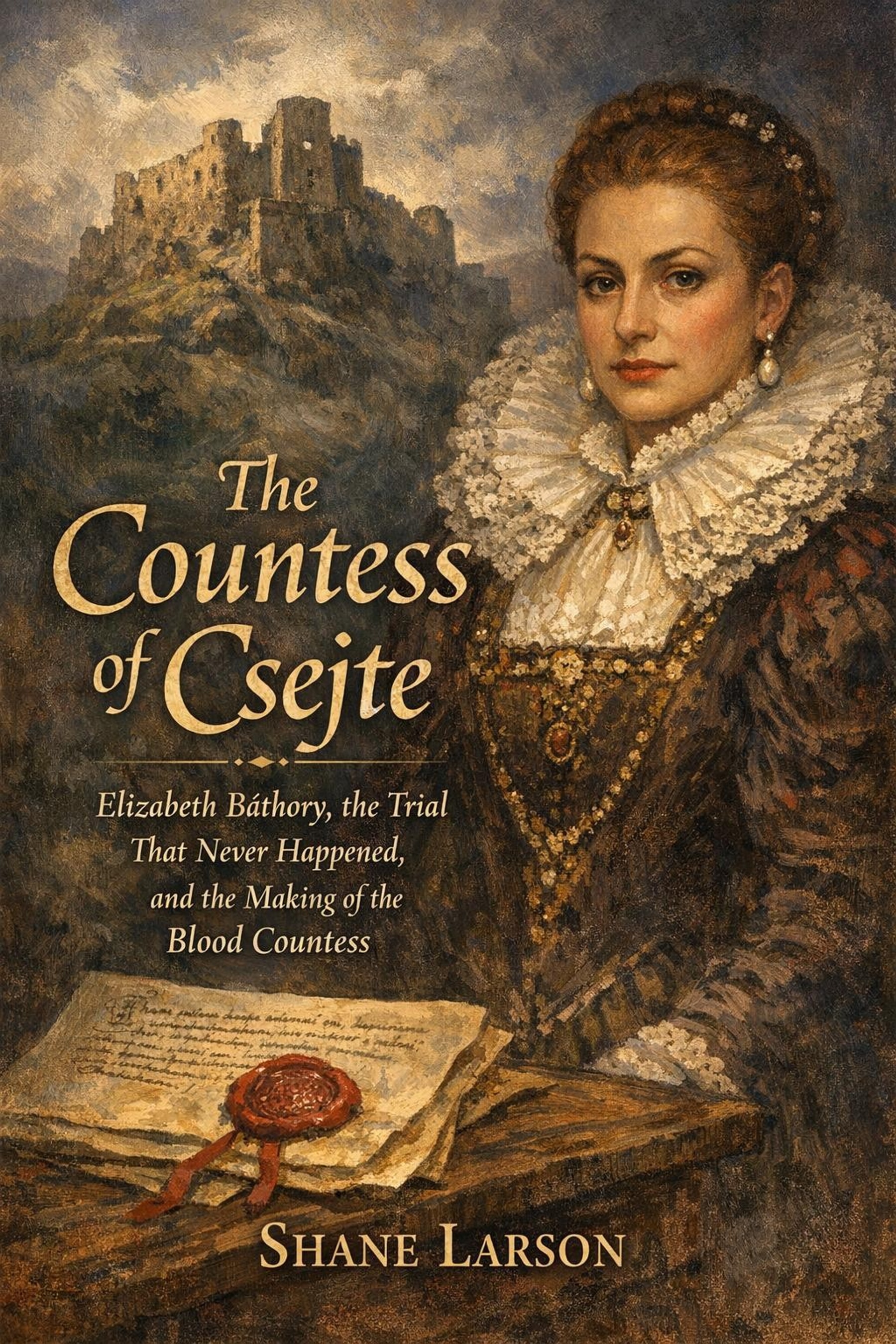
*The Countess of Csejte: Elizabeth Báthory, the Trial That Never Happened, and the Making of the Blood Countess* goes through the whole file in the order a court would have followed: the world she ran, the accusation, the evidence weighed in both directions, and then the legend. It marks every claim as recorded, probable or legend, and it does so without the gore.
The Countess of Csejte
New posts and releases, straight to your inbox. No spam, unsubscribe anytime.