Did the Borgias Really Poison People? What the Evidence Says About Cantarella
November 14, 2026 · 6 min read
Ask anyone for one fact about the Borgias and you will get poison. A pope who removed inconvenient cardinals with a pinch of white powder, a son who finished off the ones his father missed, a daughter with a hollow ring who smiled at you across the table while you drank. The poison has a name, cantarella, which makes it sound like something a chemist could identify. It is one of the best-known stories of the Renaissance.
It is also a story with remarkably little under it. Nobody has ever produced a recipe, a sample, a bill, a letter ordering its use, or a witness who saw it given. That does not prove the Borgias never poisoned anyone. It does mean that the most famous thing about them is the thing we know least about, and it is worth asking how that happened.
A poison without a paper trail
Start with the name. Cantarella does not appear in any document written during the lives of Pope Alexander VI or his son Cesare. It turns up for the first time in the work of Paolo Giovio, a historian writing decades after the pope died in 1503. Later writers added detail as they went: that it was a white powder, that it was pleasant to the taste, that it could be made to kill quickly or slowly as required. The further the accounts get from the events, the more they know about the chemistry.
That pattern is a warning sign in any historical question. Real information tends to be richest close to the event and to thin out afterwards. Legend does the opposite.
The second thing to notice is what a poisoning accusation was worth in Renaissance Italy. Rome was a malarial city, and its summers killed people of every rank, suddenly and unpleasantly. Medicine could not tell a fever from a toxin. When a rich or powerful man died fast, the word poison was in the street before the body was cold, and it attached itself to whoever benefited. The Borgias, who were steadily acquiring the property of dead cardinals for the papal treasury, benefited often. That made the charge easy to make and impossible to disprove, which is why it was made about so many other people too. It was said of the pope who briefly succeeded Alexander, an elderly invalid who lasted less than a month. The Borgias themselves accused others of trying to poison them.
The death that made the legend
The centrepiece of the story is the death of Alexander VI himself. In the first days of August 1503 the pope and Cesare went to supper at the vineyard of a newly created cardinal, Adriano Castellesi. About a week later both of them were seriously ill. Alexander died on 18 August. His body, lying in the summer heat, turned dark and swelled so badly that it had to be forced into its coffin, and Rome concluded at once that poison had done it.
The famous version says the Borgias had intended to poison their host and were served the doctored wine by a servant's mistake. It is a wonderful story, and it comes from historians of the next generation, none of whom was there. The people who were there, the ambassadors writing home that same week, reported something duller. It had been a terrible August for fever. Much of the papal court was sick. The cardinal who gave the supper fell ill as well. And the illness came on roughly a week after the meal, which is a strange delay for a poison and an ordinary one for malaria.
A blackened and swollen corpse was what settled the matter for contemporaries. To a modern reader it describes what happens to an unembalmed body in a Roman August.
The one case that deserves a second look
It would be convenient for a debunker if every charge collapsed as easily, and it would not be honest. One case is harder. In April 1503 a wealthy Venetian cardinal, Giovanni Michiel, died after a short illness, and his property went to the pope. After the Borgias fell, a servant of the cardinal confessed that he had given poison on their orders, and he was executed for it.
The Borgia Legend
That is a confession, which is more than exists for any other alleged victim. It is also a confession obtained under a new pope who was the Borgias' bitterest enemy, in a legal system that used torture as a matter of routine, at a moment when blaming the fallen family cost nothing. A fair verdict is that this one may be true. It cannot be shown, and it cannot be dismissed. If the Borgias did poison anyone, this is the likeliest instance, and it is worth noticing that it is almost never the one people have heard of.
What they did instead
The odd thing about the poison legend is that the Borgias' documented killings did not involve poison at all. They were done with cord and steel, and more or less in the open.
In August 1500 Cesare's lieutenant strangled Alfonso of Bisceglie, the second husband of Cesare's sister Lucrezia, in his bed in the Vatican, a month after a failed attempt to stab him on the steps of St Peter's. In December 1502, at Senigallia, Cesare welcomed a group of his own mercenary captains who had recently rebelled against him, walked them into the town, and had them seized. Two were strangled that night and two more a few weeks later. A Florentine envoy travelling with him wrote it all up for his government in a tone close to admiration. The envoy's name was Niccolò Machiavelli.
Nobody at the time doubted who was responsible for these deaths, and Cesare did not much trouble to hide it. A family willing to kill that directly had limited need of a secret powder.
And Lucrezia?
Lucrezia Borgia is the most famous poisoner of the lot and the one with the least against her. No source from her lifetime accuses her of killing anyone. She was married three times before she was twenty-two, each time to suit her father's diplomacy. Her third marriage took her to Ferrara, where she spent the remaining seventeen years of her life, fourteen of them as duchess, ran the government when her husband was away at war, and died in 1519 with a reputation for piety and good sense.
The poisoner arrived three centuries later. In 1833 Victor Hugo put her on the Paris stage as a murderess who poisons a banquet, and the same year Donizetti set the story to music. The hollow ring, the fatal supper and the beautiful monster come from the theatre. Later novels, films and television inherited them.
Why the story stuck
If the evidence is this thin, why has the legend lasted five hundred years? Partly because it is a good story. But mostly because of who was left to tell it. The Borgias were Spaniards in a city that resented them, and they made enemies of nearly every great Italian family in a decade of rapid, aggressive success. Then, in one week, the pope died and Cesare was too sick to act. Within three months the papacy belonged to a man who had spent ten years in opposition to them. No Borgia state survived in Italy with a reason to defend their name. Other papal families did things that were comparable and had dukes, cardinals and court historians to smooth the record afterwards. The Borgias had only their enemies.
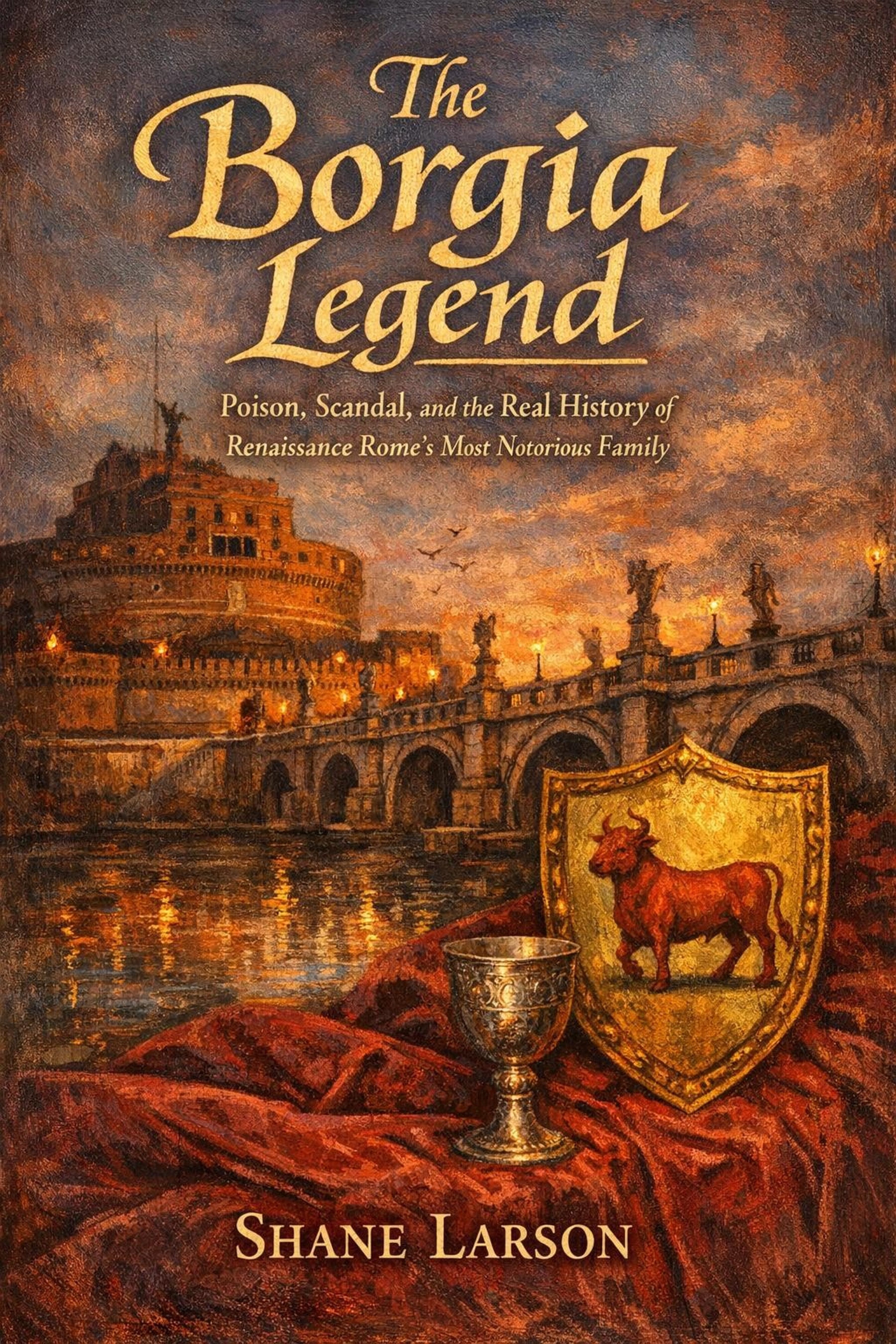
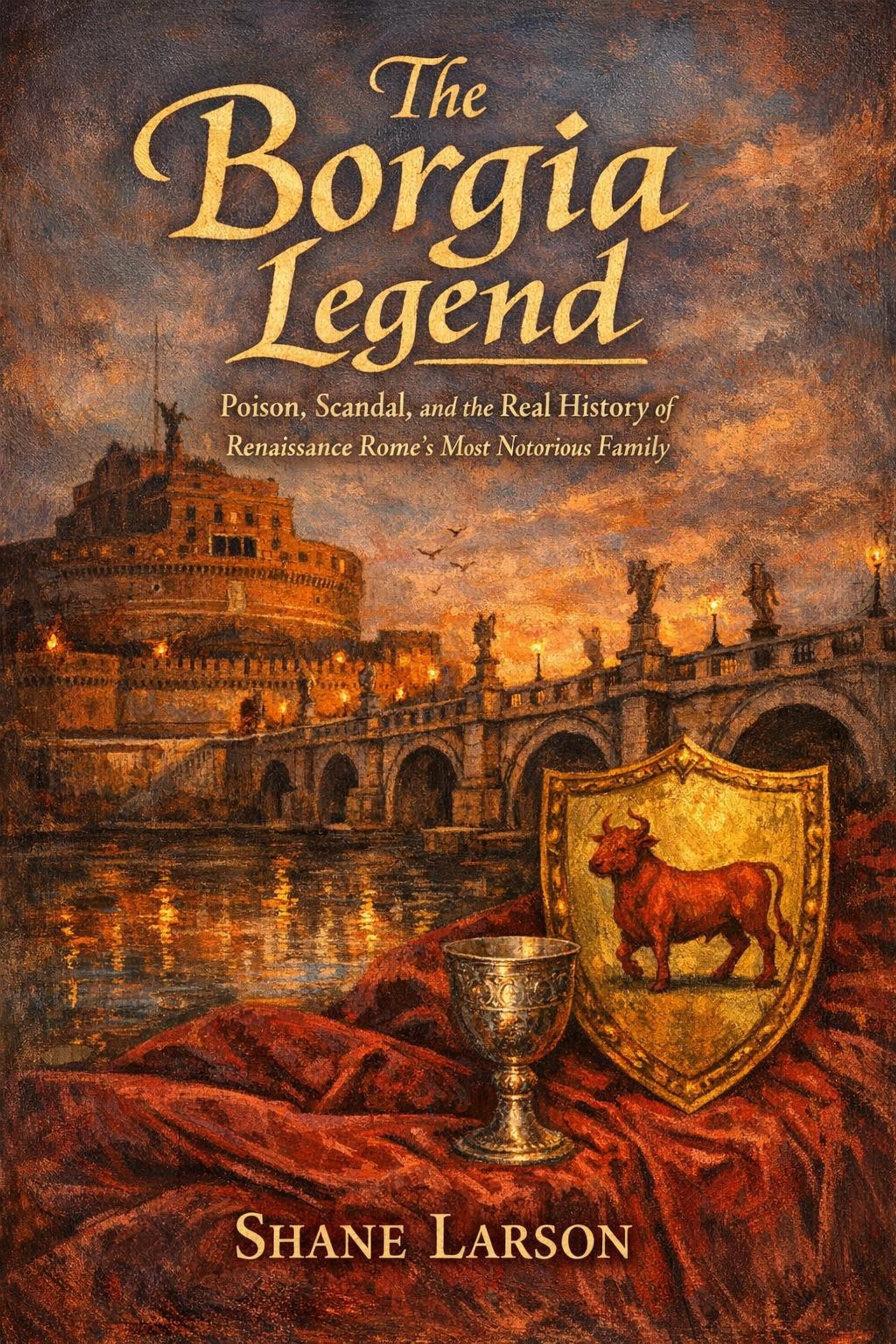
None of this turns them into innocents. A pope bought his election, a duke murdered his brother-in-law, and both used the Church as a family asset. But the poison, which is what everyone remembers, is the part of the story that cannot be found in the record. The real history is harsher in some places and far kinder in others, and it is told in full in *The Borgia Legend: Poison, Scandal, and the Real History of Renaissance Rome's Most Notorious Family*, which takes every famous charge back to the first person who made it.
The Borgia Legend
New posts and releases, straight to your inbox. No spam, unsubscribe anytime.