The English Didn't Sink the Spanish Armada: Where the Ships Were Really Lost
November 16, 2026 · 8 min read
The medal the Dutch struck for the victory of 1588 carried four words of Latin: Flavit Jehovah et dissipati sunt. God blew and they were scattered. It is the honest version of the English story, and it has been quietly set aside in favour of the other one ever since: Drake finishing his game of bowls, the fireships, the English guns doing their work off Gravelines. The medal says the wind did it. The medal is closer to the truth, and it is still not the whole of it.
Here is the arithmetic. Something like a hundred and thirty ships left Lisbon in the last days of May 1588, carrying just under nineteen thousand soldiers and a little over eight thousand sailors by the printed muster. Between a third and a half of those ships never came home, and perhaps half of the thirty thousand men died. English gunfire sank one ship. The rest of the dying happened somewhere else.
What the English guns actually did
The fleet was sighted off the Lizard on 29 July (19 July by the English calendar, which was ten days behind the Spanish one). Over the next nine days, up the Channel to Calais and then off Gravelines on 8 August, the Spanish Armada lost six ships.
Two went before any serious fighting and without English help. The Nuestra Señora del Rosario was disabled in a collision off Plymouth and surrendered next morning to Drake, who had left his station in the night to go after her. The San Salvador was wrecked by an explosion in her own powder. The galleass San Lorenzo ran aground under the walls of Calais in the confusion after the fireships. Off Gravelines the María Juan was holed and sank in the open sea, the only Armada ship sunk by English gunfire in the whole campaign, and two of the big Portuguese galleons, the San Felipe and the San Mateo, were shot to pieces, drifted onto the banks of Zeeland and were taken by the Dutch.
That is the entire bill for English gunnery: three ships, four if you count the San Lorenzo. Spanish casualty returns put the dead at around six hundred by the time the fleet cleared Gravelines, though some contemporary estimates for that day alone run above a thousand. Gravelines mattered: it settled that the Armada would not now meet Parma's army. But a hundred and twenty-odd ships were sailing north, damaged and short of water, and still in formation.
The anchors off Calais
The real damage had been done two nights earlier, and it did not look like damage at the time.
On the night of 7–8 August (28–29 July by the English calendar) the English sent eight fireships down on the Spanish anchorage off Calais. Medina Sidonia had expected it and had given sensible orders: slip the cable, leave the anchor buoyed on the bottom, stand clear, come back for it when the fire had passed. In the dark, with burning hulls bearing down and no way of knowing which might be packed with powder, most captains did not wait to slip. They cut. Some cut one cable and then the other. The heaviest anchors in the fleet, the ones laid out to hold against a strong tide, were left on the seabed off Calais, and the fleet never came back for them.
It made no difference in the North Sea. It made every difference six weeks later, when ships driven onto the west coast of Ireland tried to anchor off a lee shore and found that what they had left would not hold. (Calais itself had been England's last foothold on the Continent until 1558; see *The Hundred Years' War*.)
North about
The English fleet followed the Armada north for four days and never attacked again; it was out of powder and short of food. On 12 August (2 August by the English calendar), off the Firth of Forth, it turned for home, and from that afternoon the Spanish fleet was fighting nobody but the North Atlantic.
Medina Sidonia's sailing orders survive. The fleet was to go north past Shetland, then far out west into the Atlantic before turning south for Spain, and to take great care not to fall upon the island of Ireland. Water was rationed and, by a much-repeated account, the horses and mules went overboard to save it. Some ships could hold the course. Many, leaking and undermanned, turned south too early.
Two things made that error systematic. There was no instrument for longitude, so every pilot estimated his westing by dead reckoning, and the wind and surface drift of the north-east Atlantic both set eastward, carrying ships back towards the coast they believed they had cleared. And the best charts of the day drew the west coast of Ireland running more nearly north and south than it does, without the true reach of the headlands of Mayo, Galway and Kerry. Modern reconstructions, including Colin Martin and Geoffrey Parker's, suggest that many ships turned south a degree or more of longitude east of where their pilots supposed, which at those latitudes is forty miles or more. By their own reckoning they were clearing Ireland. By the Atlantic's they were sailing onto it.
The Enterprise of England
The Irish coast
Between the middle of September and the end of October something like two dozen Armada ships were wrecked on the coast of Ireland or lost within sight of it, from Kerry round to Antrim. Most came in two gales, one around 21 September and a fiercer one in the last days of the month. The count is a modern estimate and cannot be exact: some wrecks are known only from English officials' letters, some only from Spanish lists of ships that never returned, and a few were probably reported twice.
In Blasket Sound, off the Dingle peninsula, the Santa María de la Rosa came in with her sails in rags, let go the one anchor she had left, and swung onto a rock when the tide turned. She went down almost at once with every soul aboard but one. In Kinnagoe Bay in Donegal the thousand-ton Venetian merchantman La Trinidad Valencera struck a reef in mid-September, and four or five hundred men got ashore over the following days.
At Streedagh Strand in County Sligo three ships, the Lavia, the Juliana and the Santa María de Visón, lay at anchor for four days off the beach, unable to land and unable to leave, until a westerly put all three onto the sand within sight of each other. They broke up in about an hour. Captain Francisco de Cuéllar, aboard the Lavia, put the drowned at more than a thousand and those who reached the beach at fewer than three hundred; the English officer sent to inspect the strand, Sir Geoffrey Fenton, reported counting some eleven hundred bodies. The two numbers come from opposite sides and agree.
The last and worst was the galleass Girona, which left Killybegs for Scotland in late October carrying the survivors of two other wrecks, something between twelve and thirteen hundred men in a hull built for a third of that. She struck the reef at Lacada Point on the Antrim coast in the dark. Nine men reached the shore by the usual count; some reports say five.
The usual estimate of the Armada dead in Ireland, drowned and killed together, is five to six thousand. Most drowned. Of those who reached land, many were put to death. The Lord Deputy, Sir William Fitzwilliam, issued a commission at the end of September authorising the killing of any Spaniard found in Ireland, and in Connacht Sir Richard Bingham carried it out thoroughly, reporting totals in four figures that historians treat with caution, since a governor writing to London had every reason to make his province look secure. Modern estimates of those killed on land run from several hundred to well over a thousand, and nobody can now give the number to within a few hundred. Some Irish lords and households sheltered survivors at real risk. O'Rourke, in whose country Cuéllar found refuge, was hanged at Tyburn in 1591 with the harbouring of Spaniards among the charges against him.
Scotland, the open sea, and Santander
The Scottish losses were smaller: the Gran Grifón wedged in a cleft in the cliffs of Fair Isle in late September and most of her people climbed ashore, and the San Juan de Sicilia blew up in Tobermory Bay in November. Other ships simply vanished; the hulk Castillo Negro fell behind one night and was never seen again. The ships that held the course began reaching Santander and the other Biscay ports in the third week of September, starved, scorbutic and riddled with typhus, and men went on dying in harbour into October. The English, for their part, lost perhaps a hundred men to the enemy and several thousand to disease in the weeks after they won; on 20 August (10 August by the English calendar) Howard wrote from Margate that his men were dying in the streets. Neither side kept its men alive once the fighting stopped.
What the seabed added
For nearly four centuries all of this was argued from paper. In June 1967 a Belgian diver, Robert Sténuit, worked out the Girona's position from the documents and found her, and the excavations that followed quietly rewrote the battle. The guns were a mixture of every calibre and origin, several of the heaviest siege pieces meant for English towns after the landing. The Spanish shipboard carriage, two-wheeled with a long trail, was a land carriage adapted for a gun deck, slow to reload beside the compact four-wheeled truck the English used. And the wrecks held large quantities of heavy shot that had never been fired, loaded for a boarding fight the English never allowed to happen.
The archaeologists have been the first to state the qualifications: the wrecks are not a random sample of the fleet, and some historians think the gunnery thesis has been pressed too far. It is an argument from evidence, not a verdict. But the carriages and the unfired shot sit beside the anchors off Calais and the charts that drew Ireland in the wrong place as the real reasons the Enterprise of England failed. The wind did the rest. The English guns were a long way down the list.
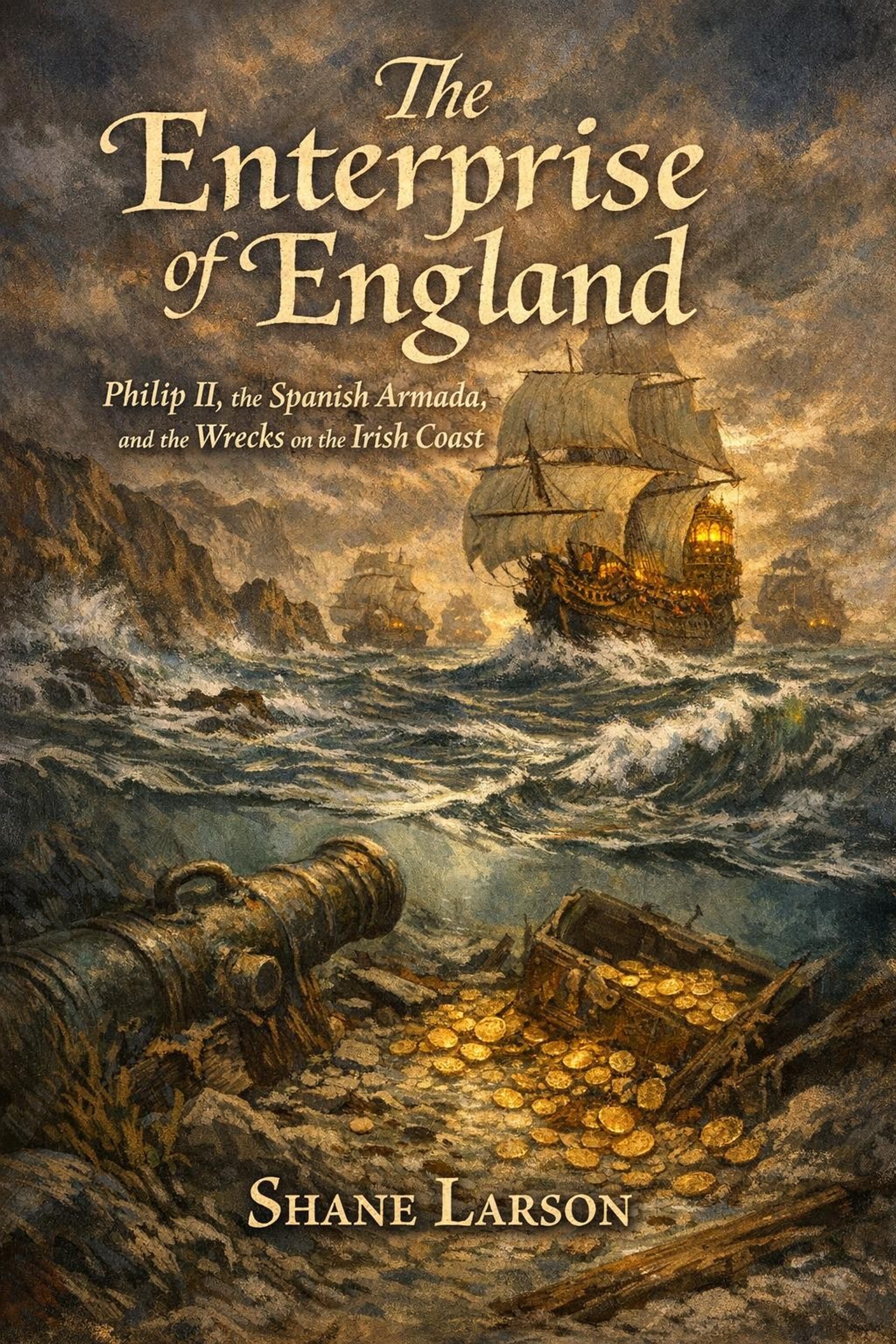
*The Enterprise of England: Philip II, the Spanish Armada, and the Wrecks on the Irish Coast* is a standalone military history on the English-history shelf, beside Elizabeth I and Mary, Queen of Scots. It follows the campaign from Philip's desk in the Escorial to the two flagships in the Channel and on to the Irish and Scottish shore, gives the voyage home a full quarter of the book, and carries a gazetteer of every identified Armada wreck for anyone who means to stand on those beaches.
The Enterprise of England
New posts and releases, straight to your inbox. No spam, unsubscribe anytime.