The Word You Have Been Using Means the Opposite
May 17, 2026 · 10 min read
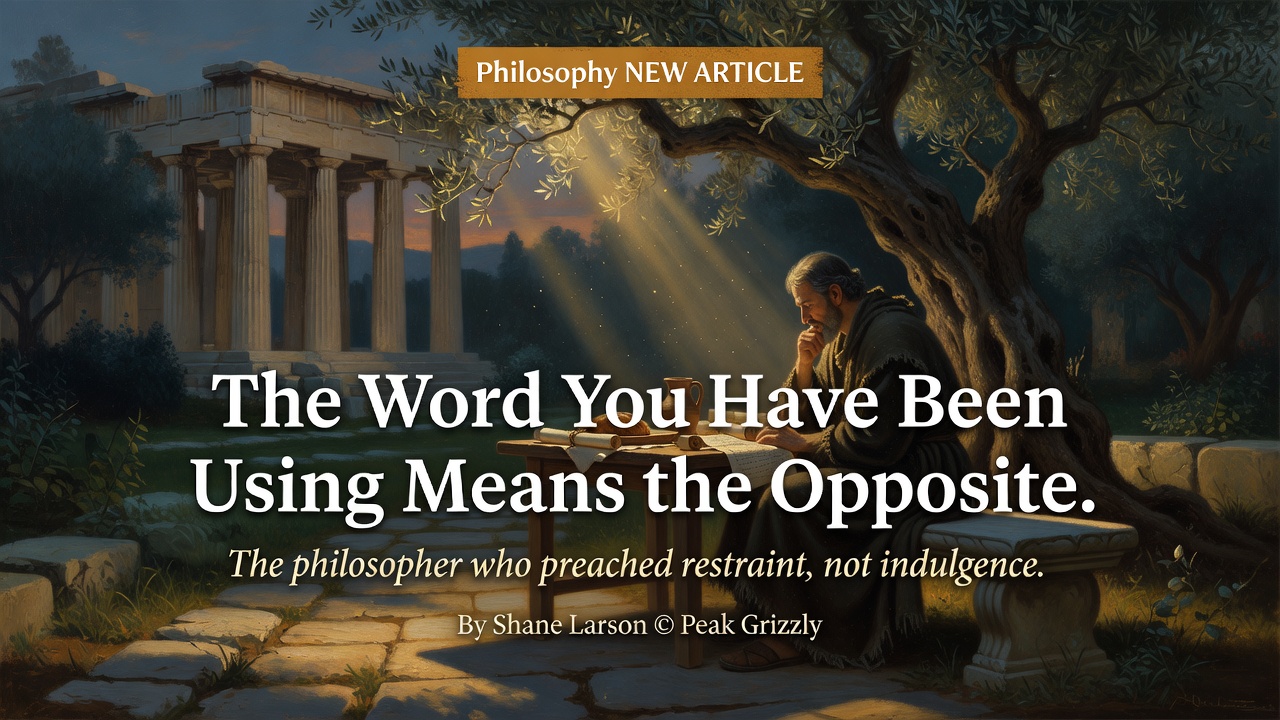
There is a magazine, founded in 1995 and still publishing, called Epicurious. It is owned by Condé Nast. It runs restaurant reviews, recipes, wine pairings, and travel features. To call yourself "epicurean" today is to call yourself a person of refined taste — someone who knows good wine, distinguishes the better olive oils, has opinions about the right way to prepare a duck. The word means sensualist, connoisseur, lover of fine living.
The man whose name the word borrows would not have recognized any of this. Epicurus of Samos, who founded the school in Athens around 307 BCE, was a vegetarian who lived on bread, water, and the occasional small piece of cheese. He once wrote, in one of the few sayings of his that survives, that he could feast on bread and water and rival the gods in happiness. He taught that the simpler the diet and the fewer the desires, the closer one came to the philosophical ideal. He taught that luxury, fine food, expensive wine, and elaborate dining were positively dangerous to philosophical practice, because they multiplied desires that were difficult to satisfy and easy to lose.
This is one of the great misreadings in the history of Western thought. The English word "epicurean" means almost the literal opposite of what the actual philosophy taught. And the misreading has been so thorough, for so long, that even readers who think they know something about Epicureanism almost always know the popular version — the philosophy of pleasure understood as luxury and refinement — rather than the historical philosophy, which was the discipline of reducing pleasure to its irreducible natural minimum and cultivating philosophical friendship as the highest available human good.
This article is about how the misreading happened, what the actual philosophy was, and why it matters.
The Garden
The school that Epicurus founded met in a walled garden outside the Dipylon Gate of Athens. The members lived together, ate together, and pooled their resources. The school admitted women on equal terms with men — almost unprecedented in antiquity. It admitted slaves as full philosophical participants. The named women of the Garden include Leontion (a substantial philosophical writer whose work was famous in antiquity), Themista, Mammarion, Hedeia, and Erotion. The slave-member of the Garden whose name we know was called Mys; Epicurus's will, preserved by Diogenes Laertius, freed him on the founder's death and arranged for his continued participation in the community.
The Garden's institutional design was as important as its doctrinal content. It was an alternative community organized around philosophical friendship, sustained by shared daily practice rather than by external political legitimacy, admitting members on grounds of philosophical commitment rather than social status. It is the structural ancestor of every subsequent intentional community in the Western tradition — the Christian monastic orders, the Renaissance philosophical academies, the modern academic departments, the contemporary intentional communities. None of these acknowledge their Epicurean roots, but they are all there.
The System
Epicurus taught a complete philosophical system in three integrated branches: a theory of knowledge (canonic), a theory of nature (the famous atomism), and a theory of ethics (the analysis of pleasure and the philosophical life). The three branches were treated as inseparable. The popular modern Epicureanism has retained the ethical conclusions while dropping the physical and epistemological foundations; the historical school never did.
The physics is what most surprises a modern reader who knows Epicureanism only through the ethical popularizations. The universe consists of atoms moving in void. Atoms are absolutely small, absolutely solid, eternal, infinite in number. Void is the literal nothing — the empty space without which motion would be impossible. The atoms combine to form compound bodies (including human bodies, including animal souls, including the gods themselves). Compound bodies eventually dissolve back into atomic motion. The cosmos is uncreated, eternal, and indifferent to human concerns. There are infinite worlds — the Epicurean universe was the original multiverse, not a recent science-fictional speculation but a serious philosophical conclusion drawn in the late fourth century BCE.
The gods exist but they do not concern themselves with human affairs. They live in the spaces between worlds, in a state of perfect contentment, contemplating their own existence. They do not punish, do not reward, do not answer prayer. The implication: divine punishment and reward are fictions, and the religious anxiety that has organized so much of human life is based on a mistake about the nature of the gods.
The soul is a material composition of fine atoms, dispersed at death. There is no personal immortality. There is no afterlife reward or punishment. The argument that the school is most famous for — Epicurus's "death is nothing to us" — depends on this materialist anthropology. While we exist, death is not present. When death is present, we no longer exist. There is no one to whom being dead is happening. The fear of death is a fear of something that cannot happen.
This was extreme by ancient philosophical standards. It was also extreme by the standards of every subsequent religious and philosophical tradition that read it. The Christian intellectual establishment of late antiquity and the medieval period found this philosophy more offensive than almost any other surviving pagan tradition, precisely because it denied the providence, the personal immortality, and the divine moral judgment that Christianity needed.
The Ethics
The ethical conclusions follow from the physics. If the gods are uninvolved, religious fear is unfounded. If the soul is material and dissolves at death, the fear of being dead is unfounded. If the cosmos is not organized for human benefit, the philosophical project is to live well in conditions that are not arranged for us.
What does living well look like, in the Epicurean analysis? The answer is the part of the philosophy that the popular modern word most thoroughly distorts.
Pleasure is the highest good, but pleasure properly understood is not the active pleasures of luxury and refinement. The school distinguished kinetic pleasures (active pleasures, the pleasures of motion or change — the pleasure of eating when hungry, of satisfying a desire) from katastematic pleasures (stable pleasures, the pleasures of equilibrium — the pleasure of being well-fed without hunger, of mental tranquility without disturbance). Epicurus argued — and this is the central distinctive ethical move of the school — that the katastematic pleasures are the higher form. The kinetic pleasures depend on pre-existing desires that need to be satisfied; they come and go. The katastematic pleasures, once achieved, can be maintained indefinitely. The wise person aims at bodily aponia (absence of pain) and mental ataraxia (absence of disturbance) — these two together constitute the highest pleasure available to a human being.
Epicureanism
This is what the popular reading of Epicureanism most fundamentally misses. The Epicurean ideal life is not the life of accumulated luxuries. It is the life of a quiet, contented person who has reduced unnecessary desires, achieved the stable katastematic pleasures, and is therefore free from the constant chase after the next kinetic pleasure. The Epicurean is the person who does not need fine wine because the simple wine satisfies; who does not need expensive food because the simple food is enough; who does not need fame because the philosophical friendships are sufficient.
The school's analysis of desires sharpened the practical conclusions. Natural and necessary desires (food, water, shelter, basic comfort) must be satisfied as simply as possible. Natural but not necessary desires (sex, fine food, social pleasures) can be satisfied or not — the wise person does not suffer when they are unavailable. Neither natural nor necessary desires (wealth beyond what is needed, fame, political power, luxury, status) are produced by false belief and should be eliminated altogether. The discipline of the philosophical life is the discipline of working through one's desires, identifying which kind each desire is, and reducing one's commitments accordingly.
How the Misreading Happened
The semantic drift of "epicurean" from "follower of Epicurus" to "sensualist" happened gradually across the medieval Latin centuries. The Christian polemical tradition against the philosophy treated it as the philosophy of denial — denial of providence, denial of immortality, denial of moral judgment. The Christian writers attacked Epicureanism precisely on its rejection of the religious framework. To call someone an epicureus in medieval Latin was to call them a heretic.
The further drift to "sensualist" came in the late medieval and early Renaissance period. The argument seems to have been roughly: Epicureans believe pleasure is the highest good; pleasure is associated in popular usage with bodily indulgence; therefore Epicureans must be advocates of bodily indulgence. The logic is faulty (the school distinguished kinds of pleasure carefully and recommended the simpler kinds), but the popular semantic drift did not require the logic to be sound. By Chaucer's late 14th-century Canterbury Tales, the word was being used in English in the sensualist sense — the Franklin is described as an Epicurean because of his love of fine food, not because of any philosophical commitments. The shift was complete in vernacular usage well before any of Epicurus's actual writings became accessible again in the West.
The recovery of the actual texts began in 1417, when an Italian humanist named Poggio Bracciolini found a manuscript of Lucretius's De Rerum Natura in a German monastic library. Lucretius's six-book Latin verse epic, written around 55 BCE, set the entire Epicurean system to poetry. Within a century of Poggio's recovery, the poem was reshaping European intellectual life. The atomic theory of matter was rebuilt in the seventeenth century by Pierre Gassendi as the foundation of modern natural philosophy. Newton's mechanics built on Gassendian-Epicurean atomism. Locke's empiricism has Gassendian-Epicurean preconditions. Hume's analysis of the passions is substantially Lucretian. Adam Smith's Theory of Moral Sentiments treats human beings in a recognizably Epicurean analytical framework. Thomas Jefferson explicitly identified himself as an Epicurean in an 1819 letter to William Short. The "pursuit of happiness" in the American Declaration of Independence has substantial Epicurean philosophical content.
The modern world is, in substantial part, an Epicurean world. The modern world does not know its own genealogy.
Why It Matters
The contemporary popular Epicureanism is real but small. Stephen Greenblatt's The Swerve won the 2012 Pulitzer for General Nonfiction and reached hundreds of thousands of readers with the rediscovery story. Catherine Wilson's How to Be an Epicurean (2019) built the leading philosophical-popularizer Epicurean audience. The Vesuvius Challenge — the AI-assisted decipherment of the carbonized Herculaneum papyri — has begun, in 2023 and 2024, to recover direct Epicurean source material at a rate the previous two thousand years of scholarship had not matched. Epicureanism is having a moment.
The moment is smaller than the contemporary Stoic revival, but the conditions are similar. The same secular ethical readership that has driven the Stoic revival is increasingly receptive to Epicureanism. The philosophical resources for atheist or non-theist ethics; the materialism that aligns with modern science; the analysis of death without religion; the critique of organized political life as a source of unhappiness; the cultivation of small-scale community and friendship — all of these speak to specific aspects of contemporary culture.
The two great Hellenistic schools — Stoicism and Epicureanism, founded in Athens within a few decades of each other in the late fourth century BCE — remain the structural alternatives that secular philosophical ethics has been arguing about ever since. The Stoic preaches engagement, duty, virtue, and the immanent rational order of the cosmos. The Epicurean preaches withdrawal, friendship, pleasure properly understood, and a materialist universe of atoms moving in void without providence or purpose. Most readers will find one of these orientations more congenial than the other. Some will find ways to integrate both. The argument is not going to be settled in our lifetimes or in any other. The conversation has been going for two thousand three hundred years and is unlikely to stop.
What contemporary readers can do is enter the conversation with enough knowledge to participate intelligently — to know what each school actually taught, to see the family resemblances and the structural differences, to recognize their own intuitions as latest expressions of one or the other (or both) of the two great traditions.
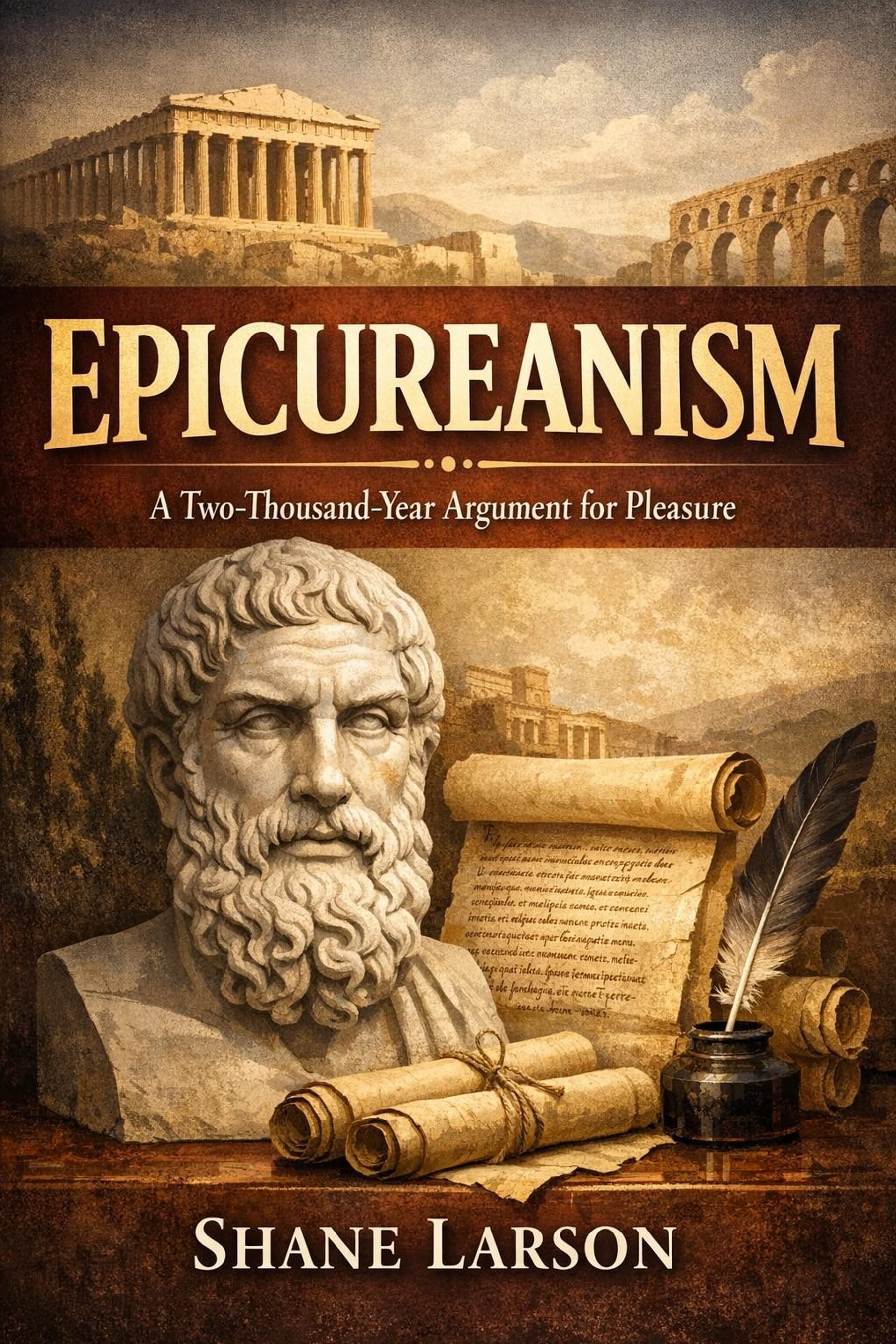
If this resonated, my new book goes much deeper. Epicureanism: A Two-Thousand-Year Argument for Pleasure walks through the founding generations of the Greek school, the complete philosophical system, the Roman inheritance through Lucretius and the Herculaneum papyri, the medieval near-disappearance, the 1417 recovery, the early modern absorption into the foundations of modern science and modern liberalism, and the contemporary revival. It is the direct companion to my earlier Stoicism: A Five-Hundred-Year Conversation. The two volumes are designed to be read together.
The Garden is gone. The villa is buried. The argument is two thousand three hundred years old and is still here. The next century of it is yours.
Epicureanism
New posts and releases, straight to your inbox. No spam, unsubscribe anytime.