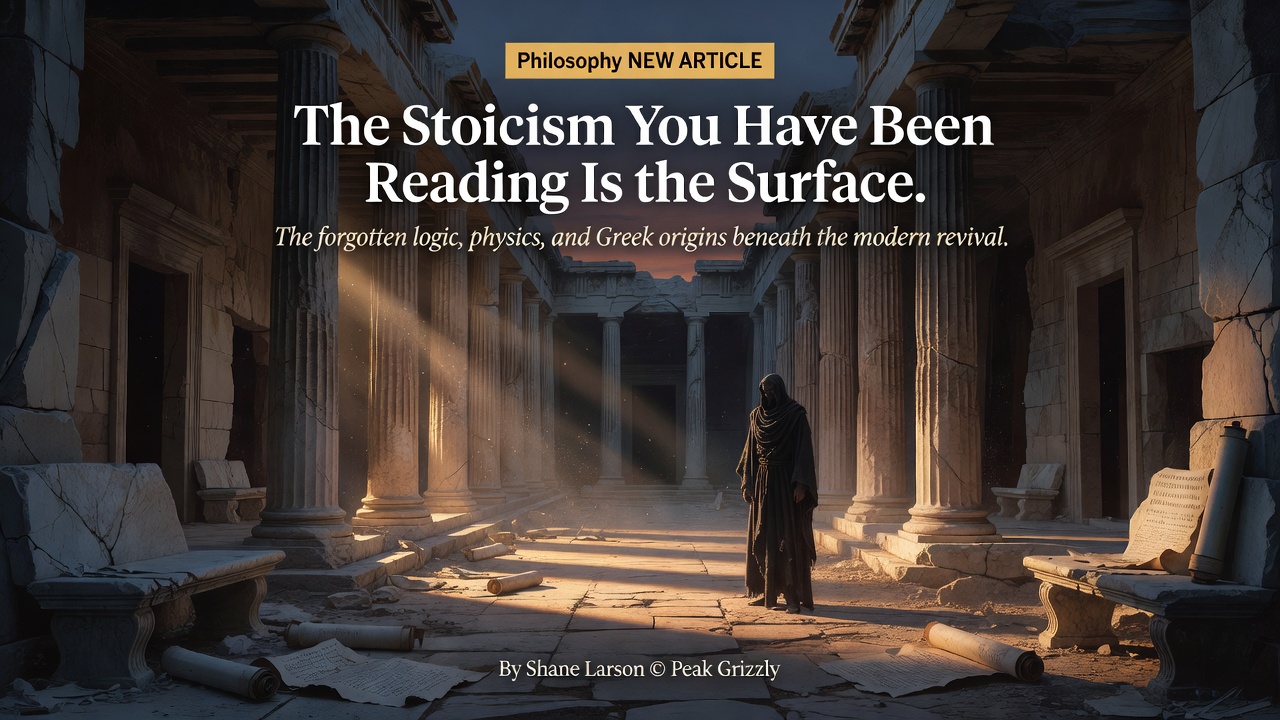
The Stoicism You Have Been Reading Is the Surface
May 12, 2026 · 10 min read
The contemporary Stoic revival is one of the great commercial-philosophical phenomena of the early twenty-first century. Ryan Holiday's books have sold millions of copies. Massimo Pigliucci's How to Be a Stoic is a sustained bestseller. William Irvine's A Guide to the Good Life introduced an entire generation of readers to the practical discipline of negative visualization. Donald Robertson has built a clinical-philosophical practice around the integration of Stoic ethics with cognitive-behavioral therapy. The Daily Stoic email newsletter has hundreds of thousands of subscribers. Marcus Aurelius's Meditations is now one of the best-selling philosophy books in the world.
This is a real cultural moment. It has helped a great many people. It is also a thin and partial version of the philosophy underneath it.
The philosophy underneath it was a comprehensive system, developed across five centuries, by a chain of named teachers working in public schools across the Mediterranean. It started in Athens around 301 BCE when a forty-something Phoenician merchant's son named Zeno, who had been shipwrecked off Piraeus and had stayed on to study philosophy, began teaching in a public colonnade on the north side of the agora. The colonnade was called the Stoa Poikile — the Painted Porch — and the school took its name from the building. For the next five hundred years the school produced philosophical work at a scale and rigor that few intellectual traditions have ever matched.
And then almost all of it disappeared.
This article is about what the modern Stoic revival has lost, and what is still recoverable.
What the Greek Founders Built
The standard popular Stoicism opens with a one-paragraph mention of Zeno and then spends the rest of the book on the three Roman survivors — Seneca, Epictetus, and Marcus Aurelius. The Greek founders almost never come into focus. The Roman writers do not get treated as inheritors of a longer tradition; they get treated as the tradition itself.
But the Greek founders built the system. Three figures matter most:
Zeno of Citium (c. 333-262 BCE) founded the school. He had read Xenophon's Memorabilia of Socrates and had decided he wanted to find men like Socrates to learn from. He studied with three major teachers in Athens — the Cynic Crates, the Megarian logician Stilpo, the Academic Polemo — and integrated what each of them taught into a single philosophical project. Cynic ethics (the centrality of virtue, the suspicion of conventional goods), Megarian logic (the technical apparatus of rigorous argument), and Academic systematic method (the integration of metaphysics with ethics) combined into something none of the original schools had been. The result was Stoicism.
Cleanthes of Assos (c. 330-230 BCE) succeeded Zeno as head of the school. He was a working laborer who hauled water at night for Athenian gardeners and attended Zeno's lectures by day. He led the school for thirty-two years and produced one of the few substantial early Stoic texts that survives: the Hymn to Zeus, a religious poem that articulates the Stoic doctrine of divine providence in the form of a traditional Greek prayer.
Chrysippus of Soli (c. 280-206 BCE) was the great consolidator. He wrote over seven hundred treatises (the ancient sources are emphatic about this number; we have eight hundred surviving fragments quoted in other writers). He built the technical apparatus of Stoic logic, refined the cosmology, and articulated the integration of the three branches of philosophy. The ancient tradition was unanimous that without Chrysippus, the Stoa would not have survived as a major philosophical school.
These are the founders. None of them has the popular profile in 2026 that Seneca, Epictetus, and Marcus Aurelius have. The reason is partly accidental — the founders' texts did not survive, while the Roman survivors' did — and partly contingent on what the modern revival has chosen to emphasize. The Roman survivors are easier to teach, easier to apply, easier to turn into daily-quote applications. The Greek founders built the system that made the Roman writing possible. The system is what has been lost.
The Three Branches
The Stoic school taught philosophy in three integrated branches: logic, physics, and ethics. The school's own self-understanding was that the three branches were inseparable — that ethics, in particular, could not be done well without the logical methods and the physical framework that grounded it.
The modern popular Stoicism is almost entirely ethics. The logic and the physics are mentioned in passing if at all. Here is what is being skipped.
Stoic logic was the most sophisticated formal logical system in antiquity. Chrysippus identified five basic argument forms — modus ponens (if P then Q, P, therefore Q), modus tollens (if P then Q, not Q, therefore not P), the disjunctive syllogism, and two others — as the indemonstrable starting points of his system. These are recognizable today as standard rules of propositional inference. The Stoic system worked at the level of whole propositions, where Aristotle's syllogistic logic worked at the level of subject-predicate terms. The Stoic system was substantially equivalent in power to what Gottlob Frege and Bertrand Russell would build at the turn of the twentieth century, more than two thousand years later, working from scratch.
This is not an obscure historical curiosity. The Stoic theory of judgment — the analysis of how the mind receives impressions and assents to them or refuses them — is the philosophical ancestor of modern cognitive-behavioral therapy. The CBT analysis of thoughts as the source of emotional suffering, and of clinical practice as the revision of those thoughts, is structurally identical to the Stoic analysis. The connection is recognized in the academic literature; it is not yet visible in the popular revival.
Stoic physics was a materialist cosmology in which the universe is a single living rational organism. Everything that exists, in the Stoic system, is body — including the soul, including the divine. The cosmos is pervaded by a divine breath (pneuma) that is simultaneously the principle of life, the principle of cohesion, the principle of rational order, and the divine itself. The Stoic God is not a transcendent creator separate from the world; the Stoic God is the immanent rational principle that constitutes the world from within.
This cosmology is the foundation of the famous Stoic ethical doctrines. The claim that the wise person should "live in accordance with nature" depends on the claim that nature is divinely rational. The claim that the wise person should accept whatever happens depends on the claim that whatever happens is part of the divine rational order. The strict ethical claim that virtue is the only good depends on the claim that virtue is the unique state of being aligned with the cosmic order. Without the physics, the ethics is just intuitive psychology. With the physics, the ethics is the practical conclusion of a complete philosophical system.
Stoicism
Stoic ethics is what everyone knows. The dichotomy of control, the analysis of the passions as judgments, the doctrine that virtue is sufficient for happiness, the cosmopolitan extension of moral concern to all rational beings. The popular revival has done good work on the ethics. What it has not done — and what the book this article comes from tries to do — is connect the ethics back to the logic and the physics that originally supported it.
The Disappearance
The other thing the modern revival usually skips is the thirteen hundred years of near-silence between Marcus Aurelius's death in 180 CE and the Renaissance recovery in the late sixteenth century.
The Greek Stoic library disappeared in those centuries. Zeno's books, Cleanthes's books, Chrysippus's enormous corpus, the works of the middle Stoa — all lost. The reasons were complex: the closing of the Athenian schools by Justinian in 529 CE, the decline of philosophical Greek as a working language in the Latin West, the medieval scriptorial choices that prioritized other texts, the Arabic translation movement of the ninth through twelfth centuries that focused on Aristotle and Plato rather than the Stoics, the long slow erosion of any tradition that nobody is actively teaching.
What survived was selective. The three Roman writers — Seneca, Epictetus, Marcus Aurelius. Cicero's Latin transmission of middle Stoa material in De Officiis and the Tusculan Disputations. The doxographical sources — Diogenes Laertius's Lives Book 7, Stobaeus's Anthology, Plutarch's hostile anti-Stoic essays. The late-antique commentators on Aristotle who mentioned Stoic positions to refute them. From these fragments, modern scholarship has reconstructed a substantial portion of the original system — but only a portion.
The early Christian writers — Clement of Alexandria, Origen, the Cappadocian Fathers, Augustine — were deeply read in Stoic philosophy and absorbed substantial Stoic content into Christian theology. The Stoic doctrine of the immanent logos became the philosophical preparation for the Christian doctrine of the incarnate Word. The Stoic cosmopolitan ethics became the philosophical ancestor of the Christian doctrine of universal brotherhood. The Stoic analysis of the passions became part of the Christian ascetic tradition's analysis of temptation. The transfer was substantial, often without acknowledgment, and produced a situation in which many ideas that modern readers think are distinctively Christian have direct Stoic roots.
By 1200 CE, the Stoic school had no institutional continuity anywhere in Christendom or the Islamic world. The texts that survived survived inside Christian theology and as quiet manuscript traditions in monastic libraries, not as living philosophy.
The Renaissance Recovery and the Modern Revival
The Stoic recovery began in the fifteenth century with the Renaissance humanist project of recovering classical texts. The Flemish humanist Justus Lipsius (1547-1606) produced two major works — De Constantia (1584) and Manuductio ad Stoicam Philosophiam (1604) — that founded Neostoicism as a major intellectual current in late-16th and 17th-century Europe. The Neostoic moment shaped early-modern political theory (Hugo Grotius's international law has Stoic roots), early-modern philosophy (Spinoza's Ethics is arguably the most thoroughly Stoic of the major early-modern philosophical works), and early-modern literature (Montaigne's Essays, the Senecan revival in Renaissance drama).
The moment faded by the early eighteenth century. The Enlightenment philosophical project moved in directions Stoicism could not easily provide for. By 1800, Stoicism was no longer a major living philosophical current in European intellectual life. It would sleep for over a century.
The modern academic recovery began with the German philological tradition in the late nineteenth century. Hans von Arnim's three-volume Stoicorum Veterum Fragmenta (1903-1905) provided the modern foundation for serious scholarship by collecting every surviving fragment of early Stoic philosophy. The mid-twentieth-century philosophical reassessment — Józef Bocheński's identification of Stoic propositional logic in 1947, Benson Mates's Stoic Logic in 1953, A. A. Long's Hellenistic Philosophy in 1974, Pierre Hadot's Philosophy as a Way of Life in the 1980s, John Sellars's accessible scholarship from the 2000s — built the academic infrastructure that the popular revival eventually drew on.
The popular revival itself began around 2008 with William Irvine's A Guide to the Good Life. Massimo Pigliucci's How to Be a Stoic (2017) consolidated the philosopher-popularizer model. Ryan Holiday's The Obstacle Is the Way (2014) and the subsequent series brought Stoicism to the productivity-and-executive market. Donald Robertson's clinical-philosophical work integrated Stoic practice with cognitive-behavioral therapy. The Modern Stoicism organization (founded around 2012), the annual Stoicon conference, Stoic Week, the online communities — all of this built up over the last fifteen years.
The current popular Stoicism has reached more readers than any moment in the philosophy's history. It is also the most selective version of Stoicism that has existed. It uses three Roman writers, drops most of the philosophical system, softens the harder ethical doctrines, treats the school as unified rather than as a five-hundred-year argument, and treats the Greek founders as historical background rather than as the central figures.
What Is Worth Doing Now
The book I have just published is for readers who suspect there is more underneath the contemporary revival. It is the in-depth version of the Stoic tradition — five hundred years of philosophical development followed by thirteen hundred years of partial disappearance followed by the long modern recovery. The Greek founders get four full chapters. The complete philosophical system (logic, physics, ethics) gets a dedicated chapter. The medieval near-disappearance and the modern recovery each get their own treatments. The contemporary popular revival is treated as the latest phase of a continuous tradition — neither dismissed nor uncritically celebrated.
The next phase of the conversation is happening now. What the current generation chooses to keep — and what it chooses to recover from the deeper tradition — will shape the philosophy for the next century. My argument is that the recovery is worth doing. The Stoic logic, the Stoic physics, the Stoic political theory, the Greek founders, the full ethical system — all of this is recoverable, and the recovery will make contemporary Stoic practice more grounded and more defensible than the current popular version manages on its own.
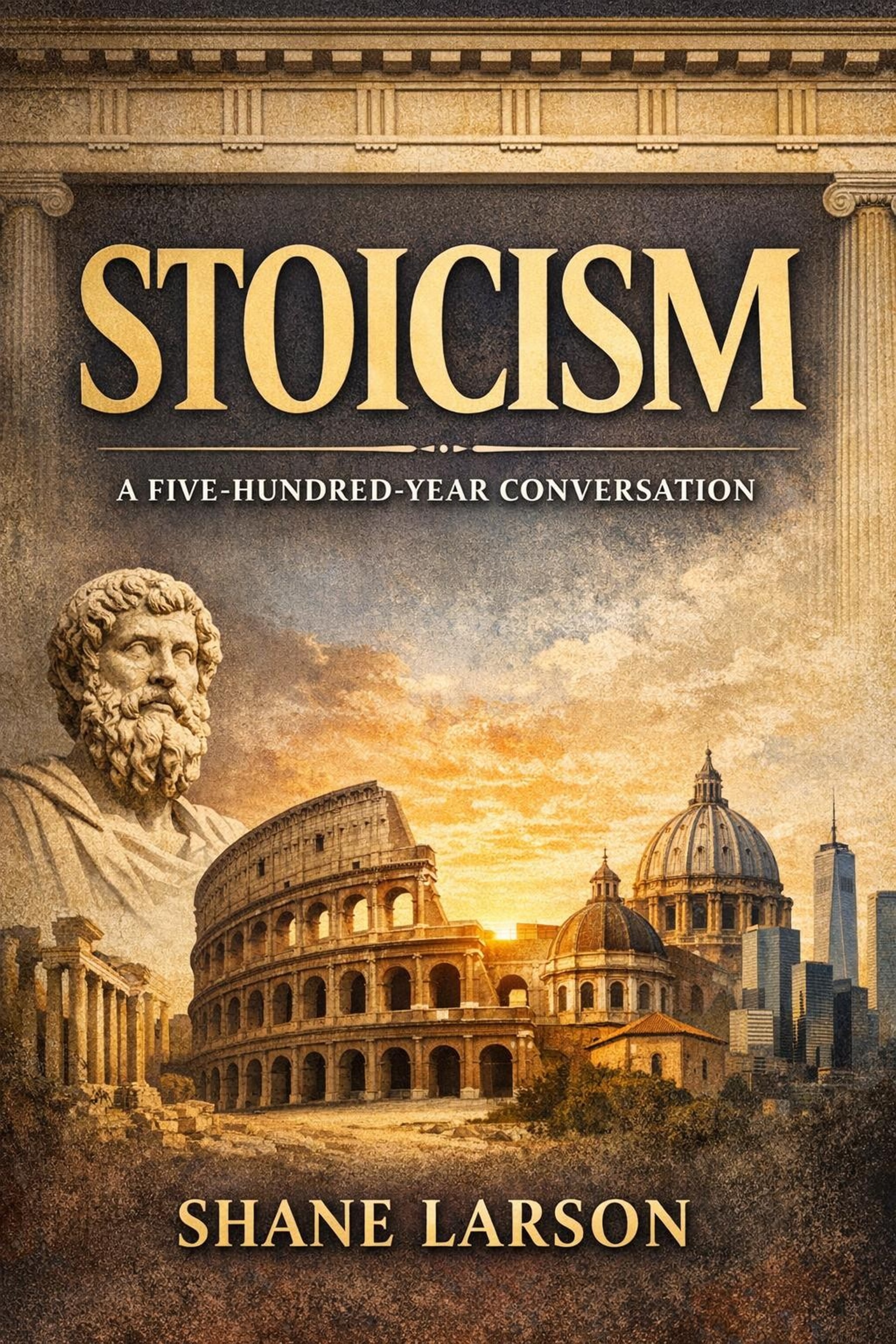
If this resonated, the book goes much deeper. Stoicism: A Five-Hundred-Year Conversation is available now on Amazon Kindle.
Stoicism
New posts and releases, straight to your inbox. No spam, unsubscribe anytime.