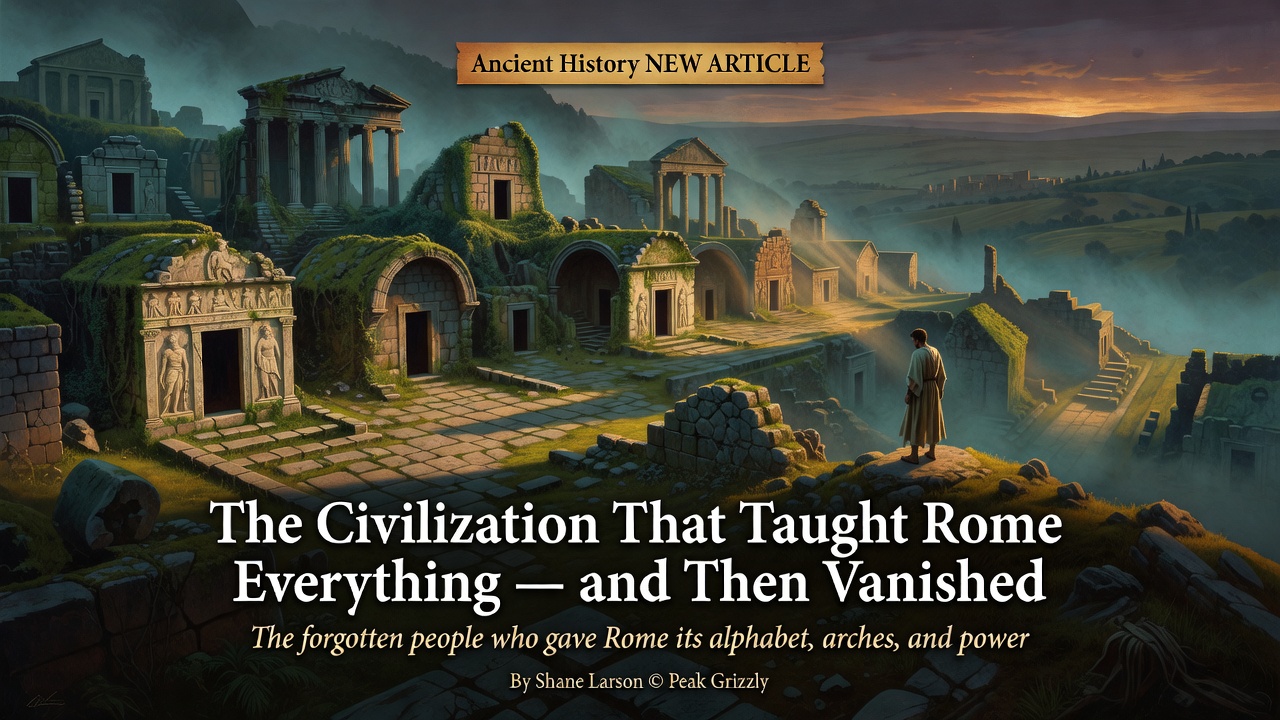
The Civilization That Taught Rome Everything — and Then Vanished
July 20, 2026 · 7 min read
Here is a sentence that should be much better known than it is: for about a hundred years, the city of Rome was ruled by foreign kings, and those kings were Etruscan.
We don't tell the story that way, of course. The version most people absorb — from school, from movies, from the general cultural fog around ancient Rome — starts with Romulus and a wolf and proceeds more or less directly to togas, legions, and Caesar, as though Rome sprang from the Italian soil fully formed and self-invented. It's a great story. It's also, in its early chapters, largely a Roman public-relations exercise, and the biggest thing it edits out is the civilization that was already old, rich, and sophisticated when Rome was still a muddy town figuring out what it wanted to be.
That civilization was the Etruscans. And once you know what Rome took from them, you can't unsee it.
What Rome Owed the People It Forgot
Start with the physical stuff, because it's the least deniable. The arch — the engineering principle Rome would carry across a continent in aqueducts and bridges and triumphal gateways — the Etruscans had mastered first. The draining of the marshy valley that became the Roman Forum, the heart of the city, was an exercise in the kind of hydraulic engineering the Etruscans were famous for; they cut drainage tunnels through rock as a matter of routine. Rome's first great temple, the vast sanctuary of Jupiter on the Capitoline hill, was built to an Etruscan plan by, according to Roman tradition, an Etruscan sculptor.
Now go to the symbols of Roman power, and it gets almost eerie. The fasces — the bundle of rods tied around an axe, carried before Roman magistrates as the visible emblem of state authority to command and to punish — was an Etruscan symbol, and archaeologists actually dug a real bronze example out of an Etruscan tomb. (If that object sounds familiar, it's because the fasces was borrowed again in the modern era, giving us the word "fascism," and it still appears on plenty of official architecture, including in Washington.) The triumph, that most Roman of ceremonies — the victorious general parading through the city in a chariot, robed in purple, his face painted, a laurel in his hand — came, regalia and all, substantially from Etruria. The rounded drape of the toga itself descends from an Etruscan garment. The Roman obsession with reading the will of the gods in the flight of birds and the livers of sacrificed animals was Etruscan religious science, adopted wholesale; Rome kept official Etruscan-style diviners on call for close to a thousand years. Even the gladiatorial games most likely began as Etruscan funeral rites.
And then there's the alphabet. The letters you are reading right now trace a path: from the Phoenicians, who developed the alphabet, to the Greeks, who added vowels, to the Etruscans, who adapted the Greek letters — and from the Etruscans to the Romans, whose version became the Latin alphabet used across most of the world today. The script of Western civilization passed through Etruscan hands and took several of its decisive turns there.
I want to be fair to Rome, and in the book I work hard to be. Borrowing is not copying, and Rome's own genius — for law, for military organization, for administration, for the sheer scale of what it built and absorbed and systematized — was entirely real and entirely its own. The Etruscans supplied a great deal of the toolkit. Rome built the machine. But the toolkit came from somewhere, and pretending otherwise is the historical equivalent of a self-made man who never mentions the inheritance.
A People You Can Read Aloud but Cannot Understand
If the Etruscans were only Rome's forgotten teachers, they'd deserve a book. What makes them irresistible is that they come wrapped in two genuine mysteries, and both are better than the legends they replaced.
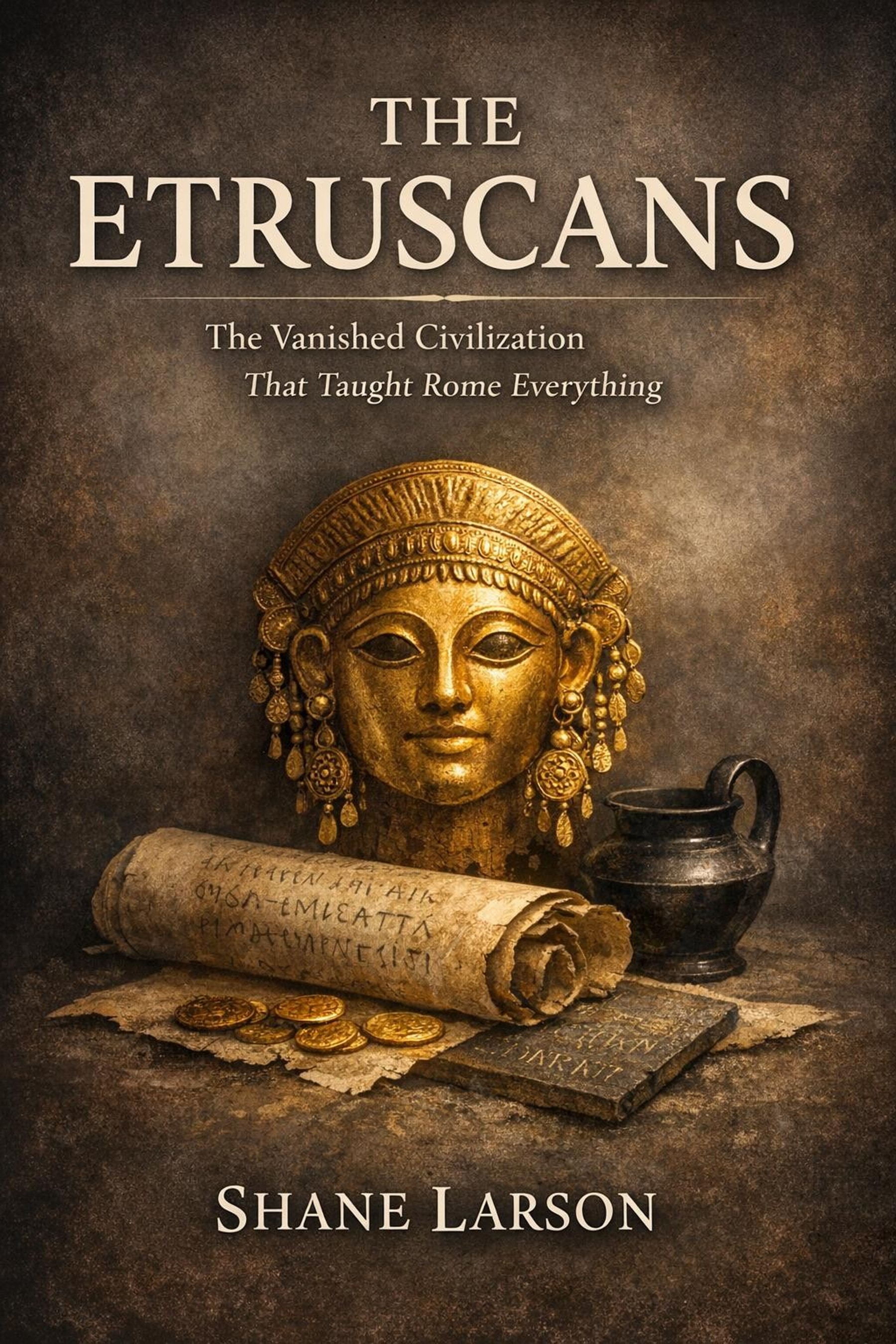
The Etruscans
The first is their language, and it produces a fact that still stops me cold: we can read Etruscan perfectly and understand it barely. The reason is a kind of cruel joke of history. The Etruscans borrowed their alphabet from the Greeks, so every letter maps to a sound we know; a scholar can pick up an Etruscan inscription and pronounce it aloud without hesitation. But the language those sounds belong to is not Indo-European. It isn't related to Latin or Greek or Celtic or Persian or Sanskrit or virtually anything else. So you can say the words and have almost no idea what they mean. We have something like thirteen thousand Etruscan inscriptions, and the great majority are tiny — names on tombs, a word or two of dedication — so even that huge pile yields a frustratingly thin dictionary. The single longest Etruscan text we possess survived, I am not making this up, because it was a linen book that someone in antiquity tore into strips and used to wrap an Egyptian mummy, now in a museum in Zagreb. A whole literature, reduced to reused funeral cloth.
The second mystery is where they came from, and it has a wonderful modern twist. The Greek historian Herodotus said the Etruscans were refugees who'd sailed to Italy from Lydia, in Asia Minor, to escape a famine. Other ancient writers said no, they were native Italians all along. The argument ran for two and a half thousand years with no way to settle it — until, in the last couple of decades, ancient-DNA studies finally read the answer off the Etruscans' own bones. The verdict: they were locals. Genetically, they were essentially the same population as their Latin-speaking neighbors, the future Romans. There was no migration from Asia Minor.
Which is where it gets really interesting, because that answer doesn't solve the mystery — it deepens it. If the Etruscans had been Lydian immigrants, their weird unrelated language would have a tidy explanation: they brought it from abroad. But they didn't come from abroad. They were locals, biological cousins of the Romans — and yet the Romans spoke an Indo-European language and the Etruscans spoke something from outside that whole family entirely. Same ancestry, radically different tongue. The best explanation is that Etruscan is a survivor: a relic of the languages spoken in Europe before the Indo-European languages spread across the continent and replaced almost everything. The Etruscans, on this reading, aren't exotic foreigners. They're the last speakers of an older Europe, hiding in plain sight in the middle of Italy.
The Slowest Kind of Ending
What finally happened to them is the part that haunts me, and it's why the book exists.
The Etruscans didn't fall. There was no apocalypse, no single catastrophe, no dramatic last stand that fits on a monument. What happened was slower and quieter and, I think, more unsettling. Rome, once it got going, absorbed them — city by rival city, over three centuries, exploiting the fatal fact that the Etruscans were never a unified state but a league of proud, independent cities that would not combine to save one another. Rome never had to beat Etruria. It only had to beat one Etruscan city at a time while the others watched.
And as the cities were absorbed, the culture dissolved. The Etruscan elite were granted Roman citizenship, which was a generous thing and also a solvent: to become a Roman was, gradually, to stop being an Etruscan. The language retreated from the forum to the household, from the household to the temple, from the temple to nowhere; the last fluent speakers died out around the age of Augustus. The emperor Claudius, a genuine scholar married to an Etruscan noblewoman, wrote a twenty-volume history of the Etruscans in the first century AD — and even that has vanished without a trace. A people who taught their conquerors how to build a city, run a triumph, read the gods, and write their letters were absorbed so completely that they became a rumor in their own land.
That, in the end, is what drew me to them. We tend to think civilizations end in fire — the sack, the collapse, the ash layer. The Etruscans are the great counterexample: a civilization that vanished without ever being destroyed, that left its fingerprints on everything and its name on almost nothing. Their story is a quiet warning about how much of what any culture calls its own is inherited, about how thoroughly the winners get to write the history, and about how a whole people can shape the world and still slip out of its memory. If any of that resonates, the book goes much deeper — into the tombs, the trade, the scandalous freedom of Etruscan women, and the long, strange struggle to make a lost language speak again.
The Etruscans
New posts and releases, straight to your inbox. No spam, unsubscribe anytime.