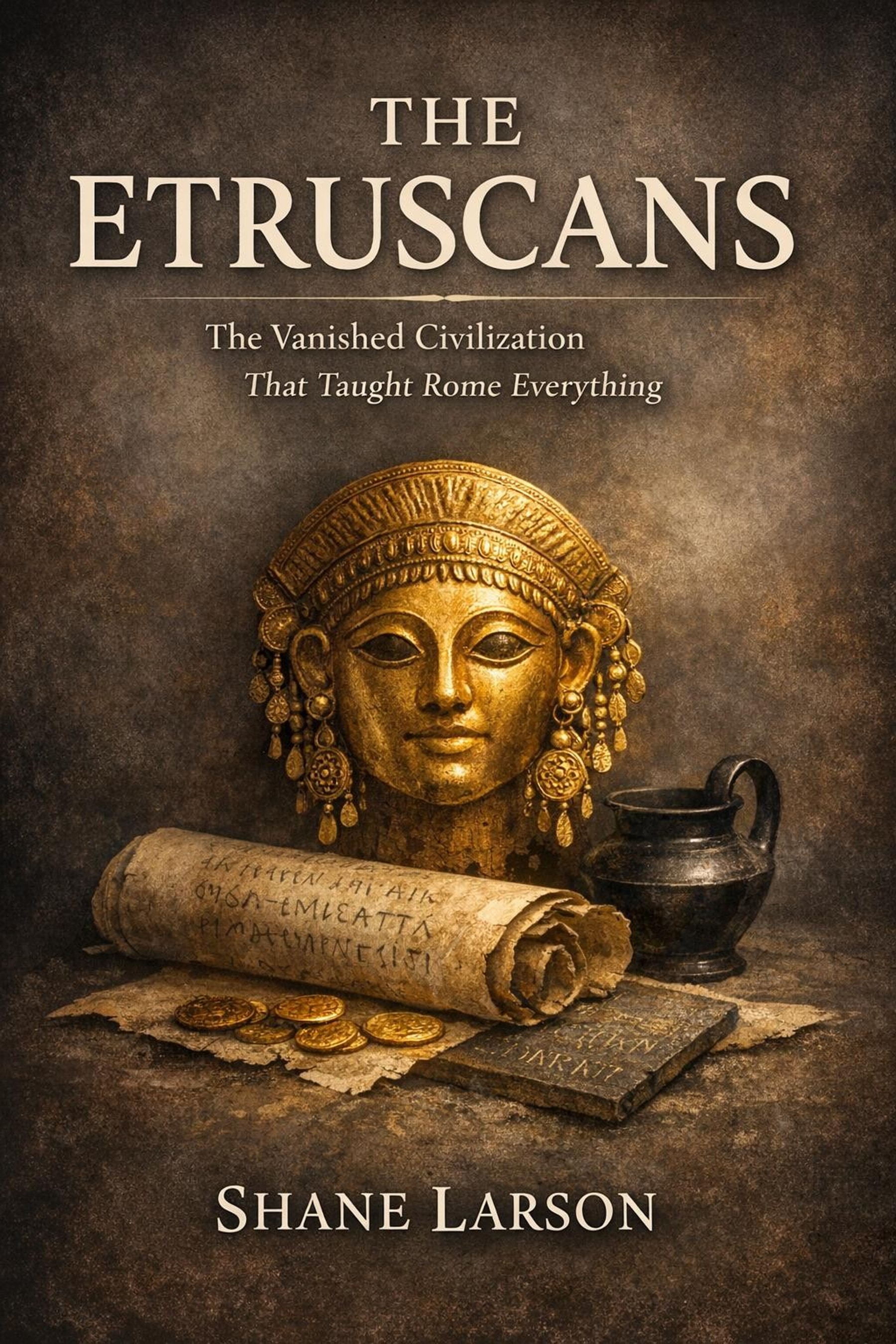
The Etruscans
The Vanished Civilization That Taught Rome Everything
By Shane Larson
About This Book
In a museum in Zagreb lies the linen-wrapped mummy of an Egyptian woman, bought by a curious Croatian traveler in the nineteenth century and shipped home as a souvenir. For years no one paid much attention to the bandages. Then someone noticed that the linen was covered in writing — not Egyptian, but a strange script running the wrong way across the cloth. The wrappings, it turned out, had been cut from a book. And the book was written in Etruscan.
It is the longest Etruscan text in existence, and it survives only because someone in antiquity tore up a sacred linen volume, carried the strips to Egypt, and used them to wrap a corpse. That single absurd accident preserved more connected Etruscan prose than all the tombs and temples of Italy combined. It is a fitting emblem for a whole civilization: a people who once taught Rome how to be Rome, reduced to a rumor, their entire literature hanging by a thread of reused funeral cloth.
The Etruscans are the most important ancient people you were never really taught about. This is the story of who they were, what Rome owes them, and how they managed to vanish so completely.
Rome's Origin Story, Told from the Other Side
Everyone knows the Romans. Almost no one knows the people who taught them. Yet before Rome was a power, before it was even much of a town, the civilization to its north was already old and rich: a league of walled cities in the hills of what is now Tuscany, with paved streets, engineered drainage, international trade, monumental temples, and an aristocracy buried in worked gold. For roughly a century, Rome was actually ruled by kings of Etruscan connection, and it was under them that the city first became a city — the Forum drained, the great Capitoline temple raised, the sewers dug.
When Rome later told its own founding story, it quietly wrote that century out, recasting foreign tutors as tyrants to be expelled and inherited genius as native brilliance. This book puts the Etruscans back where they belong: at the beginning of the Roman story, as its teachers. The arch, the toga, the triumphal procession, the rods-and-axe symbol of state authority, the reading of omens, the gladiatorial games, and the very alphabet these words are printed in all reached Rome through Etruria. Rome's own genius was real — for organization, law, and sheer scale — but the toolkit was, to a startling degree, borrowed.
And then the teachers disappeared. Not in a war, not in a catastrophe, but through absorption: city by city, generation by generation, the Etruscans became Roman citizens and stopped being Etruscans. Their language retreated from the forum to the hearth and then to nowhere. Their books decayed. By the age of Augustus the last fluent speakers were dying out, and an emperor who wrote a twenty-volume history of them saw even that work vanish. It is a quieter and, in its way, more haunting kind of ending than any sudden collapse.
What's Inside
- How iron and trade turned Iron Age villages into the wealthy league of twelve cities
- The origins mystery: Herodotus said they sailed from Lydia; modern DNA says they were locals all along — and that answer makes their alien language stranger, not simpler
- Why a league bound by religion instead of a capital was strong in peace and fatally weak in war
- The painted tombs of Tarquinia and Cerveteri, read as a window onto food, music, sport, and belief — and how their mood darkened as Rome closed in
- The remarkably free women of Etruria, whose status scandalized Greek writers and is confirmed by the sarcophagi
- The elaborate Etruscan science of reading lightning and livers, which Rome adopted and kept for centuries
- The full inventory of what Rome inherited, each item weighed for how good the evidence really is
- The language we can pronounce but not read, the mummy that saved its longest text, and what a new bilingual would unlock
Why I Wrote This
I have spent years writing about the ancient Mediterranean, and the Etruscans kept turning up at the edge of other people's stories — the mysterious teachers behind early Rome, the makers of half the Greek vases in our museums, the people whose language nobody can read. Every time, they got a paragraph and a shrug. Nobody, it seemed, had written the accessible, narrative book that put them at the center.
What hooked me was the double vanishing. Here was a civilization that disappeared twice over: first as a people, absorbed into Rome until being Etruscan meant nothing, and then as a voice, its literature rotting away until we were left with tombs full of art and a language we can sound out but not understand. That is a genuine mystery, and it comes with two of the best hooks in ancient history — the DNA plot twist and the unreadable script. I wanted to give the Etruscans the full treatment they never get: Rome's origin story, honestly told from the side of the people Rome forgot.
Frequently Asked Questions
Who were the Etruscans, briefly?
They were the dominant civilization of pre-Roman Italy, centered on modern Tuscany, at their height from roughly the eighth to the fifth centuries BC. They were wealthy traders and metalworkers organized into a league of independent cities, and they profoundly shaped early Rome before being absorbed by it.
Did the Etruscans really rule Rome?
For about a century, traditionally the 500s BC, Rome had kings of Etruscan connection — the Tarquins. Under them Rome was transformed from a village cluster into a real city, with its Forum drained and its great Capitoline temple built. The book weighs the legends against the archaeology to sort what we know from what Rome later invented.
Why can't we read the Etruscan language?
We can pronounce it perfectly — the alphabet was borrowed from Greek — but the language itself is non-Indo-European and related to almost nothing else, and most surviving texts are very short. So we can sound out the words and understand only a fraction of them. The book explains what has actually been worked out and why no Rosetta Stone has yet surfaced.
Do I need to know anything about ancient history first?
Not at all. The book starts from the beginning and is written for the general reader, in a narrative style rather than an academic one. If anything, it works beautifully as a prequel to the Roman history most people already half-know.
Does it quote the ancient sources directly?
The ancient writers — Herodotus, Livy, Dionysius, and the hostile Greek gossips — are paraphrased in my own voice rather than quoted from modern translations. Since nearly all of them were biased against the Etruscans, reading them critically is part of the story rather than a footnote.
If You Liked This, You Might Like
- The Minoans — Another brilliant Mediterranean civilization that vanished and left an undeciphered script; the closest companion to this book.
- The Fall of Rome — The end of the empire whose beginning the Etruscans shaped.
- Lost Civilizations of the Ancient World — More vanished peoples and the mystery of how whole societies disappear.
- Julius Caesar — Rome at the height of the story the Etruscans set in motion centuries earlier.
They were there first. They taught the teachers of the world, and then they were absorbed until nothing was left but the lessons and a language no one can read. This is the civilization Rome forgot — put back at the start of its own story.
Part of the vanished-civilization line alongside The Minoans and Lost Civilizations of the Ancient World*, and a prequel to the Rome shelf.*
Included with Kindle Unlimited — read it free if you're a member.
New Ancient History releases and free chapters — no spam, unsubscribe anytime.