The Saint Who "Wrote" to the Virgin Mary: How Forged Letters Nearly Buried Ignatius of Antioch
November 22, 2026 · 6 min read
In a medieval Latin manuscript there is a short letter from Ignatius, bishop of Antioch, to the Virgin Mary. He asks her to confirm what he has heard about her son. Beside it is her reply. She tells him that what he learned from John is true, and encourages him to hold firm.
Neither letter is real. They were composed in western Europe, probably in the twelfth century, more than a thousand years after Ignatius died. For a long time they were copied and read alongside his other letters anyway, and that is the problem this article is about. By the time printing arrived, the genuine Ignatius was buried under so much later material that some of the sharpest minds of the Reformation concluded there was no genuine Ignatius at all.
Why his letters were worth forging
Ignatius was condemned in Antioch in the reign of the emperor Trajan, probably within a decade either side of AD 110, and sent to Rome under guard to be killed in the arena. On the way across Asia Minor he dictated seven letters: to the churches at Ephesus, Magnesia, Tralles, Rome, Philadelphia and Smyrna, and to Polycarp, the bishop of Smyrna.
They are short, and they are early. They were written within living memory of the apostles, and they speak to questions that later Christians cared about intensely. Ignatius takes it for granted that a church has one bishop, with elders and deacons. He insists that Christ had a real body and really suffered. He speaks of the Eucharist in strong physical terms. He is the first writer we know of to use the phrase "the catholic church."
A voice that old, saying things that pointed, is valuable. It is also a temptation. If Ignatius could be made to say a little more, he could settle arguments he had never heard of.
The fourth-century editor
Sometime in the later fourth century, someone in Syria took the seven letters and improved them. He expanded each one, working in long strings of Scripture and phrases that reflect the doctrinal fights of his own day, two and a half centuries after Ignatius. Then he wrote six new letters outright: to the churches at Tarsus, Philippi and Antioch, to a deacon named Hero, and an exchange with a woman called Mary of Cassobola.
Scholars call this collection of thirteen the long recension. Many think its editor was the same man who compiled a church manual called the Apostolic Constitutions, because the two share habits of language and theology. He did his work well. In the Greek East his version spread widely, and in the Latin West it was the only Ignatius most people ever saw.
It is worth saying that he probably did not think of himself as a criminal. Writing in the name of a revered teacher, to say what that teacher would surely have said, had a long history in the ancient world. The effect was the same either way. The real letters and the invented ones were now bound together, and nobody could tell them apart by looking.
Print makes it worse
The long recension was printed in Latin in 1498 and in Greek in 1557. The medieval Latin letters to John and to Mary had reached print a few years before the first of those. Now every scholar in Europe could read Ignatius, and what they read was a second-century bishop who quoted texts that had not yet been written and took sides in fourth-century debates.
Catholic writers cited him on bishops and on the authority of Rome. Protestant writers smelled a rat. John Calvin said flatly that nothing was more nauseating than the absurdities published under the name of Ignatius. In England in the 1640s, when the question of whether the church should have bishops at all was about to become a matter of civil war, defenders of bishops quoted Ignatius and their opponents answered that the letters were forgeries. The poet John Milton was among those who said so in print.
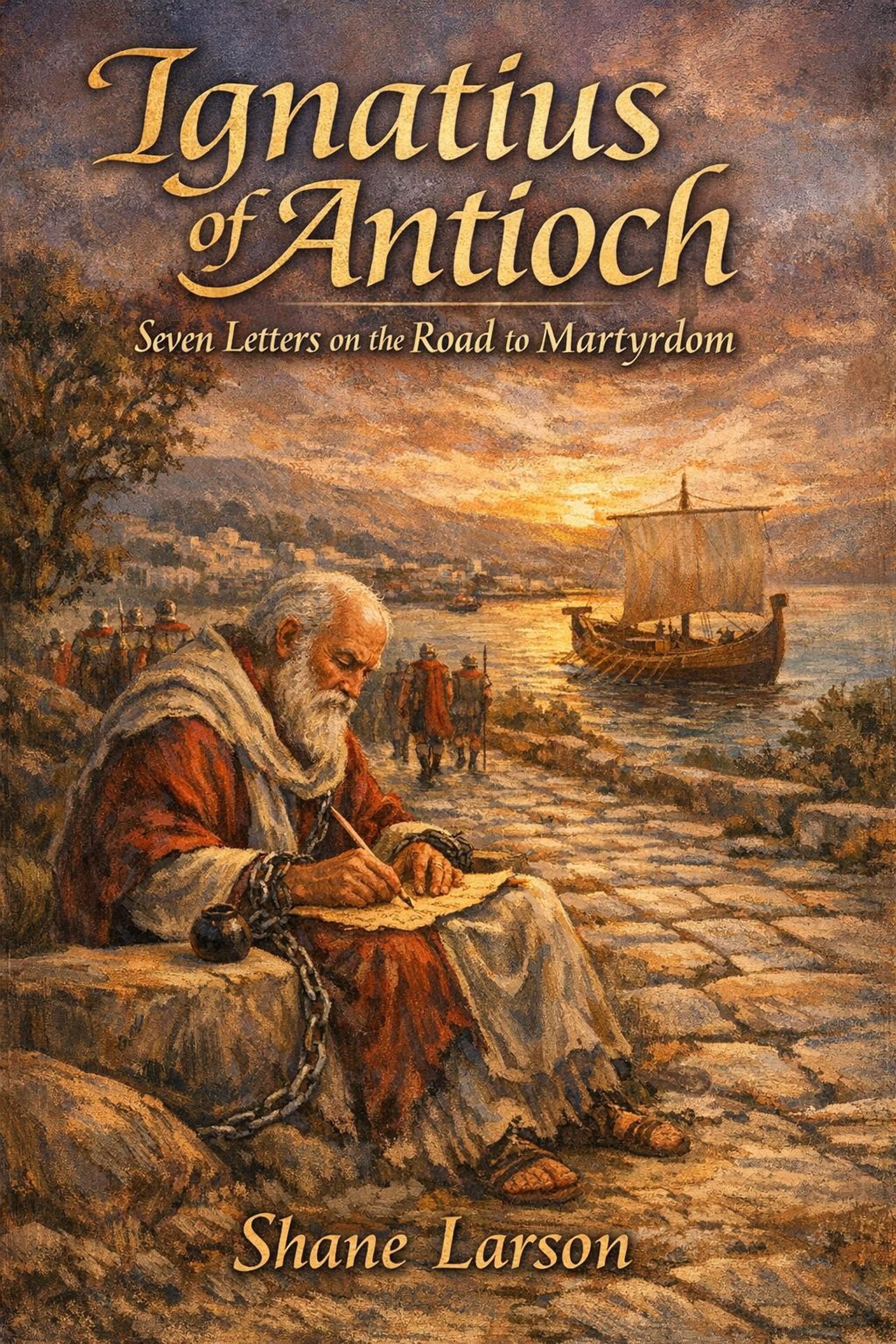
Ignatius of Antioch
Both sides were half right. Much of what they were arguing over was forged. The question was whether anything underneath it was not.
Ussher's deduction
James Ussher was the Archbishop of Armagh, a formidable scholar, and a defender of bishops. He noticed something odd in his reading. Three medieval English writers, the most important being Robert Grosseteste, the thirteenth-century Bishop of Lincoln, quoted Ignatius in a form that did not match the printed text. Their quotations were shorter. And they agreed, nearly word for word, with the quotations of Ignatius preserved by ancient writers such as Eusebius and Theodoret, who had been reading him before the fourth-century editor did his work.
Ussher drew the inference. Somewhere in England there must have been, and perhaps still was, a Latin translation of Ignatius made from an older and unexpanded Greek text. He went looking in English libraries and found two manuscripts of exactly that. In 1644 he published the result, setting the newly found text beside the familiar one so that readers could see the additions for themselves.
It was a Latin translation, not the Greek original, but it showed what the original must look like. Two years later the Dutch scholar Isaac Voss printed a Greek manuscript from the Medici library in Florence that matched Ussher's Latin for six of the seven letters. The Greek of the seventh, the letter to the Romans, was published from a Paris manuscript by Thierry Ruinart in 1689.
Two more rounds
The argument did not end there. In 1666 the French Protestant scholar Jean Daillé published a long attack on all the Ignatian letters, short and long alike. The English bishop John Pearson answered him in 1672 with a defence so thorough that it set the terms of the debate for nearly two centuries.
Then, in 1845, William Cureton of the British Museum published a Syriac manuscript, brought from a monastery in the Egyptian desert, that contained only three letters, each shorter again than the Greek. Cureton argued that these three were the only authentic Ignatius, and the seven were themselves an expansion. For a generation the question was open once more.
It was closed by two enormous works of scholarship: Theodor Zahn's study of 1873, and J. B. Lightfoot's edition of 1885. Between them they showed that the Syriac was an abridgement made from the seven-letter collection, not its source, and that the seven fit the early second century in language, in theology and in the small incidental details no forger would have known to include. That verdict has held. A few scholars since the 1970s have argued for a later date or for forgery, and their arguments are taken seriously, but they have not persuaded the field.
What the story shows
It would be easy to tell this as a tale of pious fraud exposed by sceptics. That is not what happened. The people who recovered the real Ignatius were churchmen. Ussher was an archbishop, Pearson and Lightfoot were bishops, and Zahn was a conservative Lutheran. They wanted to know what Ignatius had actually written, and they were willing to throw out letters they might have liked to keep in order to find it.
What they recovered is a small thing: seven letters, about eight thousand words, written in a few weeks by a man on his way to die. They are stranger and more urgent than the padded version, and they are his.
*Ignatius of Antioch: Seven Letters on the Road to Martyrdom* follows that journey stop by stop and letter by letter, and gives the full story of how the letters were lost and found.
Ignatius of Antioch
New posts and releases, straight to your inbox. No spam, unsubscribe anytime.