A Roman Emperor Once Set the Legal Price of a Lion. Here Is What Else Was on the List.
November 22, 2026 · 5 min read
Late in the year 301, stonecutters in dozens of cities across the eastern Roman Empire were handed the longest job of their careers. The text they were told to carve ran to well over a thousand lines. It began with a sermon and ended with a price list, and the price list covered nearly everything a person could buy or hire: wheat, wine, sausages, boots, parchment, a day of a carpenter's time, the fee for a lawyer, freight from Alexandria to Rome.
Near the end, among the wild animals, a first-class lion was listed at 150,000 denarii.
This was the Edict on Maximum Prices, issued in the names of the emperor Diocletian and his three colleagues. It is the most ambitious attempt at price control to survive from the ancient world, and one of the best documents we have for what ordinary life cost in the Roman Empire. It is also a record of a government trying to command something it did not understand.
Why an emperor was pricing sausages
The background is a ruined currency. For most of the third century, emperors who needed to pay soldiers had done it by putting less silver into the coins. By the 270s the standard silver coin was a bronze disc with a silver wash that wore off in the hand. Prices climbed to match. A soldier's pay, fixed in coin, bought less every year, and soldiers who could not live on their pay were the reason emperors kept getting murdered. (That half-century is the subject of The Crisis of the Third Century.)
Diocletian, who came to power in 284, attacked the problem from several directions. He issued new coins in good gold and good silver. He moved much of the tax system over to payment in kind, so that the army could be fed and clothed in grain and cloth rather than in doubtful money. Then, on 1 September 301, a decree doubled the face value of the coins in circulation. A few weeks later came the Edict.
The preamble explains why, at length and in a temper. It says that greed rages without limit, that profiteers follow the armies and charge so much that a soldier can lose his pay and his bonus in a single purchase, and that the rulers, as the parents of the human race, have decided that justice must step in. The limits were to apply everywhere. The penalty for charging more was death. So was the penalty for paying more, and for keeping goods off the market to avoid selling at the legal price.
What was on the list
The prices are given in an accounting unit, the common denarius. The most useful way to read them is against the wages in the same document, because the Edict capped pay as well as goods.
A farm laborer was allowed 25 denarii a day, with his food. A stonemason or a carpenter got 50. A wall painter got 75, and a painter of pictures 150. A barber could charge 2 denarii per customer. An elementary teacher was allowed 50 a month for each pupil, and a teacher of rhetoric 250.
Now the shopping. Wheat was capped at 100 denarii for an army measure, so a farm hand worked four days to buy one. A Roman pound of pork was 12 denarii, about half his daily wage. Beef was 8. Ordinary wine was 8 for roughly a pint, and the famous Falernian was 30. Egyptian beer, at 2, was the cheapest drink in the document. An egg was 1.
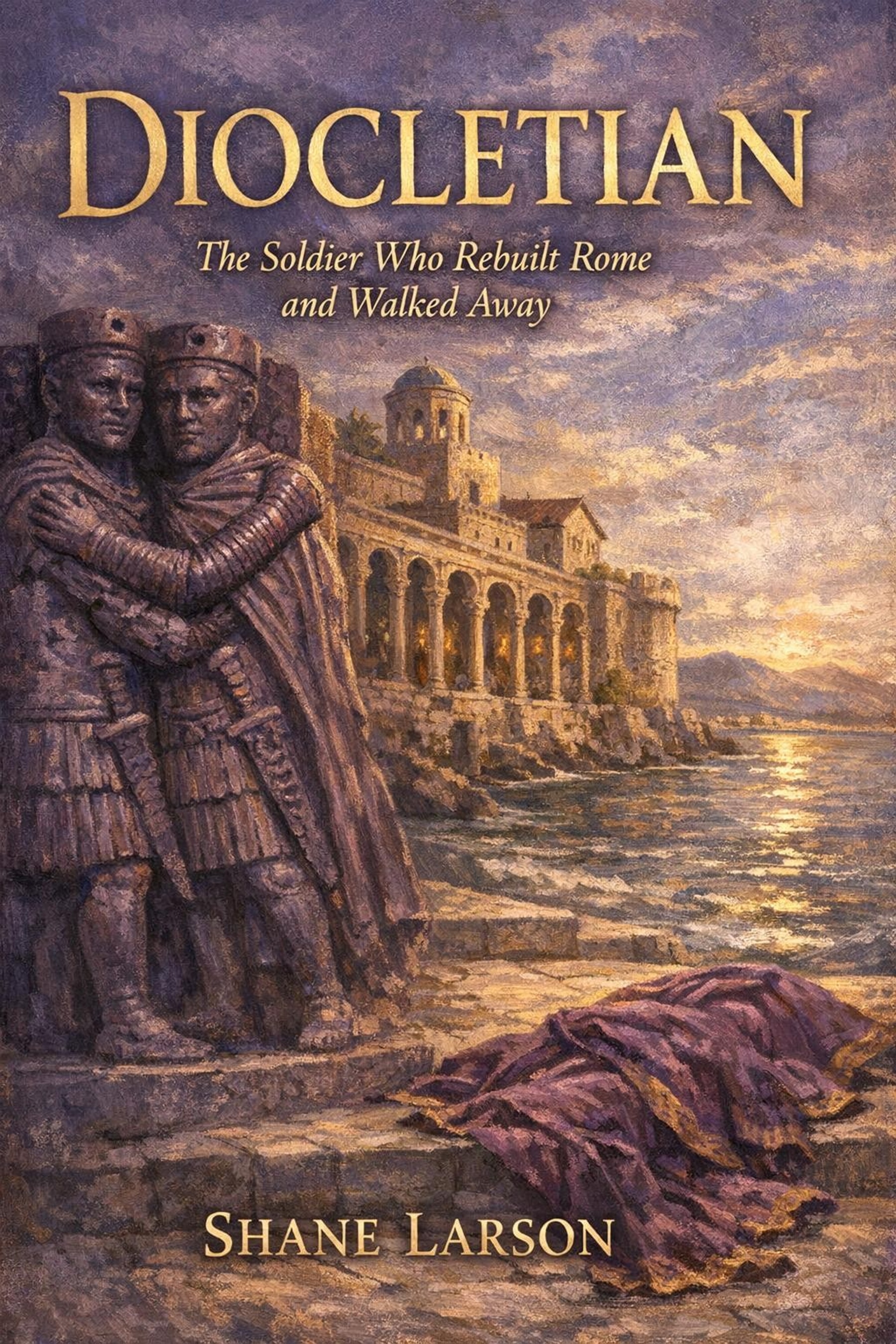
Diocletian
A lawyer could charge 250 for opening a case and 1,000 for pleading it, which is forty days of field labor for a single appearance. A pound of gold was set at 72,000. A pound of purple silk was 150,000, the same as the lion.
That lion works out to six thousand days of a laborer's pay. Nobody on that wage was shopping for one. The entry is there because cities and magistrates bought animals for the arena, and the men who drafted the Edict did not leave things out.
Did it work?
The one contemporary writer who describes the result says no. Lactantius was a Christian teacher of rhetoric who lived in Diocletian's capital and hated him, so he has to be read with care. He says that much blood was shed over small and cheap things, that goods disappeared from sale out of fear, and that prices rose further until the law lapsed from sheer necessity.
That is a hostile summary, but the other evidence does not contradict it. Egyptian papyri from the following decades show prices far above the legal limits, and no sign that anyone had been observing them. And the surviving copies of the inscription come almost entirely from the Greek-speaking East, the part of the empire Diocletian and his deputy ran in person. No copy has been securely identified in the western provinces governed by his two colleagues, which may mean it was barely published there at all.
The deeper problem was in the design. The Edict set one ceiling for the whole empire, although wheat in Egypt, where it grew, had never cost what it cost in a mountain garrison town. (How that grain actually moved is the subject of Feeding Rome.) A merchant who could not legally charge enough to cover transport stopped transporting. The document even contains a long table of maximum freight rates, as if the drafters half saw the difficulty and tried to solve it with more maximum prices.
What it tells us about the man
It would be easy to treat the Edict as a tyrant's folly. It reads better as the work of a certain kind of mind. Diocletian was a career soldier who had spent twenty years fixing an empire one emergency at a time. Provinces too large to govern were cut in half. Generals who might rebel were separated from the governors who held the money. A throne too dangerous for one man was shared among four. Each fix answered a specific failure, and most of them held for centuries.
Prices were the one enemy that would not take an order. The same government that could count every field in Egypt for tax could not make a butcher sell at a loss. The attempt failed quickly, and Diocletian seems to have let it die without comment.
*Diocletian: The Soldier Who Rebuilt Rome and Walked Away* tells the whole story: the civil war that gave him the throne, the four-emperor system, the reforms, the Great Persecution of the Christians, and the day in 305 when he did what no Roman emperor had done before and resigned. An appendix sets out more than thirty entries from the Price Edict, converted into days of work.
Diocletian
New posts and releases, straight to your inbox. No spam, unsubscribe anytime.