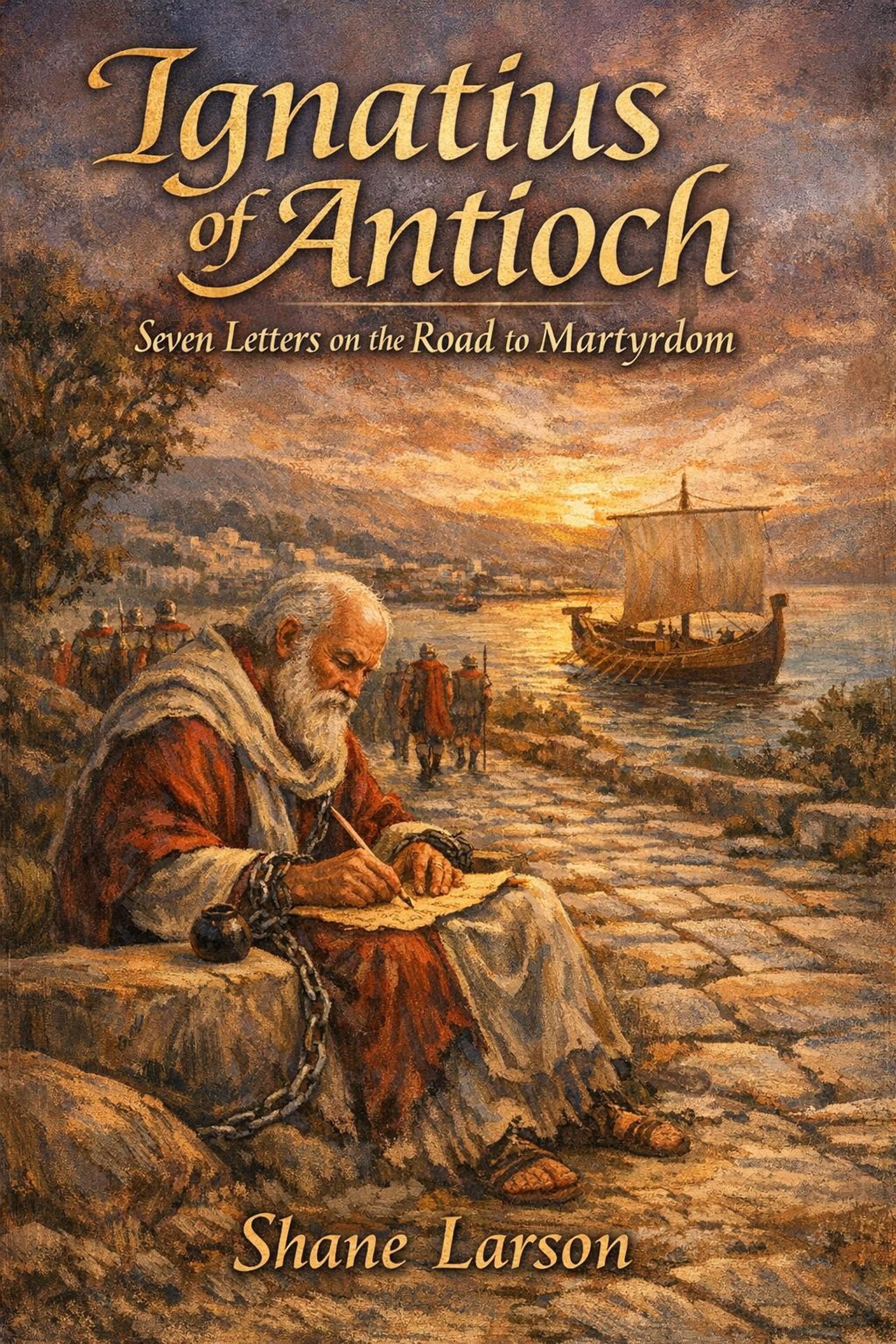
Ignatius of Antioch
Seven Letters on the Road to Martyrdom
By Shane Larson
About This Book
On the twenty-fourth of August, in a year nobody recorded, a man chained to a squad of Roman soldiers sat in the harbor town of Smyrna and dictated a letter to people he had never met. He was on his way to their city to be killed in front of a crowd. He had heard they might have the connections to get him released. The letter told them to leave him alone.
That date is the only one he ever gave. His name was Ignatius. He was the bishop of Antioch in Syria, and nearly everything that can be known about him comes from the few weeks on either side of that August day. There is no record of his birth, his family, how he came to faith, what he was charged with, or how exactly he died. What survives is seven letters, written on the road, to churches that sent people out to meet a condemned man as he passed.
The Story
The soldiers took him overland across what is now western Türkiye. He complained that they treated him worse the more they were tipped, and called them his ten leopards. At Smyrna he stayed long enough to meet Polycarp, the young bishop there, and to receive visitors from three churches that lay off his route. He wrote to each of them, and to Rome. Further north, at Troas, he wrote three more letters while the guards waited for a ship. News reached him there that the trouble in his home church at Antioch was over. Then the order came to sail, and he asked Polycarp to finish his correspondence for him.
The letters are short, hurried, and crowded with images. They are also the earliest window anyone has onto ordinary church life after the apostles were gone. Ignatius assumes each congregation has a single bishop, a council of elders, and deacons, and he pleads with people to stay gathered around them. He attacks teachers who said Christ only appeared to have a body. He argues with Christians who wanted to keep the Sabbath. He uses a word for the faith, Christianismos, that appears in no earlier surviving text, and he calls the whole body of believers hē katholikē ekklēsia, the church universal.
Every one of those points later became a fault line. So the book also follows the letters after his death: collected by Polycarp within months, padded and multiplied by a fourth-century forger, supplemented in the Middle Ages with an invented exchange between Ignatius and the Virgin Mary, thrown out wholesale by some Reformers, and finally sorted true from false by a chain of scholars that begins with James Ussher in 1644.
Why I Wrote This
I came to Ignatius sideways, from writing about Paul. Paul leaves a long trail: decades of travel, a stack of letters, a whole second source in Acts. Then the apostles die and the record goes almost dark, and the next clear voice is this one, a bishop from Paul's old base at Antioch, talking fast because he is out of time.
What held me was the proportion. There are a few weeks of evidence and about an hour's worth of reading, and it has carried nineteen centuries of argument about what the church is supposed to be. I wanted to lay out exactly what he said, in the order he said it, with the legends marked as legends, and then get out of the way. Readers from different churches will hear him differently. I think he can bear that, and I think he is worth hearing first-hand before hearing him quoted.
Frequently Asked Questions
Is this book about Ignatius of Antioch or Ignatius of Loyola?
Ignatius of Antioch, the bishop who died under the emperor Trajan in the early second century. Ignatius of Loyola, the founder of the Jesuits, lived fourteen hundred years later and is not covered here.
Is this book written from a Catholic, Orthodox, or Protestant point of view?
None of the three, and it is written for all of them. It treats Ignatius's faith with respect and reports what he wrote. Where the traditions read a passage differently, such as his words on bishops or on the Eucharist, each reading is given in its strongest form and the book does not pick a winner.
Are the letters of Ignatius of Antioch authentic?
The great majority of scholars accept seven letters as genuine, in the form established by Theodor Zahn and J. B. Lightfoot in the nineteenth century. A longer set of thirteen is a fourth-century expansion, and a handful of medieval Latin letters are inventions. The book explains how the sorting was done and names the scholars who still dissent.
Do I need to know church history to follow it?
No. The book explains the Roman background, the geography, and terms like presbyter and docetism as they come up. It assumes an interested reader, not a trained one.
Does the book include the full text of the letters?
No. It paraphrases and discusses them, with short quotations from public-domain translations, and tells you where to find the complete letters free in older English editions.
Can a church group use this as a study?
Yes. Appendix C is a seven-session plan, one letter per meeting, with discussion questions written so that groups from any tradition can use them.
If You Liked This, You Might Like
- Paul of Tarsus — The generation before Ignatius, including the Antioch church he would one day lead and the letters he knew almost by heart.
- The Height of Empire — Rome from the Year of Four Emperors through Trajan, the empire whose roads carried Ignatius and whose games were waiting for him.
- Aksum — A Christian kingdom in ancient Ethiopia that grew up far outside Rome's reach, and a reminder of how widely the faith had spread within a few centuries.
He left no memoir and no monument, only a set of hurried letters to friends and strangers. This is an account of what those letters say and how they reached us.
What You'll Learn
- Antioch before Ignatius. The third city of the Roman Empire, the church founded by refugees from Jerusalem, and the argument between Peter and Paul that was still echoing two generations later.
- How Rome handled Christians. The governor Pliny's letter to Trajan asking what to do with them, the emperor's reply, and the likeliest reasons a provincial bishop was shipped to the capital.
- The mechanics of the road. How prisoners were moved, why a condemned man could receive guests, and how a letter was dictated, copied, and carried.
- Each letter in its setting. What was happening in Ephesus, Magnesia, Tralles, Philadelphia, and Smyrna that made him write what he wrote.
- Bishops, elders, and deacons. What he says about church order, set beside the other evidence from the same decades, with the Catholic, Orthodox, Anglican, and free-church readings laid out side by side.
- The Eucharist and the body of Christ. His sharpest passages, and how different traditions understand them.
- A hard chapter on Ignatius and Judaism. What he was arguing against, who he was arguing with, and how his words were misused in later centuries.
- The letter to Rome. The wheat, the beasts, the plea not to be rescued, and the old question of whether this is courage or a wish to die.
- The forgeries and the recovery. Three versions of the letters, two centuries of scholarly combat, and why nearly all historians now accept seven as genuine.
- Three appendices. A guide to each letter, a who's who with a gazetteer of the route and its modern place names, and a seven-session study guide for groups.
New Ancient History releases and free chapters — no spam, unsubscribe anytime.