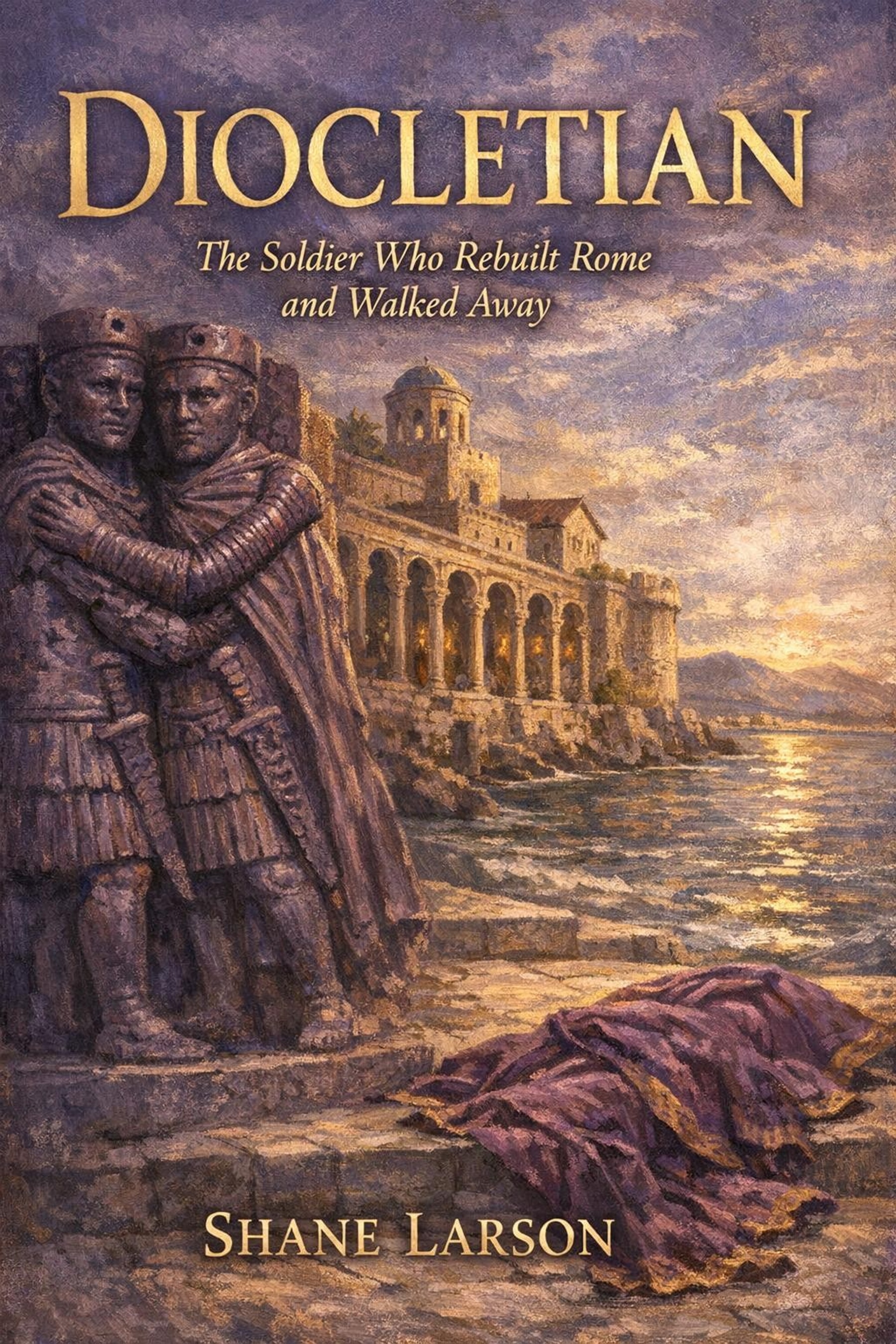
Diocletian
The Soldier Who Rebuilt Rome and Walked Away
By Shane Larson
About This Book
On the Adriatic coast of Croatia there is a city whose old town is a single Roman building. People in Split hang their washing from windows cut into a fourth-century wall. The cathedral is an emperor's tomb. The cafes in the main square set their tables between columns that once framed the approach to his private rooms.
The man who built it was the only Roman emperor who ever planned his own retirement. He moved in during the summer of 305, a few weeks after standing up in front of his army and resigning the most dangerous job in the ancient world. He had held it for twenty years. In the half-century before him, the average was closer to two.
Three years later, with the empire sliding back into civil war, his former colleagues asked him to return. A late Roman writer preserves his answer. If they could see the vegetables he had planted with his own hands, he told them, they would not ask.
The Story
Diocletian was born around 244 on the Dalmatian coast, to a family so obscure that ancient writers could not agree whether he was the son of a clerk or a freed slave himself. He rose through the army during the worst decades Rome had known, when emperors were made and killed by their own troops and the frontiers gave way on three sides. In November 284 the army of the East chose him, and his first act as emperor was to kill the man accused of murdering his predecessor, in person, in front of the ranks.
What he did next is the argument of this book. He did not arrive with a design for a new Rome. He was a soldier working through a list of things that had gone wrong, and for each one he improvised an answer. One emperor could not be on the Rhine and the Euphrates at once, so he appointed a second, and later two juniors beneath them. Governors with large provinces and armies kept making themselves emperor, so he cut the provinces in half and took the armies away from the governors. The coinage was worthless, so he taxed in grain and counted every farm in the empire to do it.
Most of these answers worked, and several outlived the western empire. One did not work at all: in 301 he tried to set the legal price of more than a thousand goods and services, on pain of death. And one was a catastrophe of his own choosing. In 303, after nearly twenty years of leaving the Christians alone, he ordered their churches demolished and their scriptures burned.
The book follows each of these in turn, and then follows him home.
Why I Wrote This
I finished a series on Rome that ended in 284, with a soldier named Diocles standing on a platform holding a bloody sword. The last page promised that what he did next belonged to another book. I kept thinking about that promise.
What held me was the retirement. Powerful people do not usually stop. He did, on a date he seems to have chosen, and then stayed stopped while everything he had arranged for the succession fell apart in front of him. I wanted to know what kind of ruler does that.
The other thing was the source problem. The best storyteller we have for his reign is a man who believed God had punished him. Working out what that witness actually saw, and checking him against tax receipts and price lists carved in stone, was the most enjoyable detective work I have done on any Roman subject.
Frequently Asked Questions
Why did Diocletian divide the Roman Empire?
He did not divide it in law. He shared the job. By 293 there were two senior emperors and two juniors, each with an army and a region to watch, because the previous fifty years had shown that one man could not answer every invasion and revolt in person. Laws still went out in all four names and Diocletian's word was final.
Did Diocletian really retire to grow cabbages?
He retired, in 305, to a palace he had built near his birthplace. The cabbage story comes from a short Latin history written about ninety years later, and the word it uses means garden vegetables in general. The remark may be polished, but the refusal to return to power is well attested.
Why did Diocletian persecute the Christians?
The ancient Christian sources blame his deputy Galerius. Modern historians are divided, because Diocletian had already legislated in defense of traditional Roman religion and had purged Christians from the army before 303. The book lays out both cases.
Did the Edict on Maximum Prices work?
No. Surviving documents give no sign the limits were ever observed, and the one contemporary account says goods vanished from the markets. It is still the best single source for what things cost in the Roman world.
Do I need to have read The Crisis of the Third Century first?
No. The introduction covers what you need. Readers who have read it will find that this book begins on the day that one ends.
If You Liked This, You Might Like
- The Crisis of the Third Century — the half-century of murdered emperors and broken frontiers that every one of Diocletian's reforms was built to stop.
- The Sassanids — the Persian empire on the other side of his eastern war, told from its own monuments.
- Zenobia of Palmyra — a queen who took a third of the Roman East a decade before he came to power, and the emperor who took it back.
- Feeding Rome — how the grain actually moved, which is the system his tax reforms were built on.
Twenty years of rule, one resignation, and a walled house by the sea. The state he assembled kept running for centuries. He is the rare ruler who can be judged on what he built, and on what he was willing to put down.
What You'll Learn
- The fifty-year emergency he inherited. A short account of the third-century collapse, enough to show which disaster each reform was built to prevent.
- How four emperors shared one empire. The system later called the Tetrarchy had no constitution and no name. It ran on marriages, seniority and the fact that Diocletian was obeyed.
- A naval rebel who minted coins calling the emperors his brothers. Carausius held Britain for seven years, and the regime's official speeches simply stopped mentioning him.
- The war that produced Rome's best treaty with Persia in a century, won by a deputy who had been publicly humiliated a year earlier, if that story is true.
- The tax census from the taxpayer's side, using the papers of an Egyptian farmer who kept his receipts.
- The Price Edict, entry by entry. Wheat, wine, a carpenter's day, a lawyer's fee and a lion, with an appendix that converts more than thirty prices into days of labor.
- The Great Persecution without a side. Why a cautious ruler began it late in his reign, how much of the blame belongs to his deputy Galerius, why it was savage in some provinces and nearly ignored in others, and what can honestly be said about the number of dead.
- The abdication. Whether he had planned it for years or was pushed out sick by a younger colleague. The evidence points both ways and the book sets it out.
- The last years at Split, when the old man watched his succession collapse, his statues come down and his wife and daughter become fugitives.
New Ancient History releases and free chapters — no spam, unsubscribe anytime.