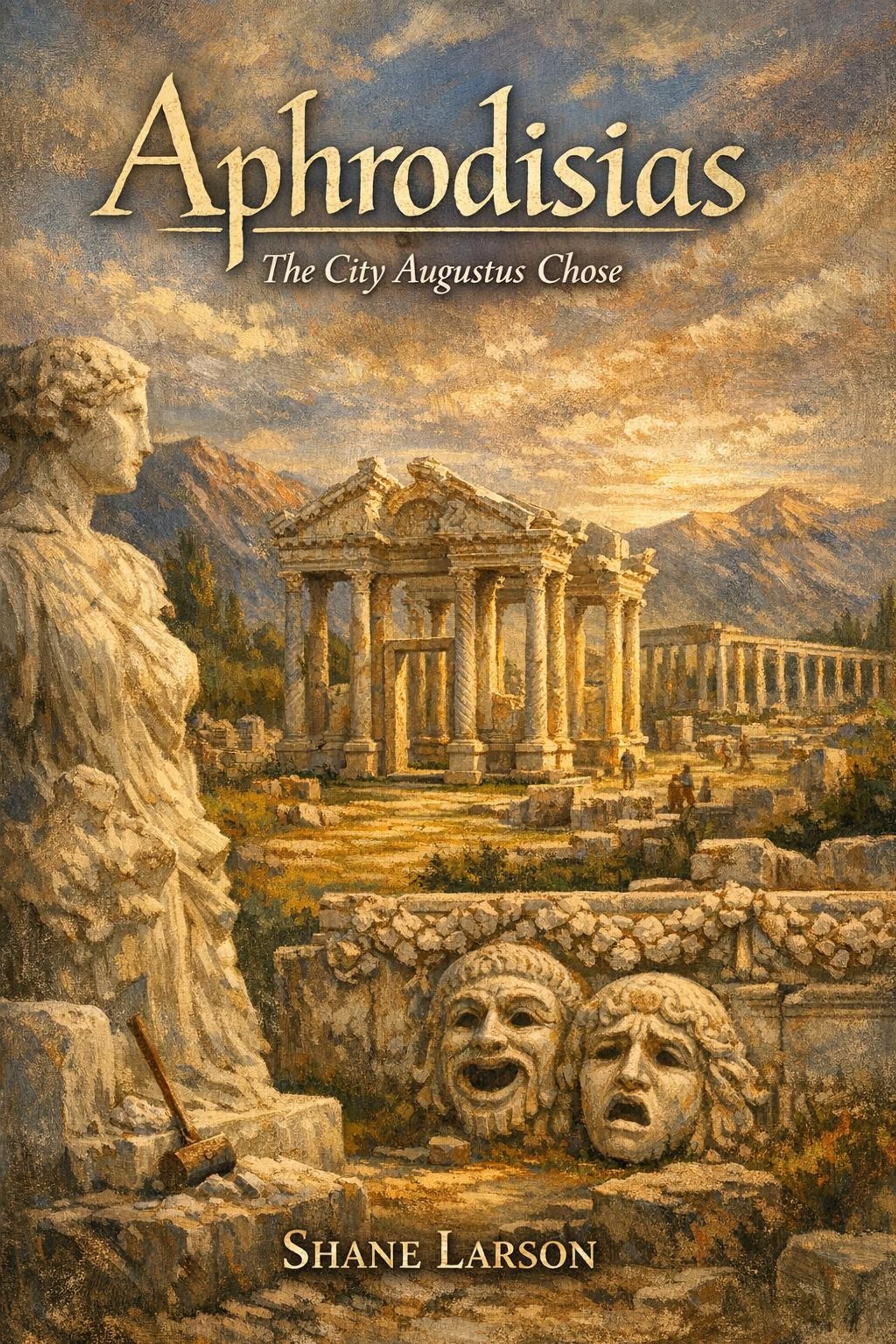
Aphrodisias
The City Augustus Chose
By Shane Larson
About This Book
The building is about 270 metres long. Thirty tiers of marble seats run down to it on each side and curve round both ends to make one continuous bowl, with room for something like thirty thousand people. It is by common consent the best-preserved stadium to survive from the ancient world. On a clear Monday in October 2026 the other visitors in it could be counted on two hands.
The city that built it was never large. The area inside its walls is about a square kilometre, and modern estimates of its population run from roughly ten thousand to fifteen thousand. It was not the capital of a kingdom, and until the third century AD it was not the capital of a province. No emperor was born there and no great battle was fought nearby.
Yet Aphrodisias also has a temple with columns still standing, a theatre, a council house with its seats intact, a pool 170 metres long, and a sanctuary to the Roman emperors that once carried some two hundred relief panels. All of it is marble. The question is where a town this far up a side valley got the means.
A quarry, a goddess and a decision
Aphrodisias: The City Augustus Chose answers that question in three parts. The quarry lay two kilometres from the workshops and produced white and blue-grey stone fine enough for portrait carving. The goddess was a local Anatolian divinity whom the Greeks came to call Aphrodite, and Aphrodite was the mother of Aeneas, the ancestor the Romans claimed and the Julian family claimed most of all. A small Carian town was keeping the shrine of Julius Caesar's family goddess.
The decision came in 40 BC. Quintus Labienus, a Roman renegade, led a Parthian army into Asia Minor, and most cities submitted. Aphrodisias held out for Caesar's heirs and was plundered. A year later the winners paid the debt. The city was declared free, excused from Roman taxation, and its sanctuary made inviolable. Octavian, the future Augustus, said in a letter the city kept that this was the one place in all Asia he had made his own. When Samos asked for the same freedom he refused, and explained that he had given it to one city only. The Aphrodisians kept that letter too.
Then came the long part. A grant from one emperor bound his successor only if somebody went and asked. For three centuries the city sent embassies, put up statues, held festivals in the emperors' honour and built their sanctuary at local expense. The untaxed income went into marble, and the marble trained generations of sculptors, some of whom carved for Hadrian's villa outside Rome. In the third century, when emperors were changing every few years, the council had the whole dossier cut into a wall of the theatre. It is still there.
The book follows the city on through late antiquity: a governor's seat, price controls carved on its basilica, the temple rebuilt as a church, and a village over the ruins.
What's Inside
- Zoilos, an Aphrodisian who was enslaved, ended up in the household of the Caesars, was freed, and came home with the ear of the most powerful man in the world. He paid for the theatre's stage building and began the new temple.
- The Sebasteion read as political media. Nobody in Rome ordered these reliefs. Two local families decided how to show Claudius over Britannia and Nero over Armenia, and chose the language of Greek myth to do it.
- Unfinished statues from the Sculptor's Workshop, which show what finished ones hide: how a block became a portrait, tool by tool, and how heads and arms were carved apart and joined.
- Reserved seats in the stadium for the tanners and the gold-workers, the epitaphs of gladiators, and the long campaign to win the city's games empire-wide rank.
- Two writers from one small city. Chariton wrote the earliest Greek novel to survive complete. Alexander of Aphrodisias wrote the commentaries on Aristotle that later centuries argued with.
- Diocletian's Price Edict of AD 301, with selected prices and wages converted into days of a labourer's work and never into modern money.
- The temple turned inside out. Around AD 500, on the excavators' current dating, builders moved the columns and reused the inner walls to make a church larger than the temple had been.
- Three appendices: a walking gazetteer in the order a visitor meets the monuments, the Price Edict in numbers, and a timeline from prehistory to the 2017 World Heritage listing.
Why I Wrote This
I drove up from Selçuk on the morning of 19 October 2026, on my way to Pamukkale, and stopped at a place I had barely heard of.
Two things stayed with me. The first was the stadium. I walked the top row with the track far below and snow already on the mountain behind, and I could not work out who had been expected to fill it. The second came at the end, down at stage level in the theatre: a wall of marble blocks covered in small, regular Greek lettering. I learned afterwards that it is the city's file of letters from Roman rulers, carved two and a half centuries after the first of them was written.
I went looking for a narrative history of the place for an ordinary reader and did not find a current one. This is my attempt at it. The sixteen photographs in the book are mine, from that day.
Frequently Asked Questions
Is this a guidebook to Aphrodisias or a history?
A history. The chapters run in time, from the Carians to the modern excavation, but each one opens at a monument on the present-day site, and Appendix A is a gazetteer that dates each building and says what is original and what was put back up by archaeologists.
Do I need to know Roman history before reading it?
No. The civil wars after Caesar's murder, the workings of a Roman province and the third-century crisis are each explained where they come up.
Does the book quote the ancient inscriptions?
No. Every inscription and every ancient author is paraphrased in the author's own words, including Octavian's letters. Greek terms that matter, such as eleutheria (freedom) and asylia (inviolability), are given and explained.
How certain is the history of Aphrodisias?
Unevenly, and the book says so. The date of the stadium, the date of Chariton's novel, the date the temple became a church and the number of earthquakes are all argued over. Each disagreement is set out with its evidence and left visibly open.
Where is Aphrodisias, and can it be visited from Pamukkale?
It is in the province of Aydın in south-western Turkey, inland, in a high valley off the main road between the Aegean coast and Pamukkale. It is commonly visited as a day trip from Pamukkale or as a stop on the drive from Selçuk, which is how the author saw it.
How long is the book, and is it part of a series?
About 72,000 words: an Introduction, thirteen chapters in four parts, a Conclusion and three appendices. It stands alone.
If You Liked This, You Might Like
- Augustus: The Man Who Ended the Republic and Called It Peace — the other party to the bargain, and the civil wars in which a small town's loyalty was worth paying for.
- The Crisis of the Third Century: Fifty Years That Nearly Ended Rome — the decades in which Aphrodisias carved its privileges on the theatre wall, seen from the empire's side.
- Mithradates: Rome's Forty-Year Nightmare — in 88 BC the town voted to send troops to a Roman commander besieged by this king, its first bet on Rome.
- The Ancient World's Greatest Engineers: The Builders Who Shaped Civilization — for readers who want more on how a stadium, a quarry road and a 170-metre pool were actually built.
Most Roman cities are known from what writers in Rome said about them. This one left its own account, in its own stone, and the book reads it.
What You'll Learn
- Why a town of perhaps 10,000 to 15,000 people built a 30,000-seat stadium
- How a freed slave of the Caesars came home and rebuilt his city in marble
- What the Sebasteion reliefs show about how a province chose to picture Roman power
- What wheat, pork and a day's work cost under Diocletian's Price Edict of AD 301
- How Aphrodite's temple was turned inside out to make a church
New Ancient History releases and free chapters — no spam, unsubscribe anytime.