What Things Cost in AD 301: Diocletian's Price Edict, Read in Days of Work
November 22, 2026 · 6 min read
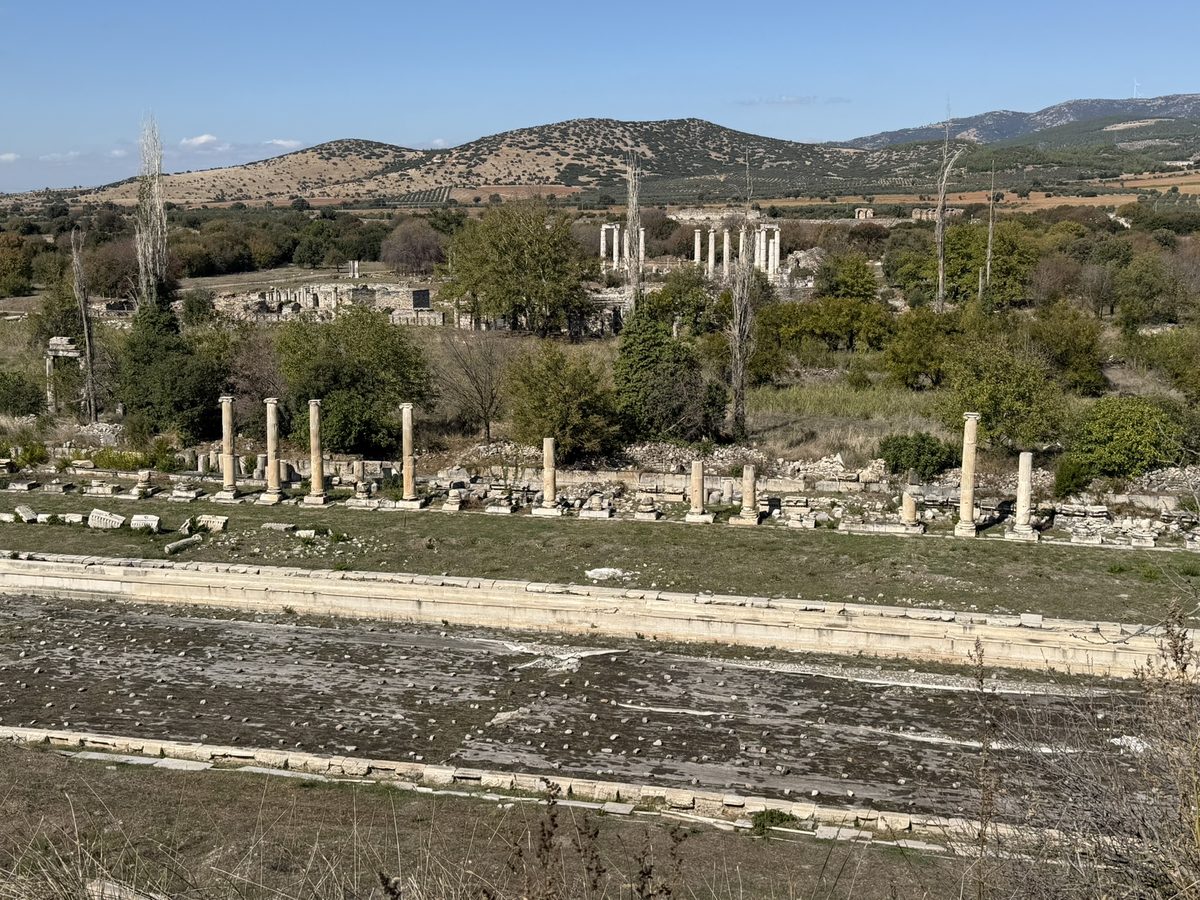
At the south end of the long pool at Aphrodisias, in south-western Turkey, stood a public hall the excavators call the Civil Basilica. It was built about AD 100, and in late antiquity its upper storey gained reliefs of the city's legendary founders. In AD 301 somebody had its front inscribed, in Latin, with a price list.
The list was an imperial law. Its full name is Diocletian's Edict on Maximum Prices, and it set a legal ceiling on the price of well over a thousand goods, wages and freight charges across the Roman Empire. The penalty for charging more was death. Copies were cut in stone in a number of eastern cities, all of them now in pieces. The Aphrodisias copy, assembled from hundreds of fragments recovered on the site since the early twentieth century, gives the fullest Latin text there is.
So it is possible to say, line by line, what an emperor thought things ought to cost in the year 301.
Why the edict existed
The third century had been hard on Roman money. For decades emperors short of silver had paid their armies in coins with less and less silver in them, and prices had climbed to match. Diocletian, who took power in 284 and rebuilt much of the imperial system, tried to stop the climb by decree. The edict's preamble blames the trouble on greed, and in particular on traders who charged soldiers whatever they could get. The fifty years that led up to it are the subject of *The Crisis of the Third Century*.
Two cautions before the numbers. These are maximums, the most a seller could legally ask. They are not a record of what anyone paid. And the unit, the denarius, was by 301 a unit of account. Nobody was handing over a hundred little coins.
Why not convert to modern money
It is tempting to say a denarius was worth so many cents. Every such figure is wrong in a different way, because a Roman household and a modern one spend on different things in different proportions. Grain was most of a poor family's budget. Clothing was expensive and labour was cheap.
The edict offers a better yardstick, because it prices labour as well as goods. A farm labourer could be paid at most 25 denarii a day, with his keep. That is the bottom of the wage scale, and everything else can be measured against it.
Food
Wheat was capped at 100 denarii for an army measure, the modius castrensis. Scholars still argue about the size of that measure, with estimates running from roughly thirteen litres to roughly seventeen. Either way it was a couple of weeks of bread for one adult.
At 25 denarii a day, that measure of wheat cost a farm labourer four days of work. Barley, the cheaper grain, was 60 denarii for the same measure, a little under two and a half days.
Meat was sold by the Roman pound, which was about three-quarters of a modern one. Pork was capped at 12 denarii a pound and beef at 8. Pork was the dearer meat, by half as much again, which is the reverse of what most modern shoppers expect. A pound of pork was close to half a labourer's day. A pound of beef was about a third of one.
Ordinary wine was 8 denarii a pint, the sextarius, a little over half a litre. Three pints took all but one denarius of a day's wage.
Put together, a labourer's day would buy a quarter of a measure of wheat, or two pounds of pork, or three pints of rough wine. It would not buy all three. His employer fed him, which is what "with keep" means, and that mattered more than the coins.
The ladder of skill
The wage section reads like a ladder with evenly spaced rungs.
- Farm labourer: 25 denarii a day
- Stonemason or carpenter: 50
- Wall painter: 75
- Figure painter: 150
A mason or a carpenter earned exactly twice what a field hand did. For him the measure of wheat was two days of work. A painter of walls earned three times the labourer's rate, and a painter of figures six times. A man who could paint a convincing human face could earn the price of a measure of wheat before the afternoon was over.
In a city like Aphrodisias, which had spent three centuries carving marble and decorating public buildings, those upper rungs were crowded. The edict treats skill with the hand as worth serious money, and it draws a sharp line between decorating a surface and representing a person.
Teachers
Teachers were paid by the pupil and by the month, which makes their income depend on the size of the class.
An elementary teacher could charge 50 denarii per pupil per month. That is two days of a labourer's wage, from each family, for a month of schooling. To take home what a labourer would earn by working all thirty days of that month, the teacher needed fifteen pupils. To match a stonemason, he needed thirty.
A teacher of rhetoric could charge 250 per pupil, five times as much. Three pupils put him level with the labourer, and six with the mason. Rhetoric was the training for public life, for speaking in a council or before a governor, and the families who paid for it were the ones who expected their sons to do those things. The fee shows what that expectation was worth.
The lion
Then there is the line that everyone remembers. A first-class lion, for the arena, was capped at 150,000 denarii.
Counted in work, that is 6,000 days of a farm labourer's wage. If he worked every day of the year and spent nothing, he would need more than sixteen years. A stonemason would need more than eight. In food, the lion is the price of 1,500 army measures of wheat, or 12,500 pounds of pork.
Nobody bought a lion out of wages, of course. Beast shows were paid for by the richest men in a city as a public gift, often by the priests of the imperial cult, and the price explains why such a gift was remembered on a man's statue base. One animal, which might be dead by evening, cost what a working man could not earn in half a lifetime.
Did it work?
By most accounts, no. The Christian writer Lactantius, who disliked Diocletian and is not a neutral witness, reports that goods disappeared from sale, that people were killed over the law, and that it was allowed to lapse. Modern historians debate whether it could ever have been enforced across an empire, and how hard anyone tried.
What it left is the list, which is better evidence than a working law would have been. It records what the government thought a fair ratio was between a day in the fields and a measure of wheat, between a mason and a painter, between a schoolmaster and a lion. Those ratios describe a society in which food was dear, unskilled labour was cheap, and the distance from the bottom of the scale to the top was very long.
*Aphrodisias: The City Augustus Chose* gives the edict a full chapter, with an appendix of selected prices and wages converted into days of labour. The rest of the book is the story of the city that displayed it: a small Carian town that backed Octavian in a civil war, was rewarded with freedom from Roman tax, spent the money on marble, and ended three centuries later with an emperor's orders carved on the front of its civic hall. The emperor who made that grant has his own book, *Augustus*.
New posts and releases, straight to your inbox. No spam, unsubscribe anytime.