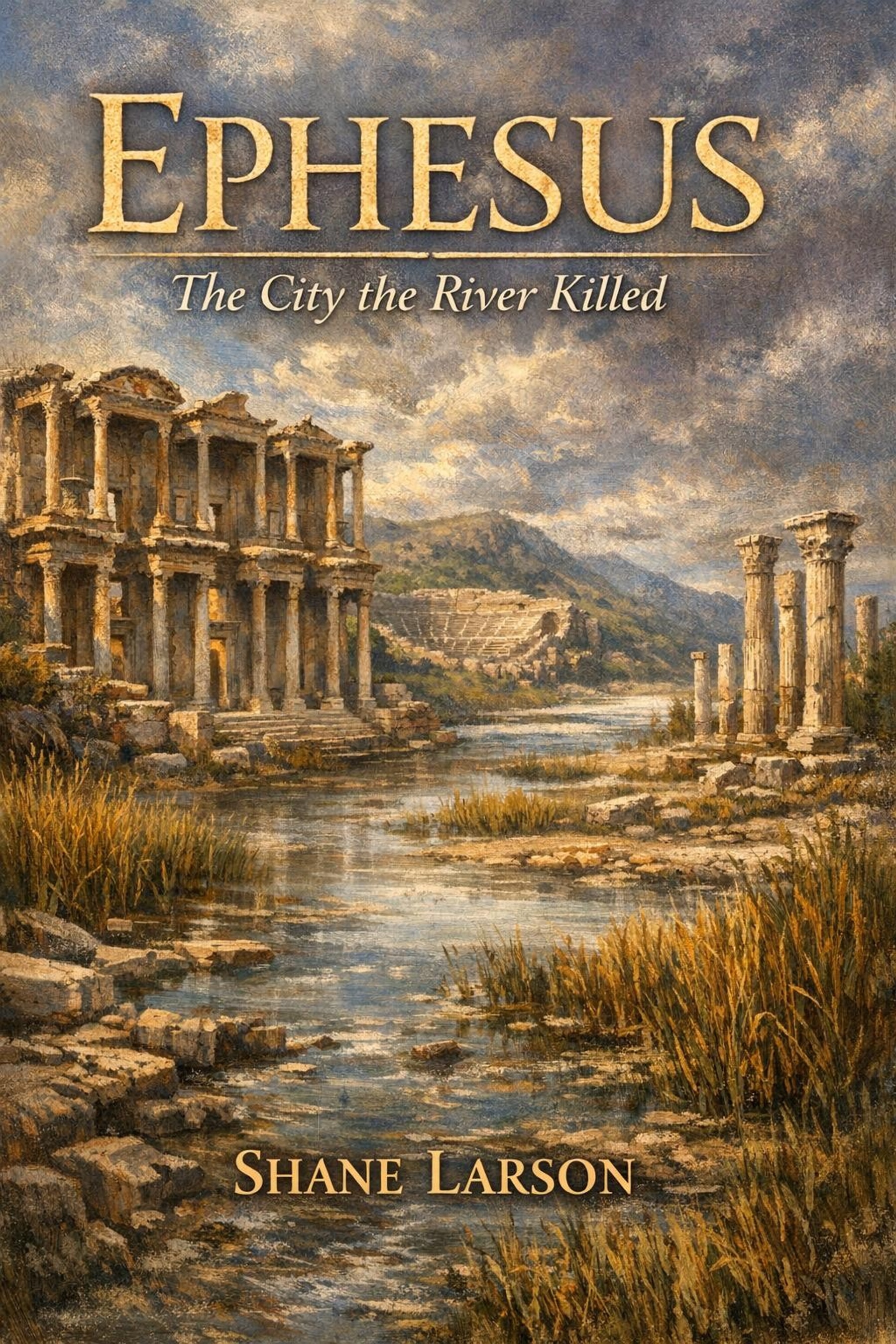
Ephesus
The City the River Killed
By Shane Larson
About This Book
On the last day of 1869, after six years of trenching the wrong places, an English railway architect named John Turtle Wood watched his workmen strike a marble pavement about six metres below the surface of a field outside Selçuk. He had found the floor of the Temple of Artemis, one of the Seven Wonders of the ancient world. Nobody had seen it in more than a thousand years. A river had buried it, one flood at a time, under twenty feet of mud.
The temple stood in a marsh on purpose; the Roman writers who describe it say the soft ground was chosen to cushion it against earthquakes. That decision put the most famous structure in Ephesus directly in the path of the Kaystros, the Küçük Menderes of the modern map, and the Kaystros spent the next two and a half thousand years doing what every river does where it meets still water. It dropped its load. The inlet beside the temple became reed bed, the reed bed became field, and the field rose over the pavement. The single column standing at the site today stands in water.
What the river did to the temple it did, more slowly and more thoroughly, to the whole city.
A thousand-year argument with a river
Ephesus: The City the River Killed is the biography of a city with a single antagonist. At the end of the Ice Age the sea ran far up the Kaystros valley. The river has been filling that gulf back in ever since, and the city followed the retreating water across the plain the way a wader follows an ebbing tide: a few steps, a pause, a few more.
The Bronze Age town on Ayasuluk hill, which the Hittite records may call Apasa, had the sea at its foot. The Greek city beside the temple had a sheltered inlet that shallowed, century by century, into lagoon. Around 290 BC Lysimachus, one of Alexander's successors, marched the whole population two or three kilometres west into the valley between Mount Pion and Mount Koressos, where a harbor could still be dug in deep water. Strabo preserves a story that the townspeople refused to go until the king blocked the drains in a rainstorm and flooded them out; the book tells it as a story. The new harbor sat on the same delta as the old one. The engineers of a Hellenistic king narrowed its mouth with a mole to make it deeper and turned it into a silt trap instead. Rome dredged it for five centuries. Every measure bought about a generation, and the channel out to open sea grew longer every decade.
The city on that shrinking waterfront was, for most of that time, one of the great places of the Mediterranean. Heraclitus wrote here that you cannot step into the same river twice, beside a river that kept moving its own mouth. Paul rented a lecture hall for two years, and a silversmith who sold miniature shrines of Artemis packed the theatre with a crowd that chanted for two hours. By the seventh century the quay was marsh, the lower city was a feverish half-walled remnant, and the survivors were climbing back up Ayasuluk to the hill where it had all begun.
The book follows that whole arc, Hittite campaign to Ottoman village, and every chapter says where the water was.
Why I Wrote This
I walked Ephesus on 18 October 2026, in at the Library of Celsus, up to the upper city, and back down to the Great Theatre, with the roofed Terrace Houses in between. I was staying in Selçuk. Two days earlier I had been up at the Basilica of St John on the hill above the town, and the day before I spent the late morning in the Ephesus Museum, face to face with the Great Artemis. What stayed with me was not any one building. It was the view west from the top row of the theatre: a marble avenue running down to where the harbor ought to be, then fields, then haze, and the sea somewhere out in it. That evening I went out to the beach at Pamucak and watched the sun go down on the water the city had lost. Every guidebook I had read dated the monuments and named who paid for them. None of them said that the whole site is the record of a fight with a river, or that the river won. I wanted the book that read the ruins that way, so I wrote it. The eleven photographs in it are mine.
Frequently Asked Questions
Is this a guidebook to Ephesus or a history?
A history, with a guidebook's spine. The chapters follow the city in time, Bronze Age to Ottoman, but each opens at a specific place on the modern visitor route, and Appendix A is a walking gazetteer that dates every monument from the upper gate to the theatre and says whether it was standing in Paul's day.
Does the book cover the House of the Virgin Mary?
Yes, in the final chapter and the gazetteer, and honestly. The house on Bülbül Dağı was identified in 1891 on the strength of the visions of Anne Catherine Emmerich, a German nun who never left Westphalia. There is no ancient evidence that Mary lived or died at Ephesus, and the book presents the shrine as the tradition it is.
Do I need to read Paul of Tarsus first?
No. Chapter 10 covers Paul's years in the city, the riot, the question of an Ephesian imprisonment and the Johannine tradition on its own terms, and nothing is assumed.
How much of the Temple of Artemis is left to see?
Almost nothing standing: one column, rebuilt from drums, in a wet field, with a stork's nest on top in most years. The sculptured drums and fragments of Croesus's dedication are in the British Museum.
How long is the book, and is it part of a series?
About 80,000 words, 265 pages in the 6x9 paperback: an Introduction, thirteen chapters in four parts, a Conclusion and three appendices. It stands alone, and it is one of a planned set on the ancient cities of Türkiye's Aegean coast.
If You Liked This, You Might Like
- Paul of Tarsus — the longest stay of Paul's career was in Ephesus, and this book tells the city's side of those three years.
- Mithradates: Rome's Forty-Year Nightmare — the order to kill every Roman and Italian in Asia in 88 BC went out from Ephesus; this is the king who gave it.
- The Library of Alexandria — the Celsus library was a provincial echo of the great one, and both books ask what a library was actually for.
- Doggerland: The Country Beneath the North Sea — the mirror image: a country the sea took, set beside a harbor the land took.
Ephesus built a Wonder in a marsh, moved itself twice to stay beside its ships, and spent the wealth of a province on dredging. The fields west of the theatre are the river's reply.
What You'll Learn
- **Each chapter opens on a stone a visitor can stand beside today**: the re-erected column in the Artemision field, the walkways above Terrace House 2, the Celsus façade in low morning light, the orchestra of the Great Theatre.
- **Herostratus**, who burned a Wonder in 356 BC so that his name would last, and the tradition Plutarch reports that the fire fell on the night Alexander was born.
- **The Attalid mole**, a sensible engineering decision that made the harbor worse, with what Strabo gets right about it and what he gets wrong about a sea with almost no tide.
- **Who lived in the Terrace Houses**, and what their marble halls say about a city where most people lived in rooms archaeology has not found.
- **The silversmiths' riot of Acts 19 read as economic history**: a guild, a pilgrimage trade, and a temple that doubled as a bank. Acts is quoted from the King James Version.
- **Which John, if any, lived here**, what Irenaeus and Polycrates of Ephesus actually claim, and the tomb under Justinian's basilica presented as the tradition it is.
- **The Councils of 431 and 449 explained plainly**, including the view from the churches that lost, and why the line drawn there still divides Christendom.
- **Three appendices**: a walking gazetteer of the modern route, a timeline from about 1500 BC to 1426, and a plain account of the harbor and the delta, with what the sediment cores leave open.
New Ancient History releases and free chapters — no spam, unsubscribe anytime.